





Why Bulk Material Storage Silos Develop Bridging, Clogging, and Flow Problems
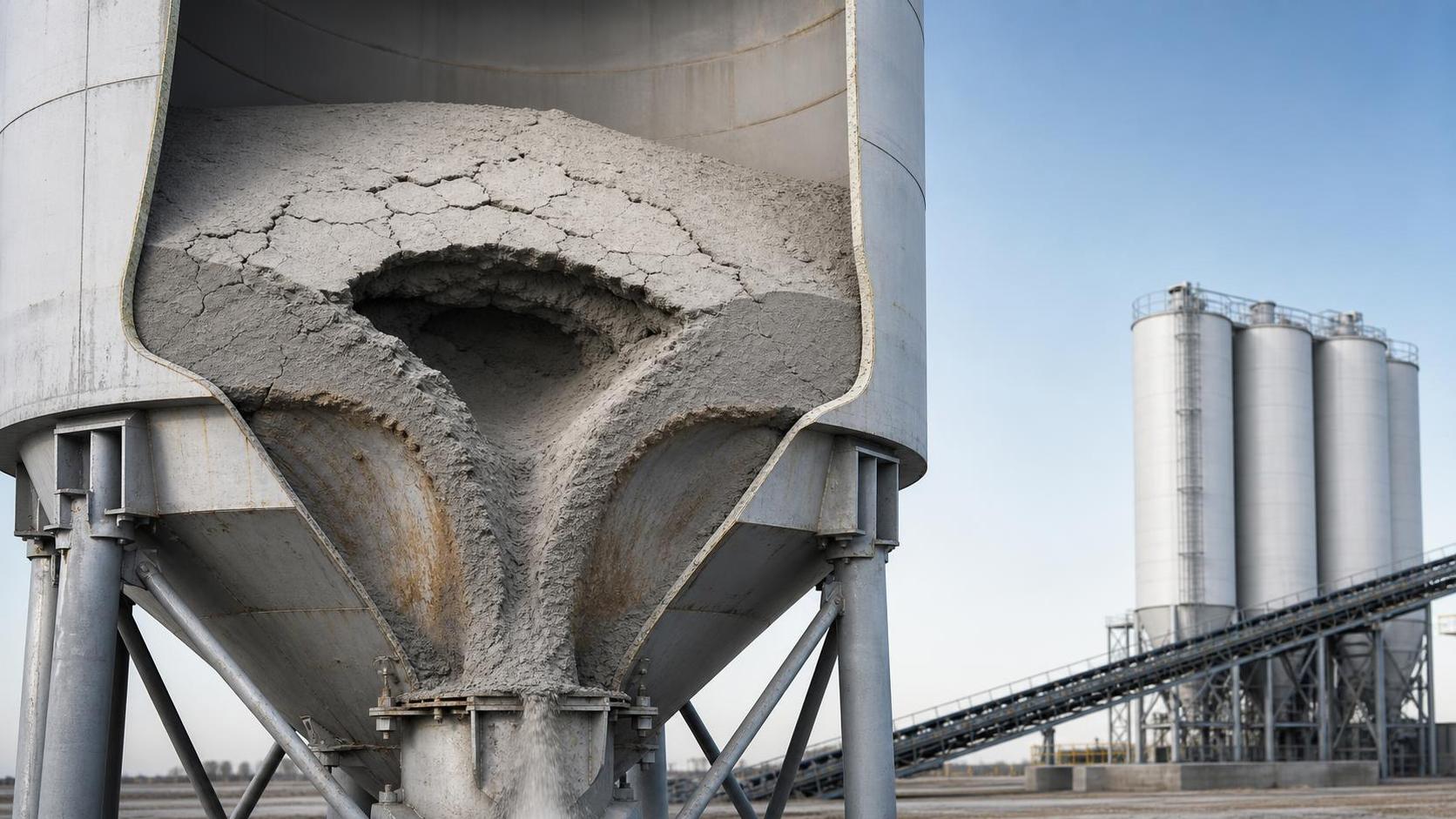
Why Flow Problems Start Long Before the Outlet
Bulk material storage silos are often blamed when discharge becomes erratic, but bridging, clogging, and ratholing usually begin with a mismatch between material behavior and silo design assumptions. Two powders can look similar on a specification sheet and behave completely differently once they sit under pressure for several days. A free-flowing grain product may discharge cleanly from a hopper that gives repeated trouble with cement, fly ash, limestone powder, or blended chemical solids. The problem is not simply that the silo is “blocked.” It is that the material has formed a stable arch, compacted into a stagnant core, or changed its internal friction and moisture condition enough to resist movement.
That is why operators in grain, building materials, power generation, and chemical plants often report similar symptoms with different root causes: one site sees sudden no-flow after rain-driven humidity changes, another sees slow discharge only after the silo has been nearly full for several days, and another gets asymmetric flow because the filling method segregates coarse and fine particles. In practice, flow problems in bulk material storage silos are rarely solved by looking at the outlet alone. The filling sequence, residence time, internal geometry, wall condition, air movement, and the material’s response to consolidation all matter.
Bridging Is Usually a Material Structure Problem
When plant personnel say a silo is “bridged,” they usually mean the material has formed a self-supporting arch above the discharge opening. In coarse granular products, that arch can be mechanical: particles interlock and carry load across the outlet. In finer or partially cohesive materials, the bridge is more often driven by moisture, compaction, or electrostatic effects. This difference matters. A larger outlet can help with particle interlocking, but it may not solve a cohesive arch if the powder is caking against itself after storage.
This is common where material arrives warm, then cools in the silo, or where daily temperature swings create condensation on interior surfaces. Grain processors see versions of this with humid product and fines accumulation. Cement and mineral powder operations see it when fines absorb moisture from air leakage or seasonal conditions. Chemical solids can be even less predictable because small changes in particle size distribution or additive ratio may alter flow without any obvious visual warning.
A recurring field mistake is to treat every bridge as evidence that the silo is undersized or poorly fabricated. Sometimes the steel structure is not the primary issue at all. The actual trigger may be long storage duration, poor stock rotation, or a feed stream that creates a dense impact zone directly under the filling point. Once material has sat under load and gained strength, discharge aids become a secondary measure, not a cure.
Clogging Often Comes from Changing Material State, Not Just Tight Openings
Operators tend to describe all no-flow conditions as clogging, but several mechanisms are different in practice. Some blockages are caused by oversized lumps or foreign matter near the outlet. Others are gradual: powder cakes on walls, flakes off, then accumulates in the hopper. In some silos, air entrainment during filling keeps fine material loose at first, then the bed deaerates and settles into a denser mass that discharges badly. This is one reason a silo can run normally during commissioning and begin failing only after regular operating cycles are established.
Building materials projects show this clearly. Cement, slag powder, and fly ash can all appear easy to store until the site starts dealing with interrupted consumption, variable incoming moisture, or irregular truck unloading schedules. A silo that turns inventory quickly behaves very differently from one used as a buffer during demand fluctuations. If material remains static too long, the stress history changes. The lower zone consolidates, and discharge resistance rises. What looks like a hopper problem may actually be an inventory management problem expressed through the outlet.
This is also where temporary projects can be deceptive. On short-term engineering sites, storage conditions are rarely ideal. Material may arrive from multiple suppliers, ambient control is limited, and installation time is compressed. In that setting, modular options such as Detachable Bolt Silos for Temporary Engineering Storage are often considered because they match project turnover and relocation needs, but the same flow principles still apply. A temporary silo handling fine powder under wet coastal conditions can face worse clogging risk than a permanent silo storing a more stable granular product inland.
Uneven Discharge Is a Warning Sign, Not a Minor Nuisance
Uneven flow is often tolerated longer than it should be because material is still leaving the silo. But once one side discharges preferentially, the operation is already losing control of what happens inside. In funnel flow conditions, a central channel may empty while stagnant material remains along the walls. With some products, that leads to age segregation, moisture pockets, or compaction zones that later break loose unpredictably. In grain storage, this can affect quality stability. In powders used for process dosing, it can disturb feed consistency and downstream blending.
There is also a structural and safety dimension. Non-uniform discharge can change load distribution on the silo shell and supporting structure. The exact effect depends on geometry and operating condition, so it should not be simplified into one rule, but ignoring repeated asymmetric flow is not good practice. Sites that keep relying on hammering, poking, or ad hoc vibration to restore discharge are usually managing symptoms while increasing risk to personnel and equipment.
What Site Conditions Usually Tip a Silo into Trouble
The most troublesome installations are not always the biggest ones. They are the ones where operating reality drifts away from design assumptions. A few conditions show up repeatedly across industries:
- Material properties vary more than expected. Different suppliers, recycled content, or seasonal raw material shifts change particle shape, fines content, and moisture sensitivity.
- The silo is used as long-term storage even though it behaves better as a short-cycle buffer.
- Filling creates segregation. Coarse fractions roll outward while fines stay central, or impact compaction develops under a fixed inlet.
- Ventilation, dehumidification, or sealing is inadequate for the local climate.
- Cleaning access and inspection routines are too limited to catch buildup before it affects discharge.
None of these issues is unusual on its own. The problem is cumulative effect. Once a cohesive material is stored longer, exposed to humidity swings, and discharged through a geometry that favors funnel flow, troubleshooting becomes harder because several mechanisms overlap.
The Same Silo Concept Does Not Behave the Same Across Industries
Shandong Guokai International Trade Co., Ltd. works across grain, building materials, electric power, and chemicals, and that cross-sector experience matters because “bulk solid” is too broad a category for one-size-fits-all judgment. Grain projects often deal with biological variability, fines migration, and hygiene concerns. Building material systems are more likely to face dust control, compaction, and abrasive wear. In power-related applications such as ash handling, dry bulk behavior may shift with collection method and residual moisture. Chemical projects can involve products whose flowability changes after storage, blending, or mild temperature exposure.
The practical lesson is straightforward: do not assume success with one stored product proves suitability for another. Even when throughput target, capacity, and shell material appear comparable, the discharge pattern can change substantially. That is why experienced project teams spend more time on the stored material’s behavior over time than on nominal capacity alone.
Questions Worth Asking Before Choosing a Remedy
When a customer asks why their bulk material storage silos keep developing flow problems, the useful response is rarely “install a bigger vibrator” or “change the hopper angle” without context. A better starting point is a short diagnostic set:
These questions do not replace formal material testing where that is needed, but they prevent a common error: spending money on hardware before identifying whether the main driver is material cohesion, storage practice, or internal geometry.
Where Selection Decisions Usually Go Wrong
One weak decision pattern is choosing purely on capacity and footprint. Another is copying a silo arrangement from a different plant without checking whether the operating rhythm is comparable. A design that works for steady daily turnover may struggle in a facility with stop-start consumption, frequent partial fills, or long idle periods. The problem becomes sharper in expansion projects, where old and new storage lines end up handling slightly different material quality under the same operating assumptions.
Temporary engineering storage deserves separate attention. Detachable systems are useful where relocation, phased construction, or schedule pressure makes fixed civil-heavy solutions less attractive. But mobility does not remove the need to judge climate exposure, discharge frequency, and product sensitivity. A modular solution such as Detachable Bolt Silos for Temporary Engineering Storage makes sense when project timing and site flexibility are central, yet it still has to be matched to the stored material’s real flow behavior rather than the project calendar alone.
What Usually Improves Reliability
The most reliable improvements tend to come from combining several modest corrections instead of waiting for one dramatic fix. Better sealing against humidity ingress, more consistent filling practice, improved stock rotation, inspection of wall buildup, and a review of discharge geometry often do more than aggressive mechanical intervention. Where material properties are uncertain or variable, the safer path is to treat flow behavior as a design input, not an afterthought.
If a silo repeatedly bridges or clogs, the decision that matters most is not whether to force discharge one more time. It is whether the operating team can identify when the problem begins: at receipt, during storage, or at discharge. That distinction is what separates a recurring nuisance from a controllable engineering issue.
Related Posts
- ▶ How a Dry Bulk Silo Handles Pneumatic Filling and Gravity Discharge
- ▶ What Is a Dry Bulk Silo, and When Does a Factory Need One?
- ▶ Can dry bulk storage silos be integrated into existing PLC-controlled batching systems?
- ▶ Do dry bulk silos designed for API 650 compliance meet ASME Section VIII requirements?
- ▶ Is almacénamiento de sólidos a granel en silos de acero inoxidable viable for small-scale agrochemical distributors?
- ▶ How do vibration-based level sensors perform in stainless steel silos with powder coating?
Online Message