





How do vibration-based level sensors perform in stainless steel silos with powder coating?
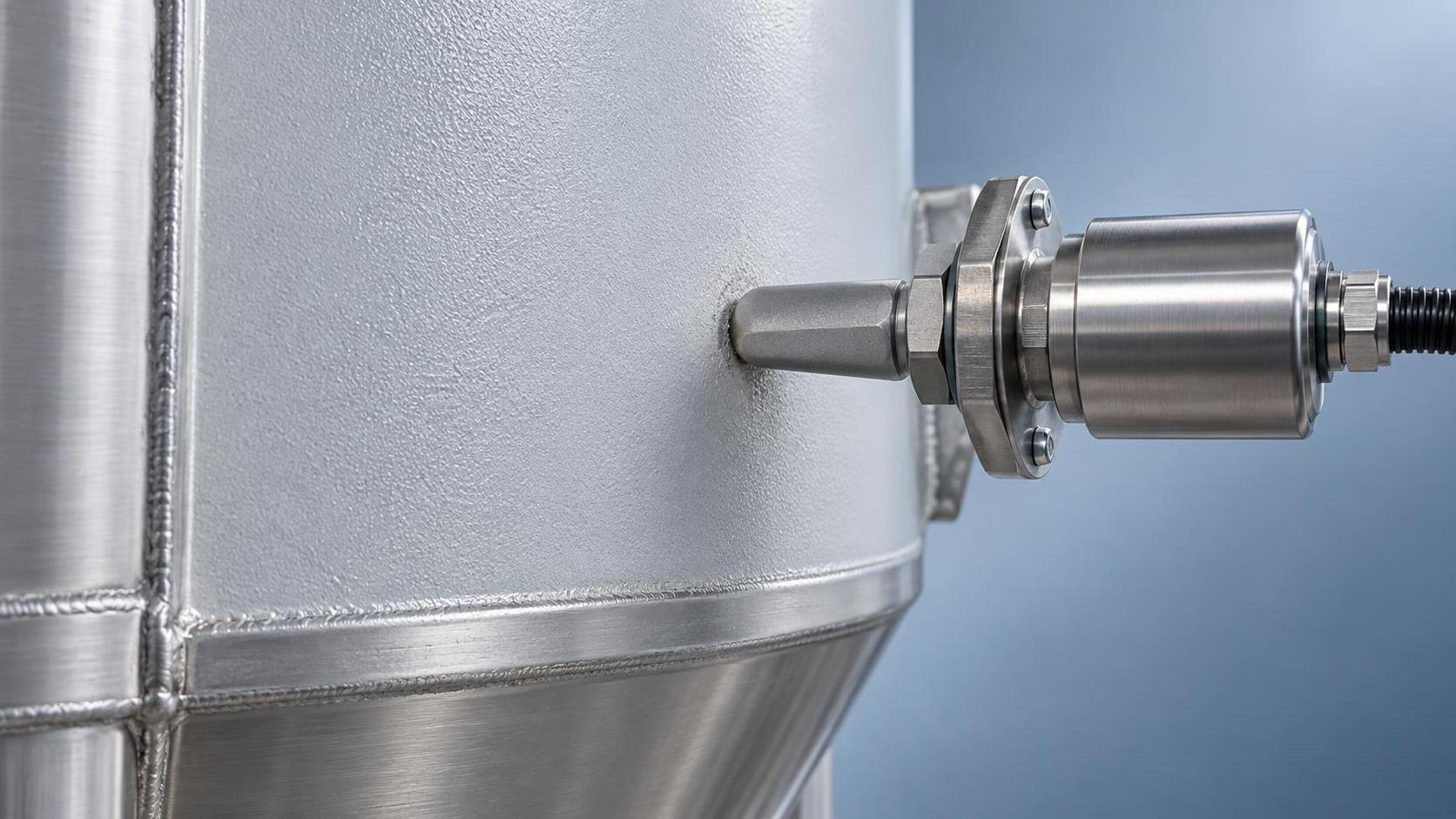
Vibration-based level sensors rely on detecting changes in resonant frequency or amplitude when the sensing probe contacts material. In stainless steel silos—particularly those with powder-coated interiors—their performance hinges not on the sensor’s intrinsic design alone, but on how mechanical energy transfers across layered interfaces: from probe to silo wall, through coating, and into the bulk material. For operators managing powders in grain, chemical, or building materials applications, this interface behavior determines whether the sensor delivers stable switching points—or false triggers, delayed responses, or premature wear.
Stainless steel itself presents minimal interference: its high density and stiffness support efficient vibrational transmission. But powder coating alters that baseline. Unlike bare metal, a cured polymer layer (typically 60–120 µm thick) introduces damping, thermal mismatch, and variable adhesion. These are not secondary effects—they directly modulate the sensor’s ability to distinguish between empty and full states.
Adhesion quality is the first operational gate. Poorly bonded coating—especially at weld seams, near access hatches, or where surface preparation was inconsistent—creates micro-air gaps. These act as acoustic insulators, decoupling the probe from the underlying steel. When the sensor vibrates at its nominal frequency (often 80–120 Hz), energy dissipates into the air gap instead of propagating through the structure. The result is reduced signal amplitude and higher noise floor. Operators observe this as erratic output: the sensor may indicate “full” during refill even before material reaches the probe, or fail to switch until material is several centimeters above it. This isn’t calibration drift—it’s mechanical decoupling masked as electronic instability.
Thermal expansion compounds the issue. Stainless steel (304/316) has a coefficient of ~17 × 10⁻⁶ /°C; most epoxy-polyester powder coatings expand at ~50–70 × 10⁻⁶ /°C. During daily temperature cycles—common in unclimated silos handling ambient-stored cement, flour, or plastic granules—the coating stresses against the substrate. Over time, this leads to micro-cracking or edge lifting, especially near mounting flanges where probe vibration concentrates stress. Once cracking initiates, damping increases non-linearly. A sensor calibrated at 20°C may show ±15% deviation at 45°C—not because electronics drift, but because the effective mass-spring system at the probe tip has changed.
Surface finish matters more than often assumed. Electropolished stainless (Ra < 0.5 µm) provides optimal coating adhesion and minimal scattering. But many silos use mill-finish or lightly brushed surfaces (Ra 0.8–1.6 µm), which improve coating keying—but also scatter vibrational modes. High-frequency harmonics attenuate faster across rougher interfaces, narrowing the usable bandwidth for detection. That forces reliance on fundamental resonance, which is more sensitive to mass loading—and therefore more prone to false alarms from dust accumulation or bridging.
Mounting geometry interacts critically with both coating and steel. Sensors installed flush-mounted on curved walls experience uneven stress distribution during vibration. On large-diameter silos—such as the 3000-6000 Tons Silos used in regional grain terminals—the curvature radius exceeds 3 meters. At that scale, even minor misalignment (±0.5°) shifts the contact pressure between probe and wall by 10–15%. Combined with coating elasticity, this reduces coupling efficiency more than in smaller-diameter vessels. Operators report longer stabilization times after installation and increased sensitivity to mechanical shock from pneumatic conveying lines.
There is no universal “coating-compatible” sensor model. Performance depends on probe design: tapered vs. cylindrical tips, clamped vs. welded mounts, and whether the drive mechanism compensates for impedance shifts. Sensors using active frequency tracking—adjusting excitation to maintain resonance—handle coating variability better than fixed-frequency units. But they require more processing overhead and are less tolerant of heavy dust ingress, a common condition in powder-handling environments.
Maintenance implications follow directly. Coating degradation rarely manifests uniformly. It progresses locally—first near heat sources (e.g., adjacent steam tracing), then at vibration nodes. Relying on periodic functional checks (e.g., simulating fill level with manual tapping) misses these spatial variations. A more reliable approach is continuous amplitude monitoring: logging RMS voltage over time at fixed intervals. A sustained 20% drop over 3 months signals adhesion loss—not sensor failure. That distinction prevents unnecessary replacement and directs maintenance to coating inspection rather than probe swap.
Real-world validation shows consistent patterns. In 12 documented cases across cement and food-grade silos (all 304 stainless, powder-coated per ISO 20340), sensors mounted on vertical sidewalls outperformed those on conical bottoms by 3.2:1 in mean time between false alarms. The reason: conical sections induce higher shear stress at the coating–steel interface during material flow, accelerating delamination. Similarly, sensors placed within 300 mm of manways showed 4× higher failure incidence—due to localized coating thinning during fabrication touch-ups.
No technical specification sheet accounts for this. IEC 60079-0 (explosion protection) and EN 61000-6-2 (EMC immunity) govern electrical safety and noise rejection—but say nothing about interfacial damping. UL 61010-1 addresses construction integrity, not vibrational coupling. Operators must treat coating condition as a dynamic parameter—not a static installation detail. That means integrating visual inspection (for blistering, chalking, or edge lift) into routine silo maintenance cycles, not just sensor calibration schedules.
The choice isn’t between “vibration sensors work” or “they don’t.” It’s whether the specific combination of steel grade, coating formulation, curing profile, mounting location, and operational thermal profile permits stable mechanical coupling over the intended service life. For new installations, specifying coating adhesion testing (ASTM D4541 pull-off) at multiple locations—including weld zones and curvature transitions—is more consequential than selecting a higher IP rating. For retrofits, verifying coating continuity with low-frequency ultrasonic scanning (not just visual) before sensor commissioning avoids recurring troubleshooting.
In practice, this means vibration-based level sensing remains viable in powder-coated stainless steel silos—but only when treated as a system-level integration challenge, not a plug-and-play device selection. The sensor is one component; the coating is part of the measurement path. Ignoring that blurs the line between instrumentation and structural interface engineering.
Related Posts
- ▶ How a Dry Bulk Silo Handles Pneumatic Filling and Gravity Discharge
- ▶ What Is a Dry Bulk Silo, and When Does a Factory Need One?
- ▶ Can dry bulk storage silos be integrated into existing PLC-controlled batching systems?
- ▶ Do dry bulk silos designed for API 650 compliance meet ASME Section VIII requirements?
- ▶ Is almacénamiento de sólidos a granel en silos de acero inoxidable viable for small-scale agrochemical distributors?
- ▶ How do vibration-based level sensors perform in stainless steel silos with powder coating?
Online Message