





Can dry bulk storage silos be integrated into existing PLC-controlled batching systems?
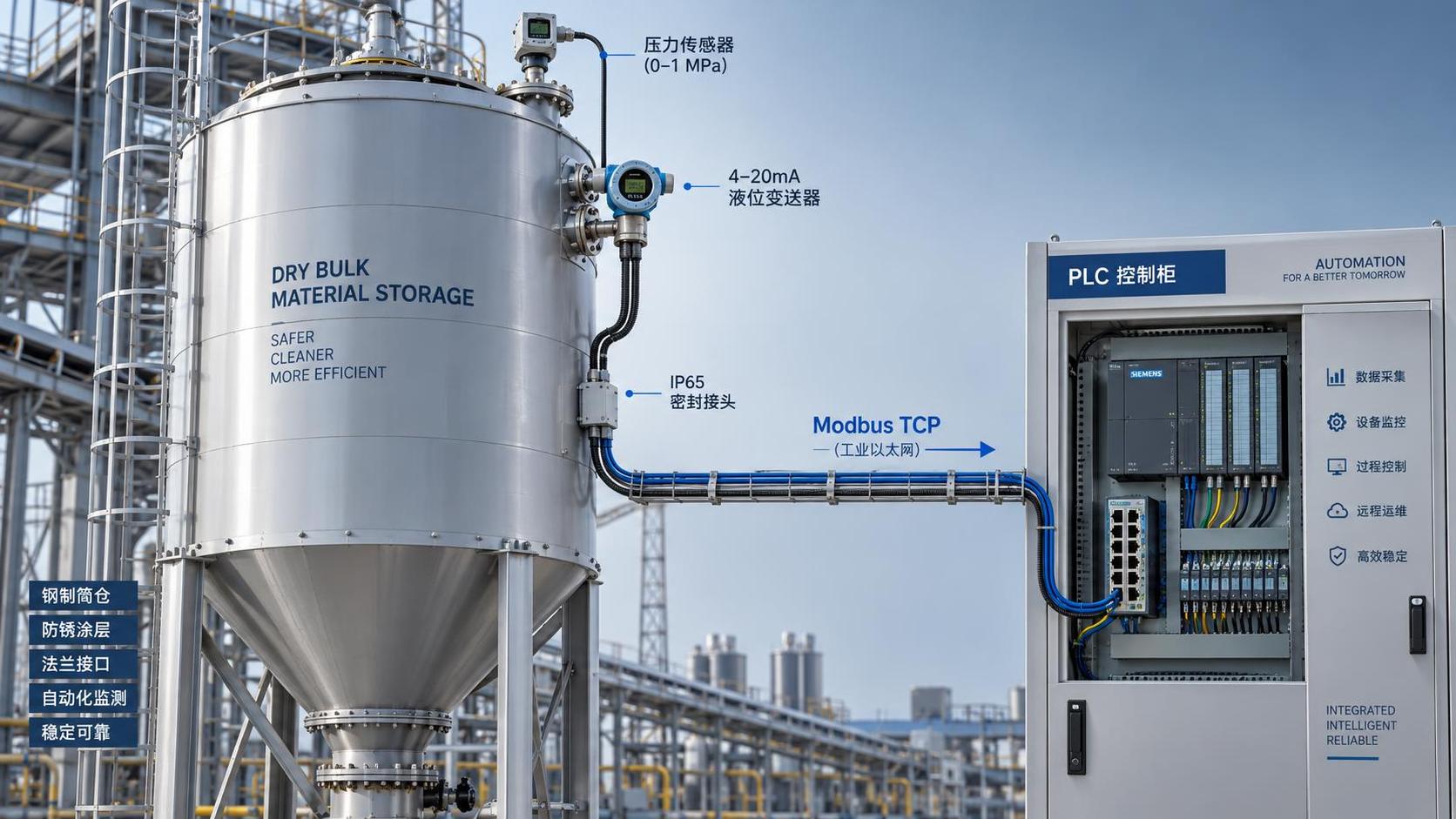
Yes — and here’s what makes integration actually work
The short answer is yes: dry bulk storage silos can be integrated into existing PLC-controlled batching systems. But project managers know that “yes” rarely ends the conversation — it usually starts it. What matters isn’t just theoretical compatibility, but whether the integration preserves control logic integrity, avoids reprogramming cascades, and fits within your current I/O budget, cabinet space, and commissioning timeline.
Many teams assume integration means replacing legacy PLCs or adding a second control layer. That’s often unnecessary — and costly. The real leverage lies in how the silo system interfaces at the hardware and protocol level: not as a standalone island, but as a coordinated node in your existing automation architecture.
Where integration breaks down — and why
We’ve seen three recurring friction points on site:
- Signal mismatch: Silos with proprietary analog outputs (e.g., 0–10 V for level) feeding into PLC inputs expecting 4–20 mA — no conversion module, no signal.
- Protocol lock-in: A silo vendor offering only Modbus RTU over RS-485, while your batch controller uses Profibus DP — without a bridge, they’re speaking different languages.
- Mechanical retrofitting: Mounting flanges, load cell wiring paths, or dust-tight conduit entries that conflict with existing structural supports or cable trays.
None of these are insurmountable — but each requires deliberate design alignment *before* fabrication begins. That’s where upfront interface specification becomes more critical than material grade or capacity.
What “seamless” really means in practice
Seamless integration doesn’t mean zero engineering effort. It means predictable effort — scoped, documented, and aligned with your PLC vendor’s documentation and firmware revision history.
At Shandong Guokai International Trade Co., Ltd., we build steel dry bulk storage silos with this reality in mind. Our approach centers on three layers of compatibility:
1. Physical layer flexibility: Standardized mounting kits, configurable inlet/outlet orientations, and pre-drilled I/O panels allow field adaptation without welding or custom machining. Load cells, level transmitters, and valve actuators ship with termination diagrams matching common PLC terminal blocks — not just generic pinouts.
2. Protocol-level readiness: All control-ready silos support Modbus TCP/RTU and Profibus DP out of the box — not as optional add-ons, but as embedded firmware features. No external gateways needed unless your system demands a specific vendor-specific protocol (e.g., Rockwell’s CIP).
3. Logic-layer transparency: We deliver full tag lists, memory mapping tables, and sample ladder logic snippets — not just manuals. If your Siemens S7-1500 reads DB12.3 for high-level alarm, our documentation confirms exactly which register maps to that address, and under what conditions it triggers.
This isn’t about making silos “PLC-friendly.” It’s about treating them as part of the same control ecosystem — with shared diagnostics, consistent alarm handling, and synchronized time stamps across batch events and silo status changes.
When you need more than standard interfaces
Not every project runs on Modbus or Profibus. Some power plants use DNP3 for remote monitoring; some chemical facilities require HART-enabled transmitters for diagnostic data; others demand SIL2-rated safety interlocks tied directly into their SIS.
That’s where customization shifts from “nice to have” to mandatory. For example, Fly Ash Silos built for cement co-generation sites often include redundant pressure sensors, purge-air interlock logic, and dual-channel level verification — all mapped to existing safety PLC racks. None of this requires rewriting your main batch sequence. It extends it — cleanly.
The key is early engagement: sharing your PLC model number, firmware version, network topology diagram, and tag naming convention before finalizing silo specs. That lets us validate register assignments, test communication during FAT, and flag any timing mismatches (e.g., scan cycle vs. silo response latency) before shipping.
What gets overlooked — and why it matters
Most integration reviews focus on input/output and protocols. Fewer consider grounding, shielding, and noise coupling — especially when adding high-current feeders or vibratory equipment near sensitive analog inputs.
Steel silos aren’t passive vessels. They generate vibration, static charge, and electromagnetic fields — particularly during pneumatic conveying or rotary valve actuation. Without proper isolation between silo-mounted instruments and PLC analog cards, you’ll see drift, false alarms, or intermittent signal loss. We specify shielded twisted-pair cabling, separate grounding conductors for instrumentation vs. power, and ferrite cores where needed — not as “premium options,” but as baseline EMC compliance for industrial environments.
Next steps — before you finalize specs
If you’re evaluating integration feasibility right now, start here:
- Confirm your PLC’s available I/O slots and spare memory blocks — not just total capacity, but what’s actually unallocated after your last expansion.
- Check whether your current HMI/SCADA system supports the silo’s native protocol stack — or if bridging adds complexity to visualization, not just control.
- Verify local requirements for explosion protection (ATEX/IECEx), seismic anchoring, or corrosion resistance — these affect instrument selection and wiring methods, which ripple into PLC configuration.
Dry bulk storage silos don’t need to disrupt your automation strategy. When designed with your control infrastructure as a primary constraint — not an afterthought — they become reliable, maintainable extensions of your existing system. That kind of alignment doesn’t happen by default. It happens by specifying it early, validating it mid-process, and documenting it fully before commissioning begins.
For project managers overseeing upgrades across grain terminals, power stations, or building materials plants, the question isn’t whether integration is possible — it’s whether your silo supplier treats your PLC as part of the system architecture, not just a destination for signals.
Related Posts
- ▶ How a Dry Bulk Silo Handles Pneumatic Filling and Gravity Discharge
- ▶ What Is a Dry Bulk Silo, and When Does a Factory Need One?
- ▶ Can dry bulk storage silos be integrated into existing PLC-controlled batching systems?
- ▶ Do dry bulk silos designed for API 650 compliance meet ASME Section VIII requirements?
- ▶ Is almacénamiento de sólidos a granel en silos de acero inoxidable viable for small-scale agrochemical distributors?
- ▶ How do vibration-based level sensors perform in stainless steel silos with powder coating?
Online Message