





What Is a Dry Bulk Silo, and When Does a Factory Need One?
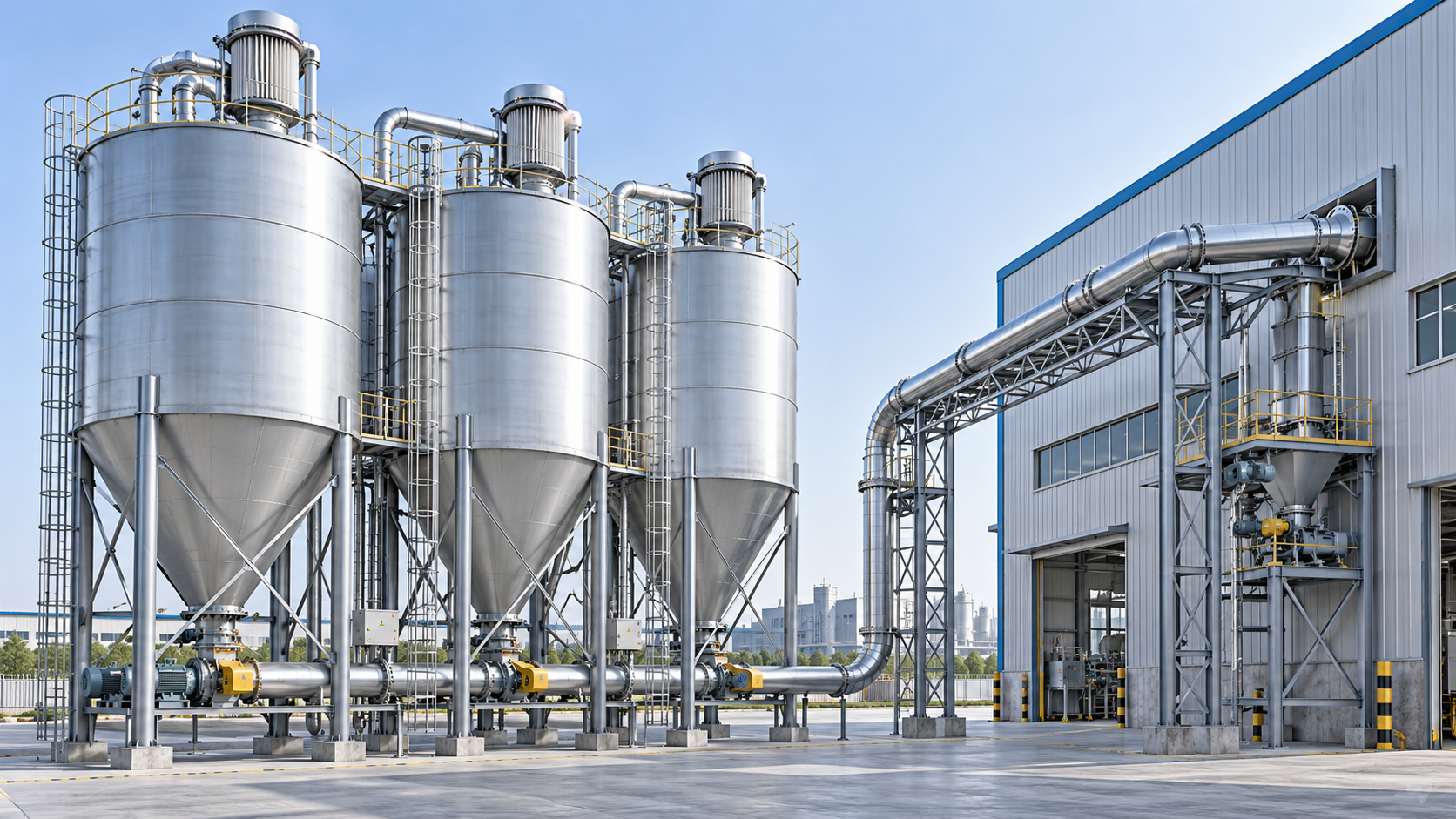
A dry bulk silo is a structure that stores loose solid materials, such as cement powder, grain, plastic pellets, or mineral products, and releases them into a handling or production system. A factory usually needs one when it uses a material consistently enough that bags, small containers, or warehouse piles create avoidable handling work, supply interruptions, or quality problems.
High consumption alone does not settle the decision. The material must suit bulk storage, deliveries must fit the available capacity, and the discharge system must feed production reliably. A silo that holds plenty of stock but cannot release it at the required rate can still leave a production line waiting.
What a dry bulk silo actually does
A silo provides an enclosed space between material delivery and material use. It allows a factory to receive a larger shipment, hold that stock, and draw from it as production requires. This buffer is useful when suppliers deliver intermittently but the factory consumes material throughout the day.
The word “dry” distinguishes these materials from liquids and slurries. It does not mean they contain no moisture. Grain has moisture within it, and powders can absorb water from humid air. Managing moisture remains part of storage design, even when the product is classified as a dry bulk solid.
Many silos are tall, cylindrical structures made from steel, although other shapes and construction materials are used. Some have a hopper bottom that directs material toward an outlet. Others have a flat floor and require equipment to remove the stored product. The appropriate arrangement depends on the material, storage volume, and unloading method.
The shell is only one part of a working installation. Filling equipment, vents or filters, level instruments, discharge devices, conveyors, and controls determine how the silo connects to the factory. A storage vessel does not automatically provide accurate dosing, drying, cooling, or blending; those functions require suitable equipment and process design.
How material moves through the system
Material enters through equipment selected for its handling characteristics. Powders may arrive in bulk tankers and be blown through a filling pipe. Grain and pellets may enter through elevators, belt conveyors, or other mechanical equipment. These methods place different demands on the silo and can affect dust generation, particle damage, and filling speed.
During filling, incoming solids displace air. Pneumatic delivery also introduces conveying air that must escape through a suitable venting and filtration arrangement. Restricted airflow can create excessive pressure, so the filling rate, filter capacity, pressure protection, and operating controls need to work together.
Stored material then moves toward the discharge point. Gravity may supply much of this movement, but solids do not behave like water. They can compact, form a stable arch above an outlet, or leave a narrow flow channel surrounded by stationary material. A screw feeder, rotary valve, or other discharge device controls the transfer to downstream equipment, depending on the application.
This is why hopper shape and outlet size cannot be selected from appearance alone. They must match how the material flows under storage conditions. Vibration or aeration can help in suitable applications, but adding a flow aid does not automatically correct an unsuitable design.
When a factory has a strong reason to consider one
The strongest case is usually a recurring material-handling problem with a measurable effect on production. A plant that repeatedly opens bags, moves pallets, and manually refills a process hopper may benefit from central storage and controlled transfer. The benefit becomes more substantial when the same material feeds several production lines.
A silo can also help when delivery timing and production demand do not align. If the factory needs material continuously but receives shipments only at intervals, storage provides operating cover. That cover must be planned around actual consumption and realistic delivery delays, rather than an arbitrary preference for a large vessel.
Bulk purchasing is another reason to evaluate a silo, provided suppliers offer a suitable delivery format. A lower material price may be attractive, but the comparison should include unloading, storage equipment, maintenance, and inventory costs. Buying more stock can tie up cash and extend the time that material remains in storage.
Common signals that justify a closer assessment include:
- Production stops or slows while operators replenish small containers.
- Bagged stock occupies valuable indoor space or creates repeated forklift movements.
- Opening and transferring packages produces frequent dust or spillage.
- A major ingredient is consumed predictably across regular production runs.
- Supplier shipment sizes are larger than the factory can conveniently handle with its current arrangement.
These signals support an investigation, not an automatic purchase. For example, dust during bag emptying might be addressed effectively with an enclosed unloading station. A silo becomes more compelling when several problems share the same cause: frequent handling of a stable, high-volume material stream.
The material determines what storage will work
Two materials that look equally dry can require very different systems. Free-flowing pellets may discharge readily, while a fine powder may become cohesive after settling. A product that flows well from a small sample container may behave differently under the pressure of a deep stored bed.
Bulk density affects both capacity and structural loading. It describes the mass occupying a given volume, including spaces between particles. A silo's volume therefore does not translate into the same stored tonnage for every product. Changes in settling or aeration can also affect the relationship between level and inventory.
Moisture sensitivity deserves separate attention. Some powders cake after absorbing moisture, while stored grain can deteriorate if moisture and temperature are poorly managed. Keeping rain out is essential, but condensation, incoming product condition, and storage duration also influence the result.
For soybean handling, a Soybean Steel Silo is an example of a material-specific storage option. Its suitability still depends on the condition of the incoming beans, expected holding time, handling method, and required monitoring or aeration arrangements. The product name alone does not establish those capabilities.
Abrasive materials can wear discharge equipment and transfer points. Corrosive products may require particular construction materials or protective finishes. Food ingredients need appropriate hygiene and cleaning provisions, especially where allergens or contamination between batches are concerns. Combustible dusts require assessment of ignition and explosion hazards across storage and conveying equipment.
These differences explain why a silo designed for grain should not automatically be reused for cement, chemicals, or another powder. The shell may appear suitable while the outlets, filters, internal surfaces, and protective systems are not.
Capacity should follow deliveries and consumption
Choosing capacity begins with a material balance: how much comes in, how quickly it leaves, and how much reserve production needs. Average daily consumption is useful, but peak demand and delivery variability often determine whether the planned capacity will work.
The factory also needs room to accept a shipment while some stock remains. If a delivery arrives before the silo is nearly empty, its available capacity must accommodate that load without exceeding the permitted filling level. Planning only for the shipment size can leave too little operating flexibility.
A practical starting calculation is:
Required working stock = consumption during the planned supply interval + operating reserve.
That stock must then be translated into volume using an appropriate bulk density. The design also needs to account for filling limits, unusable space, and material that cannot be withdrawn through the normal discharge arrangement. Gross vessel volume and usable storage capacity are different figures.
Oversizing has consequences. Longer residence time can increase deterioration or caking risks for sensitive materials, and some flow patterns leave older stock behind while newer material exits. Where stock rotation matters, discharge behavior deserves as much attention as nominal capacity.
Storage capacity and discharge capacity should be checked separately. A vessel may hold enough material for several days yet have an outlet or feeder that cannot support peak production. The required transfer rate should reflect the downstream process, including short periods of higher demand.
When bags, bulk bags, or smaller bins make more sense
A permanent silo is often difficult to justify for an ingredient used occasionally or in small quantities. Bagged material allows smaller purchases and keeps batches easier to separate. Bulk bags can reduce individual package handling while retaining flexibility, provided the unloading station suits the product.
Factories with frequently changing formulations may also benefit from smaller storage units. A dedicated silo commits capacity to a particular material, and changing products can involve emptying, cleaning, inspection, and contamination controls. Several ingredients used irregularly may be more practical to manage in separate containers.
Smaller day bins can support automated feeding without providing large storage capacity. This arrangement may suit a factory that needs consistent process delivery but still receives ingredients in bags or bulk bags. It addresses the feeding problem while keeping inventory manageable.
A silo is less attractive when the supplier cannot deliver in bulk, the site cannot accommodate unloading vehicles, or the material needs a controlled environment that the proposed system cannot provide. In those situations, the additional transfer steps or storage requirements may outweigh the expected savings.
What changes beyond the storage vessel
Installing a silo changes material movement across the site. Vehicle access, unloading connections, foundations, supporting structures, maintenance access, and the route to production all belong in the project scope. Outdoor storage can free indoor floor space, but that benefit depends on where conveying equipment and service areas fit.
Reliable operation also requires a clear unloading procedure. Operators need to identify the correct silo, confirm available capacity, and respond to alarms. Where several materials are stored, preventing a delivery into the wrong vessel protects both product quality and the production process.
Maintenance access should be considered before installation. Filters, feeders, level instruments, and valves need inspection and servicing. Silos also present hazards from engulfment, machinery, falls, and potentially unsafe internal atmospheres. Designing for external inspection and maintenance can reduce the need for entry; any entry requires dedicated isolation and safety procedures.
The financial comparison should cover the whole system. Alongside the vessel and installation, include conveying power, filter servicing, wear parts, cleaning, inspections, and inventory holding costs. Compare those costs with the current handling labor, packaging waste, material losses, and interruptions. The result will depend on how the factory actually operates.
What to establish before requesting a proposal
A useful proposal starts with a description of the material and the production requirement. Establish its bulk density, particle characteristics, moisture condition, storage sensitivity, and any hygiene or dust hazards. For difficult-flowing powders, material testing can help determine a suitable hopper and outlet arrangement.
Then define shipment size, delivery frequency, normal and peak consumption, desired reserve, and the required discharge rate. Add the site constraints: available height and footprint, vehicle access, utilities, and the location of downstream equipment.
Steel silo manufacturers such as Shandong Guokai International Trade Co., Ltd., which develops, manufactures, and sells steel storage silos for grain, building materials, electric power, and chemical applications, can use those requirements to frame a project. A useful discussion should connect the proposed vessel to filling, discharge, material preservation, and maintenance needs.
The decision becomes clearer when the factory can state the problem precisely: which material needs storing, what current handling costs or interrupts, and how reliably the proposed system must feed production. When those requirements favor bulk delivery and sustained use, a dry bulk silo can become a practical part of the production system.
Related Posts
- ▶ How a Dry Bulk Silo Handles Pneumatic Filling and Gravity Discharge
- ▶ What Is a Dry Bulk Silo, and When Does a Factory Need One?
- ▶ Can dry bulk storage silos be integrated into existing PLC-controlled batching systems?
- ▶ Do dry bulk silos designed for API 650 compliance meet ASME Section VIII requirements?
- ▶ Is almacénamiento de sólidos a granel en silos de acero inoxidable viable for small-scale agrochemical distributors?
- ▶ How do vibration-based level sensors perform in stainless steel silos with powder coating?
Online Message