





Choosing Between Steel and Concrete Bulk Material Storage Silos: A Practical Comparison
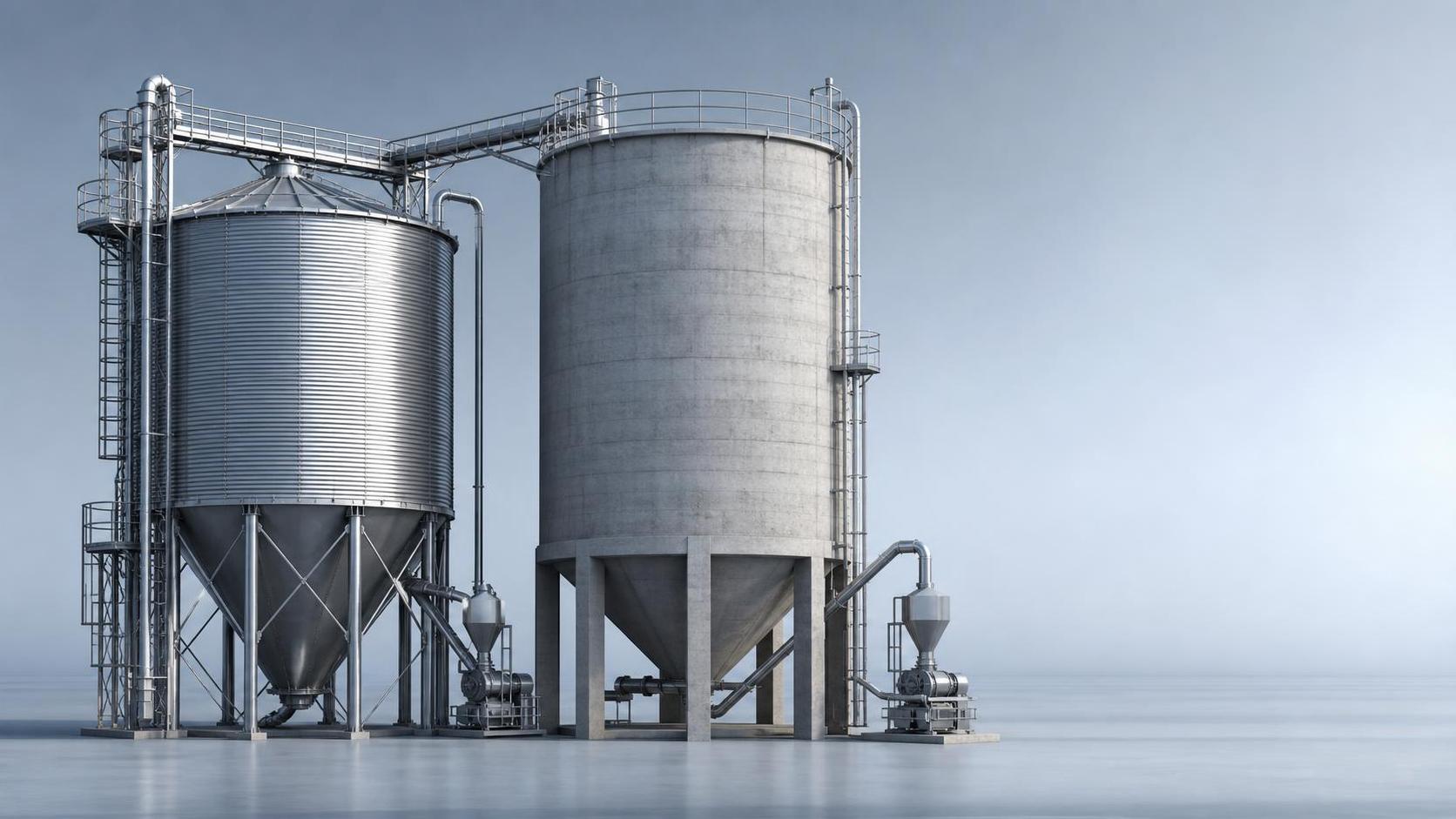
Choosing Between Steel and Concrete Bulk Material Storage Silos: A Practical Comparison
The most common mistake in silo selection is treating steel and concrete as interchangeable shells around the same storage function. They are not. For bulk material storage silos, the structural material changes far more than appearance or construction method. It affects how the silo responds to discharge loads, temperature changes, moisture, maintenance routines, future expansion, and even how much site coordination is required before the first ton of material is stored.
That is why the steel-versus-concrete decision rarely comes down to a simple “which one lasts longer” question. Technical evaluators usually need to balance several variables at once: stored material characteristics, required capacity, plant layout, erection schedule, corrosion risk, insulation needs, and the operator’s tolerance for downtime during maintenance. A silo that looks economical at the procurement stage can become expensive if it creates cleaning difficulty, bridging problems, or long shutdowns for repair.
In practical industry use, steel silos are often chosen where project speed, modular installation, and scalable capacity matter. Concrete silos tend to be considered where very large volumes, high structural mass, or certain long-term fixed-site strategies are the priority. Neither is automatically superior. The right answer depends on what the silo must do over the next 15 to 30 years, not just what it costs to build.
What the comparison really hinges on
For grain, powders, clinker, fly ash, mineral products, or chemical raw materials, the stored medium drives the decision more than many buyers expect. Free-flowing grain does not load a wall the same way as cohesive powder. Fine cement behaves differently from pelletized feed. Moisture-sensitive material brings different ventilation and condensation concerns than inert dry aggregate. This matters because silo selection is not only about static capacity; it is about discharge behavior, internal friction, pressure distribution, and how the structure tolerates repeated loading cycles.
Steel silos are generally favored when fast erection and standardized fabrication are important. In many projects, factory-made steel components simplify schedule control and reduce wet construction work on site. This is valuable in grain terminals, feed plants, building material facilities, and some power-sector applications where the operating schedule leaves little room for prolonged civil construction. Companies such as Shandong Guokai International Trade Co., Ltd., which focus on the development, manufacturing, and project delivery of steel storage silos, typically work in exactly these environments: grain, building materials, electric power, and chemical handling, where engineering coordination and practical constructability can matter as much as nominal storage volume.
Concrete silos bring a different set of advantages. Their structural mass can be attractive in large permanent installations, especially where the owner expects minimal relocation, limited geometry changes, and a long design horizon on one site. Concrete can also be appealing where external impact resistance, thermal inertia, or a specific civil design strategy is already built into the plant concept. But those advantages come with heavier site work, longer construction cycles, and less flexibility once the structure is complete.
Installation speed is not a minor detail
Technical teams sometimes treat installation as a project-management issue separate from engineering selection. In silo projects, that separation is artificial. Installation method affects risk, commissioning sequence, and the window before the storage system begins generating operational value.
Steel bulk material storage silos are usually easier to integrate into phased expansion plans. A plant can add capacity in steps, align erection with equipment delivery, and in some cases reduce disruption to nearby operating units. This is one reason steel is common in facilities that may expand with market demand. If a site later adds adjacent process systems, modular steel construction is often easier to coordinate than a new concrete structure with heavier civil dependencies.
Concrete, by contrast, tends to demand more upfront certainty. Foundation work, formwork, curing time, and site logistics can extend the program. That does not make it unsuitable; in some large projects the owner accepts the schedule because the storage block is part of a much broader permanent infrastructure package. But when the evaluation criterion includes rapid deployment or staged commissioning, steel usually starts with an advantage.
Durability depends on environment, not just material name
A persistent misunderstanding is that concrete is “durable” and steel is “maintenance-heavy,” as if those are fixed truths. Actual service life depends on exposure conditions, protective systems, operating discipline, and the material being stored. Corrosive atmosphere, coastal humidity, aggressive dust, repeated thermal cycling, and poor roof sealing can damage any silo if the design details are weak.
Steel silos require careful attention to coating systems, galvanization where appropriate, joint detailing, roof drainage, and prevention of condensation. In applications involving aggressive media or liquid handling around the storage area, engineers may also assess adjacent equipment materials differently. For example, where a plant combines dry bulk handling with insulated liquid process storage, specifications may shift toward corrosion-resistant vessels such as Insulated Stainless Steel Industrial Liquid Tanks. That does not change the silo comparison directly, but it illustrates a broader point: durability is always tied to service conditions, not just base material labels.
Concrete silos are not maintenance-free either. Cracking, moisture ingress, surface degradation, joint issues, and repair access can become real concerns over time. In some environments, inspection and repair can be more disruptive than owners initially expect. Evaluators should ask not only which structure seems robust on day one, but also which one can be inspected and restored more predictably under actual plant conditions.
The flow behavior question is often bigger than the shell material
Many storage failures blamed on “the wrong silo type” are really the result of poor flow design. Wall material matters, but hopper geometry, outlet design, aeration, discharge aids, and the known behavior of the stored bulk solid matter more. A concrete silo with weak flow design will not outperform a properly engineered steel silo simply because the wall is thicker. Likewise, a steel silo chosen only for low initial cost can perform badly if the material has cohesive or arching tendencies that were not evaluated early.
For technical evaluators, this means the steel-versus-concrete decision should come after, or at least alongside, a realistic review of bulk density, moisture sensitivity, caking tendency, particle size distribution, and discharge requirements. If the operation demands reliable first-in-first-out behavior, limited residue, or stable flow under variable humidity, internal design assumptions deserve more scrutiny than generic claims about silo type.
Operating cost is where simplified comparisons break down
Initial construction cost is visible. Lifecycle cost is usually less so, yet it is the more useful metric. A lower purchase price means little if the structure causes recurring shutdowns, difficult cleaning, or expensive corrosion remediation. By the same logic, a higher-capex concrete installation may not be a better long-term choice if the plant’s production plan changes and the storage system becomes oversized, underutilized, or difficult to adapt.
Maintenance access deserves more attention than it often receives at tender stage. Roof systems, ladders, platforms, discharge equipment interfaces, and inspection points all affect labor exposure and downtime. This is particularly relevant in food-related grain storage, power-sector ash handling, and chemical raw material storage, where contamination control, sealing integrity, or dust management may shape maintenance intervals more than the wall material itself.
Another point is thermal behavior. Where condensation can damage material quality, insulation strategy and ventilation planning may influence silo performance significantly. In some process plants, a mixed storage arrangement appears for that reason: dry bulk in silos, temperature-sensitive liquids in dedicated equipment such as Insulated Stainless Steel Industrial Liquid Tanks. For evaluators, the lesson is straightforward: storage should be selected as part of a material-handling system, not as an isolated structure.
Where each option tends to make more sense
Steel silos are often a better fit when the project needs shorter construction time, modular growth, standardized fabrication, or practical integration into an operating industrial site. They are also frequently preferred where the owner values easier future modification and where a specialist supplier can coordinate engineering, fabrication, and installation as a single package.
Concrete silos tend to enter the discussion more strongly for very large, permanent storage programs with stable long-term operating assumptions and a site strategy built around heavy civil infrastructure. Even then, the final decision should not be made on volume alone. The stored material, unloading pattern, climate exposure, maintenance capability, and plant expansion logic all matter.
A disciplined evaluation usually asks a few unglamorous but decisive questions. How predictable is the material flow? How disruptive would future capacity changes be? What corrosion or moisture conditions are expected? How quickly must the storage system be commissioned? What kind of inspection access is realistic during operations? Teams that answer these questions early usually reach a better decision than teams that compare only wall thickness, nominal strength, or budget headline.
For most technical evaluators, the useful takeaway is not that steel always wins on flexibility or that concrete always wins on permanence. It is that bulk material storage silos should be selected from the operating requirement backward. When that is done properly, the steel-versus-concrete choice becomes clearer, because the project stops asking which silo is universally better and starts asking which structure is more appropriate for this material, this site, and this operating plan.
Related Posts
- ▶ How a Dry Bulk Silo Handles Pneumatic Filling and Gravity Discharge
- ▶ What Is a Dry Bulk Silo, and When Does a Factory Need One?
- ▶ Can dry bulk storage silos be integrated into existing PLC-controlled batching systems?
- ▶ Do dry bulk silos designed for API 650 compliance meet ASME Section VIII requirements?
- ▶ Is almacénamiento de sólidos a granel en silos de acero inoxidable viable for small-scale agrochemical distributors?
- ▶ How do vibration-based level sensors perform in stainless steel silos with powder coating?
Online Message