





What common causes lead to weld seam cracking in stainless steel silos during thermal cycling?
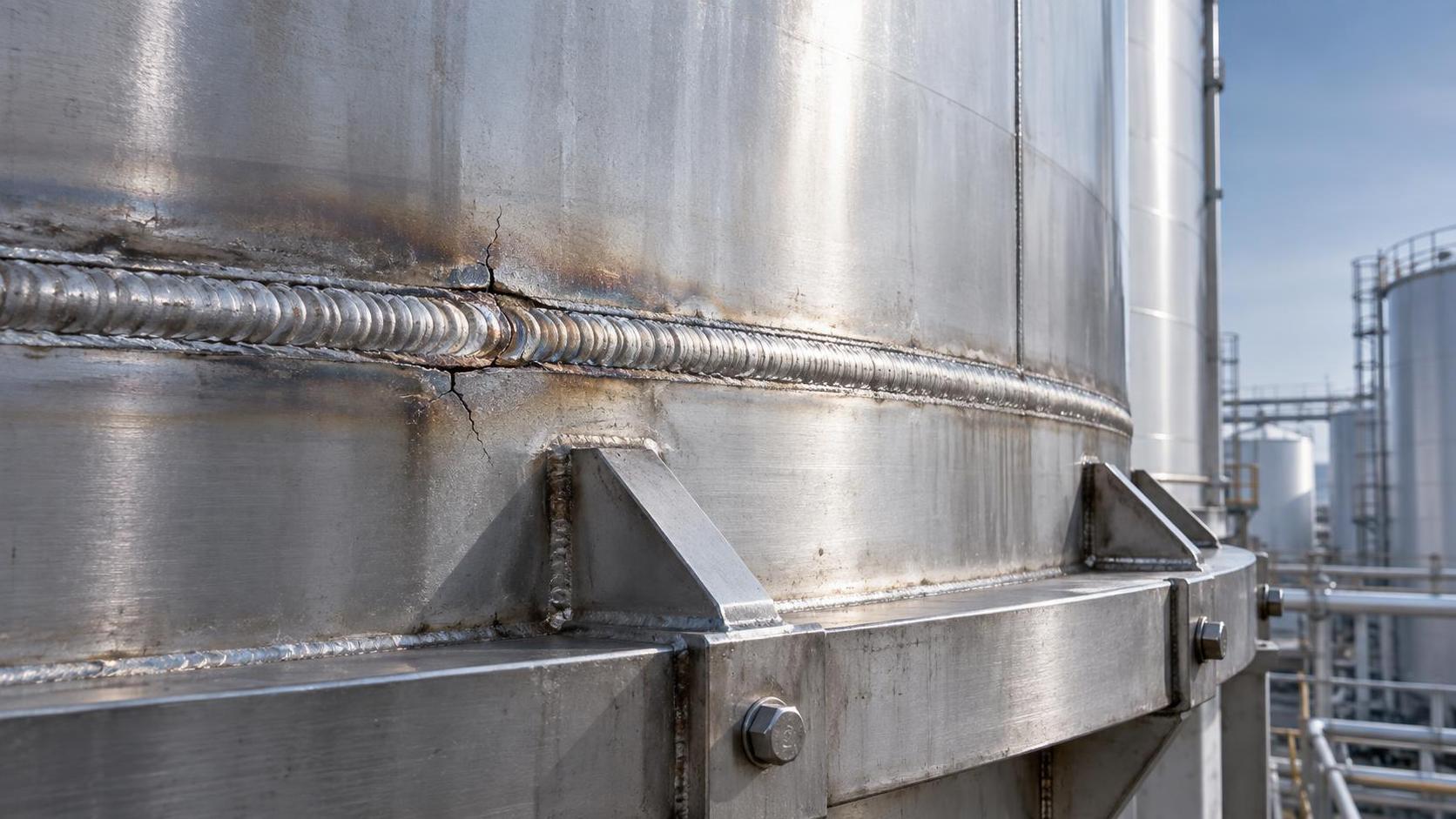
Weld seam cracking in stainless steel silos during thermal cycling isn’t just a technical footnote—it’s the quiet alarm that echoes through grain terminals at dawn, vibrates faintly in chemical plant control rooms after a steam surge, or shows up as hairline fissures during routine winter inspections. For after-sales maintenance teams, it’s rarely about one dramatic failure. It’s about the slow erosion of confidence—when a silo that held 500 tons of soybeans without issue for three years suddenly reveals micro-cracks near a support ring after its first freeze-thaw season.
Thermal cycling—repeated expansion and contraction driven by ambient shifts, process heat, or seasonal extremes—isn’t an outlier condition in stainless steel silo operation. It’s the baseline reality across grain storage, power plant fly ash containment, cement batching, and bulk chemical handling. And yet, many cracks aren’t born from overload or corrosion alone. They’re rooted in how the weld *responded* to temperature swings—not just what it was made of, but how it was made, where it sits, and what stresses it inherited before the first cycle even began.
Let’s walk through the five most recurrent causes—not as textbook bullet points, but as field-observed patterns Shandong Guokai International Trade Co., Ltd.’s service engineers have traced across hundreds of stainless steel silos over the past decade.
**1. Residual Stress Concentration at Weld-To-Base Transitions**
Stainless steel doesn’t crack because it’s “weak.” It cracks where stress concentrates—and nothing focuses stress like a sharp geometric discontinuity. At the junction between a circumferential weld seam and the base plate, or where a stiffener attaches to the shell, residual stresses from welding don’t dissipate evenly. When thermal cycling begins, these localized zones become strain amplifiers. The metal expands—but the weld zone, often harder and less ductile than the parent material, resists uniform deformation. That resistance translates into micro-strain, then micro-cracking, then visible fissures—usually parallel to the weld toe, not along the fusion line. This is especially common in silos with abrupt transitions: thick-to-thin wall sections, welded-on ladders, or non-tapered support rings.
**2. Mismatched Thermal Expansion Between Weld Metal and Base Material**
Not all stainless steels expand at the same rate—even within the same grade family. A 304L weld deposited with a 308L filler may behave differently under thermal load than the adjacent 316L shell, particularly if post-weld heat treatment wasn’t applied uniformly—or at all. The mismatch becomes more pronounced when dissimilar metals are involved (e.g., carbon steel supports welded directly to austenitic stainless shell), or when filler selection prioritized ease of deposition over coefficient-of-expansion compatibility. During cooling cycles, differential shrinkage pulls at the interface. Over time, this repeated tug-of-war fatigues the heat-affected zone (HAZ), initiating intergranular or transgranular cracks that propagate outward from the weld root.
**3. Sensitization in the Heat-Affected Zone**
This one sneaks in quietly. When stainless steel—especially grades like 304 or 316—is held between ~425–850°C for too long during welding (even briefly), chromium carbides precipitate along grain boundaries. That depletes chromium locally, undermining corrosion resistance *and* ductility. In thermal cycling environments, sensitized HAZ regions become brittle anchors—unable to accommodate cyclic strain. Cracks initiate here not from mechanical overload, but from embrittlement under repeated low-amplitude stress. You won’t see rust first. You’ll see fine, branching cracks radiating from welds in high-humidity or chloride-rich atmospheres—common near coastal grain terminals or chemical processing zones.
**4. Inadequate Joint Design for Cyclic Loading**
A full-penetration groove weld looks robust on paper—until you realize it wasn’t designed for *movement*. Many silos use square-groove or single-V joints without backing, creating weld profiles that act like stress concentrators under thermal flexing. Better alternatives? Controlled-bevel joints with smooth transitions, or partial-penetration fillets with generous throats—especially in non-load-bearing seams where flexibility matters more than ultimate strength. Also overlooked: weld sequencing. Welding all circumferential seams in one direction, without alternating passes or allowing cooldown intervals, locks in directional residual stress—making the entire ring behave like a coiled spring waiting for thermal release.
**5. Unaccounted-for Constraint from External Components**
Cracks rarely appear in isolation. They cluster where movement is restricted: near pipe nozzles, manway frames, or structural bracing welded directly to the shell. These attachments don’t just add weight—they anchor the silo wall, preventing natural thermal expansion. When the shell tries to grow 2–3 mm across a 15-meter diameter during a summer day, and a rigid ladder bracket says “no,” the resulting strain redirects into adjacent welds. Maintenance teams often misdiagnose these as “weld quality issues”—but the root isn’t poor technique. It’s uncalculated constraint. The fix isn’t re-welding; it’s introducing controlled flexibility—slotted mounting holes, sliding brackets, or isolating gaskets—so the silo breathes *with* the environment, not against it.
Prevention isn’t about eliminating thermal cycling—it’s about designing *with* it. That means selecting filler metals based on thermal expansion data—not just corrosion charts. It means specifying post-weld solution annealing for critical seams in high-cycle applications. It means reviewing joint geometry not only for static load capacity, but for strain distribution across 10,000+ thermal cycles over a 25-year lifespan.
And it means choosing partners who’ve seen these patterns repeat—not just in labs, but in real silos holding Soybean Steel Silo loads through Midwest winters and Southeastern monsoons. Shandong Guokai’s field teams routinely find cracked seams repaired with generic filler rods—only to fail again six months later—because the underlying metallurgical mismatch wasn’t addressed. Their approach starts earlier: reviewing welding procedure specifications (WPS) *before* fabrication, auditing joint design against thermal strain maps, and embedding inspection checkpoints at high-risk zones—not just at commissioning, but at 6-, 18-, and 36-month intervals.
For maintenance professionals, the takeaway isn’t “check welds more often.” It’s “read the cracks like a language.” A crack perpendicular to the weld suggests residual stress dominance. One following grain boundaries hints at sensitization. Branching patterns near a nozzle? Likely constraint-induced fatigue. Each tells a story about what happened *before* the crack appeared—not just what’s happening now.
You don’t need to rebuild every silo. But you do need to interpret what thermal cycling is saying through those seams. Because in stainless steel silos, cracking isn’t always failure—it’s feedback. And the most durable solutions begin not with a grinder or a torch, but with understanding *why* the metal chose that exact spot, at that exact time, to let go.
Related Posts
- ▶ How a Dry Bulk Silo Handles Pneumatic Filling and Gravity Discharge
- ▶ What Is a Dry Bulk Silo, and When Does a Factory Need One?
- ▶ Can dry bulk storage silos be integrated into existing PLC-controlled batching systems?
- ▶ Do dry bulk silos designed for API 650 compliance meet ASME Section VIII requirements?
- ▶ Is almacénamiento de sólidos a granel en silos de acero inoxidable viable for small-scale agrochemical distributors?
- ▶ How do vibration-based level sensors perform in stainless steel silos with powder coating?
Online Message