





Are stainless steel silos suitable for outdoor installation in coastal salt-spray environments?
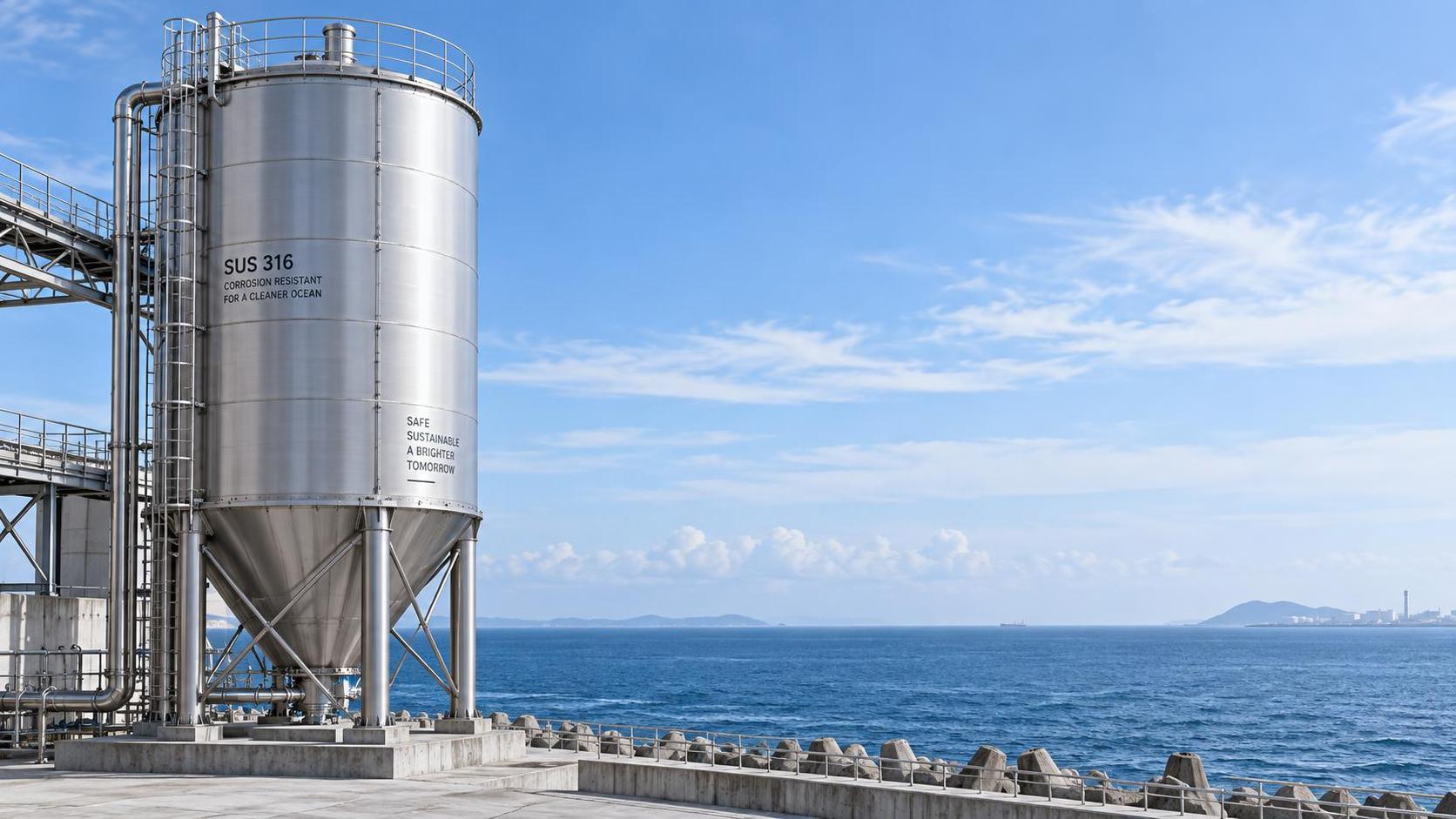
Yes—stainless steel silos are suitable for outdoor installation in coastal salt-spray environments, provided specific material, fabrication, and design criteria are met. This suitability is not automatic or universal. It depends on alloy selection, surface condition, weld quality, structural detailing, and long-term maintenance discipline—not merely the label “stainless steel.” Many installations fail prematurely not because stainless steel is inherently inadequate, but because standard 304-grade material was used where 316 or higher-grade alloys were required, or because crevices, poorly executed welds, or unsealed fastener interfaces created localized chloride traps.
Why Chloride Exposure Demands More Than Generic Stainless Steel
Salt-spray environments impose a unique corrosion challenge: airborne sodium chloride deposits combine with high humidity and intermittent wet-dry cycling to sustain electrochemical activity on metal surfaces. Unlike uniform atmospheric oxidation, chloride-induced attack targets passive oxide layers at microscopic weak points—especially where oxygen diffusion is restricted. This leads to pitting and crevice corrosion, both of which propagate rapidly once initiated and are difficult to detect visually until significant cross-section loss has occurred. Standard austenitic stainless steels like 304 (18/8) offer limited resistance under these conditions. Their critical pitting temperature (CPT) in 6% NaCl solution typically falls between 15–25°C—well below ambient coastal temperatures during humid summer months. In contrast, marine-grade 316 stainless steel contains 2–3% molybdenum, which significantly raises CPT to 30–40°C and improves resistance to chloride penetration at grain boundaries and inclusion sites.
Material Selection Is Not Binary—It’s a Gradient of Risk
Choosing 316 does not eliminate risk—it shifts the threshold. Real-world performance depends on how that alloy is applied. For example:
- Standard mill-finished 316 sheet may perform adequately on vertical, freely draining surfaces—but fails quickly in horizontal seams, bolted flange joints, or beneath rain gutters where salt-laden moisture pools and evaporates repeatedly.
- Cold-worked areas near cut edges or formed corners exhibit reduced corrosion resistance due to martensite formation and residual stress; these zones require post-fabrication annealing or passivation—steps often omitted in field assembly.
- Weld heat-affected zones (HAZ) can suffer chromium depletion if shielding gas purity is insufficient or interpass temperature control is neglected. A visible heat tint (straw to blue) signals oxide thickness beyond what nitric acid passivation can reliably restore.
This means material grade alone cannot guarantee service life. It must be paired with controlled fabrication practices—including argon backing for full-penetration welds, low-heat-input welding procedures, and mandatory post-weld cleaning with citric acid-based passivation gels applied within 24 hours of completion.
Design Details That Determine Long-Term Integrity
Even with optimal material and weld quality, poor geometry invites failure. Coastal silos must avoid features that trap salt-laden moisture or restrict airflow:
- Drainage angles: All external surfaces should slope ≥3° to prevent ponding. Flat roofs, level access platforms, or recessed nameplates become corrosion incubators.
- Crevices: Bolted connections must use non-absorbent gaskets and fully tightened torque-controlled fasteners. Overlapping lap joints without continuous welds create ideal crevices—continuous seam welding or mechanical sealing is preferable.
- Thermal breaks: Stainless steel mounted directly to carbon-steel support structures without insulating pads creates galvanic couples. Even minor electrolyte films (e.g., dew condensation) accelerate anodic dissolution of the carbon steel—and the resulting rust runoff stains and undermines adjacent stainless zones.
These details are rarely specified in general procurement documents but directly influence whether a silo lasts 15 years or requires major refurbishment by year seven.
Maintenance Is Not Optional—It’s Part of the Design Specification
Unlike painted carbon-steel silos—where coating failure is visually obvious—stainless steel degradation begins invisibly beneath surface oxides. Scheduled inspection intervals must include tactile checks for roughness along weld toes, magnified examination of heat-tinted zones, and periodic chloride ion testing using conductive wipe tests (per ASTM D4940). A single annual high-pressure freshwater rinse (≥150 bar, no detergents) removes accumulated salts before they initiate pitting. Delaying this beyond 90 days in high-exposure zones measurably reduces time-to-first-pit in field studies. Maintenance logs should record rinse dates, water conductivity readings pre- and post-rinse, and any observed discoloration—not just visual “no damage” notes.
When Smaller-Scale Applications Reinforce Core Principles
The same metallurgical and environmental logic applies across scales. For instance, compact storage solutions such as the Household Small Grain Assembly Silos rely on identical corrosion mechanisms—even with lower structural loads. Their smaller footprint increases surface-area-to-volume ratio, intensifying exposure per unit mass. Without marine-grade alloys and sealed welds, thin-gauge stainless components degrade faster than larger industrial counterparts under equivalent spray conditions. This reinforces that size does not confer immunity: it changes the margin for error, not the underlying physics.
Verification Beyond Certificates
Mill test reports confirm chemistry—not real-world behavior. Third-party verification should include:
- Positive material identification (PMI) scanning of all delivered plates and weld filler rods;
- Microscopic examination of representative weld cross-sections for intergranular attack and delta ferrite content (target: 5–10% for crack resistance);
- Electrochemical testing (ASTM G150) on fabricated mock-ups exposed to cyclic salt-spray + UV simulation for ≥500 hours.
These steps move evaluation from paper compliance to functional assurance. They also expose inconsistencies between shop drawings and as-built execution—such as substitution of 304 for 316 in secondary supports, or omission of specified passivation steps.
Conclusion: Suitability Is Conditional, Not Absolute
Stainless steel silos can perform reliably outdoors in coastal salt-spray environments—but only when alloy selection, fabrication rigor, geometric detailing, and maintenance protocols align with the severity of exposure. The presence of stainless steel does not equate to corrosion immunity. Rather, it introduces a set of precise technical dependencies that must be managed continuously—from specification through commissioning and into operational life. Projects that treat material grade as a checkbox, rather than a system-level requirement tied to weld procedure specifications, surface finish controls, and scheduled intervention cycles, will face accelerated degradation regardless of initial cost premium. Success lies not in selecting stainless steel, but in engineering its entire lifecycle interface with the marine environment.
Related Posts
- ▶ How a Dry Bulk Silo Handles Pneumatic Filling and Gravity Discharge
- ▶ What Is a Dry Bulk Silo, and When Does a Factory Need One?
- ▶ Can dry bulk storage silos be integrated into existing PLC-controlled batching systems?
- ▶ Do dry bulk silos designed for API 650 compliance meet ASME Section VIII requirements?
- ▶ Is almacénamiento de sólidos a granel en silos de acero inoxidable viable for small-scale agrochemical distributors?
- ▶ How do vibration-based level sensors perform in stainless steel silos with powder coating?
Online Message