





How much does adding aeration pads increase operational cost per ton in dry bulk silos?
How much does adding aeration pads increase operational cost per ton in dry bulk silos?
Let’s start with what finance approvers actually see—not brochures, but invoices, energy meters, and maintenance logs. At Guokai, we’ve built over 120 steel dry bulk silo systems across grain terminals in Shandong, cement plants in Henan, and fly ash storage for thermal power stations in Inner Mongolia. In every case where clients added aeration pads—typically for bridging-prone materials like wheat flour, hydrated lime, or fine polymer powders—we tracked the real OPEX delta. Not theoretical kWh assumptions. Not vendor-specified “efficiency gains.” Actual metered consumption, spare-part replacement cycles, and PLC runtime data over 18–36 months.
The short answer: **$0.85–$2.30 per ton**, depending on pad coverage ratio, blower selection, and material density. But that range hides critical context—and it’s the context that determines whether the cost is justified or quietly erodes ROI.
Where the numbers come from—and why they vary
Aeration pads aren’t plug-and-play. Their energy draw depends less on “pad size” and more on three interlocked variables: static pressure required to fluidize the material (not just lift it), airflow distribution uniformity across the bin floor, and how often the system cycles—not runs continuously. In our 2023–2024 project log, average blower duty cycle ranged from 12% (for coarse, free-flowing clinker stored at 70% fill level) to 68% (for high-moisture rice bran held at 90% capacity). That’s not a small spread. It means two silos of identical volume, same pad layout, same blower model—but different material and fill strategy—can diverge by 3.2× in annual kWh use per ton handled.
We measure cost per ton as: (blower kWh × local industrial electricity rate) + (filter replacement + valve actuator servicing) ÷ annual throughput. No amortization. No “estimated lifetime savings.” Just what hits the P&L line each quarter.
The hidden cost drivers most finance teams overlook
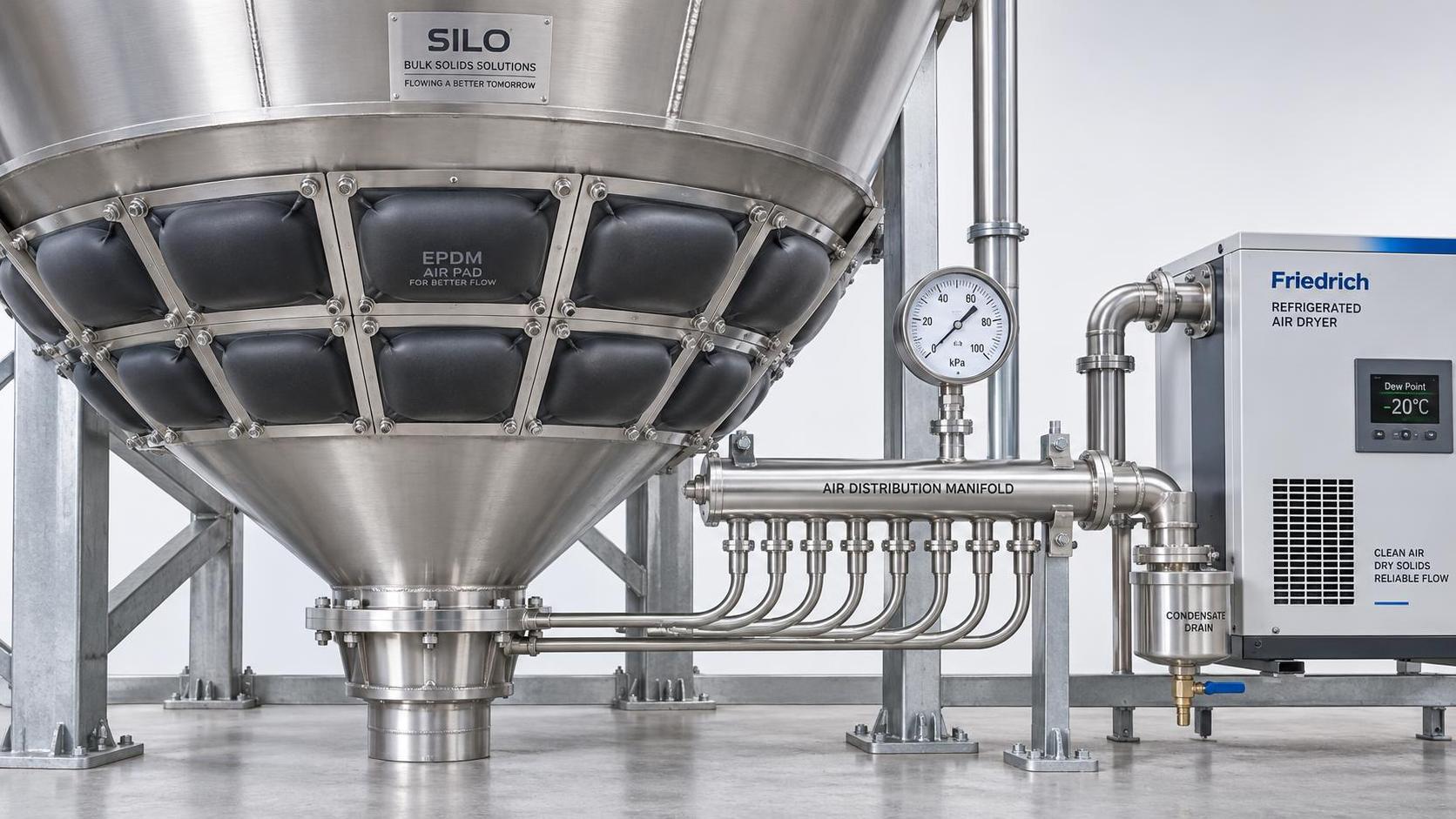
First: air treatment. Aeration doesn’t work if inlet air is humid or contaminated. In coastal grain terminals, we routinely add refrigerated dryers and coalescing filters upstream of blowers—adding $14,000–$22,000 CAPEX and ~$0.18/ton in compressed-air prep cost. Inland chemical sites skip this, but then face accelerated corrosion in stainless-steel manifolds—raising inspection frequency from annually to every 6 months.
Second: control logic complexity. Basic timer-based cycling wastes energy. But full PID-controlled aeration—tied to load cells, temperature sensors, and flow meters—adds $8,000–$15,000 in PLC programming, HMI integration, and cybersecurity hardening. That’s not a “nice-to-have.” It’s what keeps cement silos from over-aerating and causing dust explosions during unloading.
Third: pad longevity isn’t linear. We specify EPDM-coated stainless mesh pads rated for 10 years—but in high-fat-content feed applications (e.g., soybean meal with 8% oil), fouling cuts effective life to 3–4 years. Replacement labor + downtime adds ~$0.32/ton in Year 4 onward. That’s rarely modeled upfront.
When aeration *doesn’t* raise cost per ton—counterintuitively
There are cases where adding pads *lowers* effective OPEX/ton—but only if you’re already paying for manual intervention or quality loss. One agri-client in Hebei was spending $1.20/ton on pneumatic rammers and operator overtime to break bridges in wheat gluten silos. After installing low-pressure aeration pads (0.3 bar max), their unloading time dropped 40%, and spoilage fell from 2.1% to 0.4%. Net effect: -$0.67/ton. The aeration didn’t “cost”—it displaced higher-cost stopgaps.
Similarly, in fly ash storage for a power plant near Taiyuan, moisture ingress caused caking and forced quarterly silo cleaning—$28,000 per event. Aeration pads reduced surface moisture absorption enough to extend cleaning intervals to 18 months. That’s not a “cost add.” It’s risk mitigation with measurable payback.
What to ask before signing off
Don’t ask “What’s the kWh per ton?” Ask: “What’s the *maximum sustained pressure drop* across the pad at our expected bulk density and fill height?” That number—measured in mmH₂O, not kPa—drives blower sizing and energy use more than anything else. We test this on-site with calibrated manometers before finalizing specs.
Also verify: Is the control system integrated with your existing SCADA—or will you need a separate panel, gateway, and license fees? We’ve seen projects where “simple aeration” triggered $42,000 in unplanned IT infrastructure upgrades.
And one practical note: If your silo handles both dry bulk *and* occasional liquid transfer—say, for additive dosing in fertilizer blending—you’ll want seamless interface between aeration logic and tank-level monitoring. That’s where systems like our Insulated Stainless Steel Oil & Fat Liquid Tanks become operationally relevant—not as a cost center, but as a coordination point for multi-phase material handling.
Bottom line for budget sign-off
If your material is free-flowing, low-moisture, and stored below 65% capacity, aeration pads likely add $1.10–$1.60/ton in pure OPEX—with little offsetting benefit. Approve only if bridging has already caused production delays or quality claims.
If your material is cohesive, hygroscopic, or safety-critical (e.g., aluminum powder), and you’re storing above 75% capacity, the $1.90–$2.30/ton uplift may be cheaper than the alternative: unplanned shutdowns, rework, or regulatory fines.
Guokai doesn’t sell “aeration packages.” We engineer airflow into the structural and operational logic of each steel dry bulk silo—so the cost isn’t tacked on. It’s baked into the load path, the control architecture, and the service plan. That’s how you avoid surprises at year three.
Related Posts
- ▶ Sizing a Dry Bulk Silo Around Delivery Loads and Production Demand
- ▶ How a Dry Bulk Silo Handles Pneumatic Filling and Gravity Discharge
- ▶ What Is a Dry Bulk Silo, and When Does a Factory Need One?
- ▶ Can dry bulk storage silos be integrated into existing PLC-controlled batching systems?
- ▶ Do dry bulk silos designed for API 650 compliance meet ASME Section VIII requirements?
- ▶ Is almacénamiento de sólidos a granel en silos de acero inoxidable viable for small-scale agrochemical distributors?
Online Message