





Sizing a Dry Bulk Silo Around Delivery Loads and Production Demand
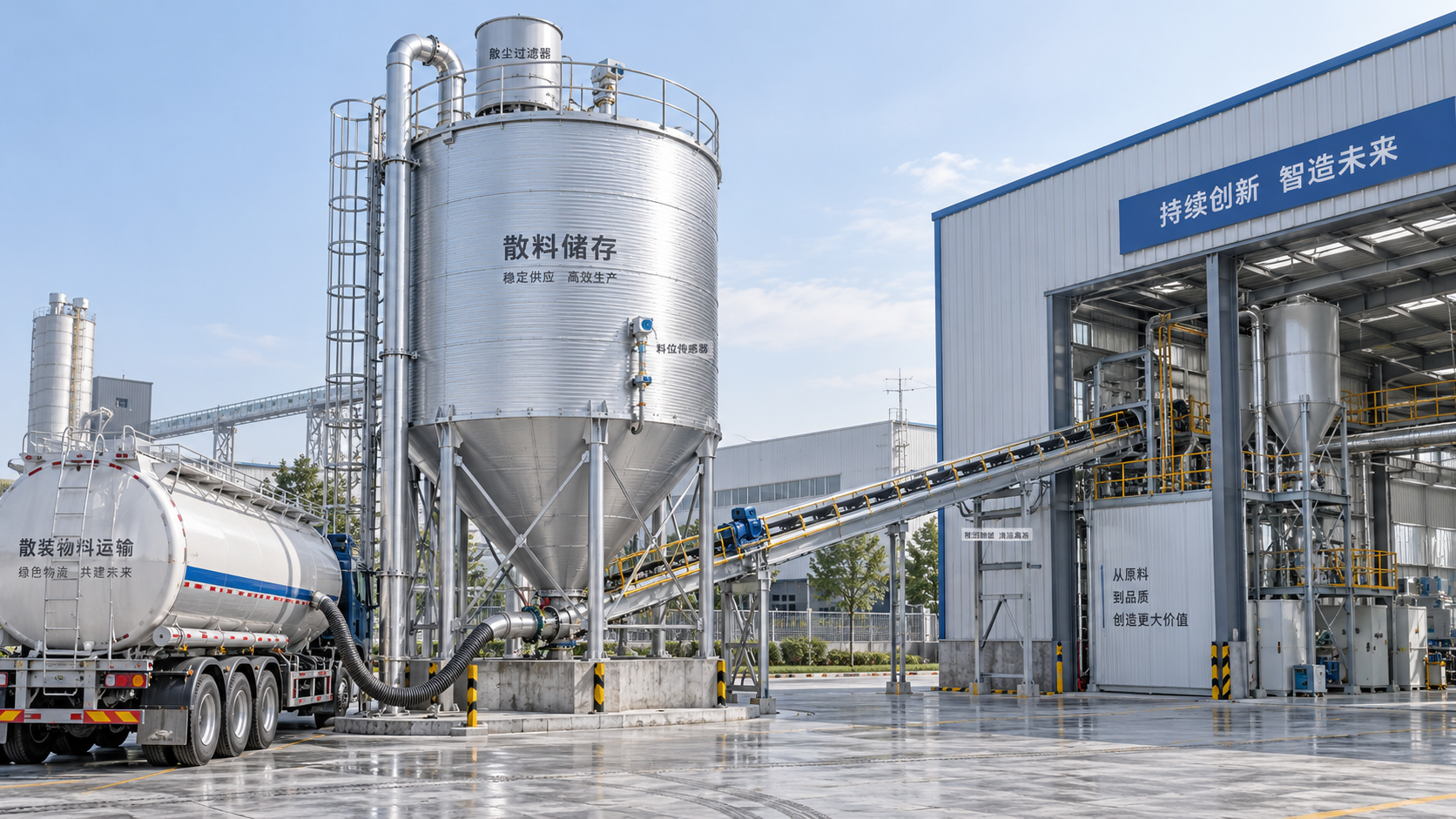
A dry bulk silo should be sized to accept the largest permitted delivery at the inventory level likely to exist when that delivery arrives, while retaining enough accessible material to cover production demand and supply delays. A capacity selected only from average daily consumption can leave too little receiving space. A capacity selected only from truck payload can leave too little operating reserve.
For technical evaluation, separate three quantities: delivery mass, usable inventory, and physical storage volume. Then check them against a realistic delivery schedule. The right specification is a storage and replenishment arrangement that works through early arrivals, delayed deliveries, demand peaks, and changes in material density.
Start with the inventory expected before unloading
The first sizing question is straightforward: how much material could already be in the silo when the next load arrives? Add the incoming load to that quantity, and the result establishes the required usable inventory capacity for that receiving event.
Required usable mass capacity = maximum credible inventory before delivery + incoming delivery mass.
Both terms need operational definitions. The incoming quantity should reflect the largest load the site intends to accept, including permitted payload variation. If partial unloading is unavailable or commercially undesirable, evaluate the full load. Assuming a truck can leave with the balance creates a receiving constraint that should be agreed with the supplier before equipment selection.
The inventory before delivery depends on scheduling. An early truck encounters more stored material than an on-time truck. A production stoppage can have the same effect: deliveries continue toward the site while consumption falls below plan. A second delivery arriving before the first load has been sufficiently consumed can create a larger requirement than either individual load suggests.
Credit for consumption during unloading needs care. It may reduce the net inventory increase when production and receiving can run simultaneously. That credit is defensible only if the discharge system can maintain the assumed rate throughout unloading and production is expected to remain available. For an initial capacity check, accepting the full delivery without this credit gives a clearer receiving requirement.
A receiving limit and a replenishment trigger perform different jobs. The receiving limit prevents overfilling; the replenishment trigger protects supply continuity. If their operating windows do not overlap, increasing silo size is one option, but changing delivery frequency, arrival windows, or order quantities may resolve the problem more economically.
Build the reserve around demand during the supply window
Average consumption helps estimate annual throughput and delivery frequency. It is less useful for determining how much inventory must remain available during a difficult replenishment period. A plant that consumes material mainly during one shift has a different depletion pattern from a continuous process, even when their daily totals match.
Use a time-based demand profile that includes credible production peaks. Where recipes or product campaigns change consumption, identify the highest sustained requirement over the period relevant to replenishment. A short peak matters if it coincides with a delivery delay or consumes the remaining reserve before another load can arrive.
A basic ordering relationship is:
Reorder inventory position = demand over replenishment lead time + safety stock.
Inventory position includes usable stock on site plus confirmed incoming quantities, less committed requirements where applicable. This distinction matters when several deliveries are already in transit or scheduled. Triggering every order from the physical silo level alone can generate overlapping deliveries and exceed the available receiving space.
Safety stock should correspond to an identified uncertainty: delivery lateness, demand variation, a restricted receiving calendar, or another interruption. If the planning lead time already includes a delay allowance, adding the same delay again as safety stock will inflate the requirement. Conversely, using only average lead time can leave the plant exposed when a delivery slips.
Separate the expected delivery schedule from the disruption allowance. Estimate normal lead-time demand, then choose a reserve that addresses the additional event the business intends to withstand. For an important production input, that might be a missed receiving slot followed by the next available delivery. The acceptable scenario depends on interruption cost and the available recovery options.
Extra silo capacity cannot compensate for an inadequate supply rate. Over the planning period, delivered mass must cover consumption. Likewise, a silo holding several days of stock provides little protection if its outlet and conveying system cannot supply the process at the required peak rate.
A worked example: one delivery cycle, several arrival times
Consider an illustrative operation consuming 30 tonnes per day, with deliveries of 24 tonnes. At steady demand, each load covers 0.8 day of production. Assume the schedule aims to leave 27 tonnes of usable inventory immediately before a normal delivery.
- An on-time delivery raises usable inventory from 27 to 51 tonnes.
- A delivery arriving 0.4 day early encounters an additional 12 tonnes of stock, so the post-delivery inventory reaches 63 tonnes.
- A delivery arriving 0.5 day late consumes another 15 tonnes before unloading, leaving 12 tonnes available.
Under these assumptions, 63 tonnes is the receiving requirement for the early-arrival case, while 12 tonnes is the remaining reserve in the delayed-arrival case. Selecting a silo for the normal 51-tonne peak would fail the early-arrival check.
The example also shows the cost of keeping more reserve on site. Raising the scheduled pre-delivery inventory increases protection against lateness, but raises the capacity required to accept an early load by the same amount. Reserve policy and receiving capacity must therefore be evaluated together.
These figures describe a single cycle at constant demand. Repeated early deliveries, overlapping trucks, or a production shutdown require a longer schedule check. Plotting inventory through several cycles reveals whether the proposed delivery rules keep stock within both the upper receiving limit and the lower operating reserve.
Convert usable tonnes into a defensible volume
Once the required usable mass is established, convert it into volume using the material’s relevant bulk-density range. A quoted capacity in tonnes is incomplete without the density used to calculate it.
Required material volume = stored mass ÷ bulk density.
For a fixed incoming mass, lower bulk density requires more space. The low-density condition therefore governs the volume check. Higher density can govern structural loading, because the same occupied volume then contains more mass. These two checks serve different purposes and should remain separate in the specification.
Bulk density can change with material grade, moisture, particle distribution, aeration, and settling. The density used for shipping documentation or settled laboratory material may not represent the condition during filling. For pneumatically delivered powder, consider the receiving condition when establishing the volume needed to avoid reaching the high-level limit.
Using the example above, suppose the agreed low design bulk density is 0.75 tonnes per cubic metre. The 63 tonnes of usable inventory requires 84 cubic metres of material volume. If a further 3 tonnes remains below the minimum reliable operating level, total stored mass becomes 66 tonnes, occupying 88 cubic metres at that density.
That 88 cubic metres is occupied material volume. The required geometric silo volume will be larger if the design needs additional space above the permitted fill surface. The supplier should establish that allowance from the silo geometry, filling arrangement, material behaviour, and level-control positions. Applying an unexplained universal percentage obscures the assumptions behind the selection.
Ask the equipment supplier to distinguish:
- Geometric volume: the internal volume included in the stated silo dimensions.
- Permitted occupied volume: the volume available below the operating fill limit, accounting for the filling profile.
- Usable inventory: material that can be reliably withdrawn above the minimum operating level.
The hopper contribution deserves attention. Its geometric volume may be included in a capacity quotation, yet some retained material may be unavailable to the process. An outlet, hopper angle, or discharge arrangement that permits arching or persistent stagnant regions can reduce usable inventory. Adding shell height does not resolve a discharge limitation.
Freeboard, retained inventory, and safety stock should not be combined into one vague margin. Freeboard preserves receiving space and the operating fill limit. Retained inventory accounts for material unavailable to production. Safety stock is accessible material held against uncertainty. Keeping them separate makes competing proposals easier to compare.
Check whether the proposed silo can operate within that envelope
Capacity calculations establish the storage requirement, but the filling and discharge equipment determine whether the requirement is achievable. Confirm that the receiving system can complete unloading within the available delivery window and that the discharge system can meet peak process demand.
For pneumatic filling, venting and filtration must be assessed against the conveying-air conditions. More empty storage volume does not correct an unsuitable venting arrangement. The fill limit, high-level detection, and unloading shutdown sequence also need to account for material that can continue entering after a stop signal.
Level indication introduces another practical constraint. A point sensor measures material at its location, while the stored surface may be uneven. A continuous level instrument also depends on geometry and material behaviour. The usable capacity calculation should align with the proposed measurement method, and the receiving procedure should establish available space before unloading begins.
Site constraints may make diameter, height, or the number of silos more influential than nominal volume. A taller, narrower vessel can fit a restricted footprint, but its structural and foundation implications still need evaluation. Separate silos may help when grades must remain isolated or maintenance would otherwise interrupt supply. Their capacities are not automatically interchangeable: an empty vessel holding a different grade does not provide space for the next delivery.
Where a standard geometry cannot provide the required working volume within the site envelope, Custom Non-standard Silos and Storage Tanks can be considered during layout evaluation. The useful comparison is whether a proposed diameter, shell height, hopper, and discharge arrangement meets the inventory requirement and site constraints at an acceptable installed cost.
Evaluate each candidate against the same few scenarios: normal operation, the earliest accepted delivery, the selected delay allowance, peak production demand, and a consumption stoppage with a delivery already committed. For each scenario, identify the highest stored quantity, lowest accessible inventory, and any delivery that must be deferred.
The resulting specification should state the largest accepted load, design density range, required usable inventory, retained-material allowance, operating fill limit, peak discharge demand, and delivery assumptions. Require the supplier’s capacity calculation to show how those conditions translate into geometry and structural loading.
A larger vessel becomes justified when it closes an identified operating gap—for example, accepting a full load while preserving the reserve needed through the next delivery window. If the gap can be closed through a reliable scheduling change, compare that option before committing to more steel, greater height, or additional foundations. The capacity decision is ready when the proposed silo and delivery rules support the same inventory envelope.
Related Posts
- ▶ Sizing a Dry Bulk Silo Around Delivery Loads and Production Demand
- ▶ How a Dry Bulk Silo Handles Pneumatic Filling and Gravity Discharge
- ▶ What Is a Dry Bulk Silo, and When Does a Factory Need One?
- ▶ Can dry bulk storage silos be integrated into existing PLC-controlled batching systems?
- ▶ Do dry bulk silos designed for API 650 compliance meet ASME Section VIII requirements?
- ▶ Is almacénamiento de sólidos a granel en silos de acero inoxidable viable for small-scale agrochemical distributors?
Online Message