





Welded Steel Silo Design Considerations for Heavy Bulk Material Loads
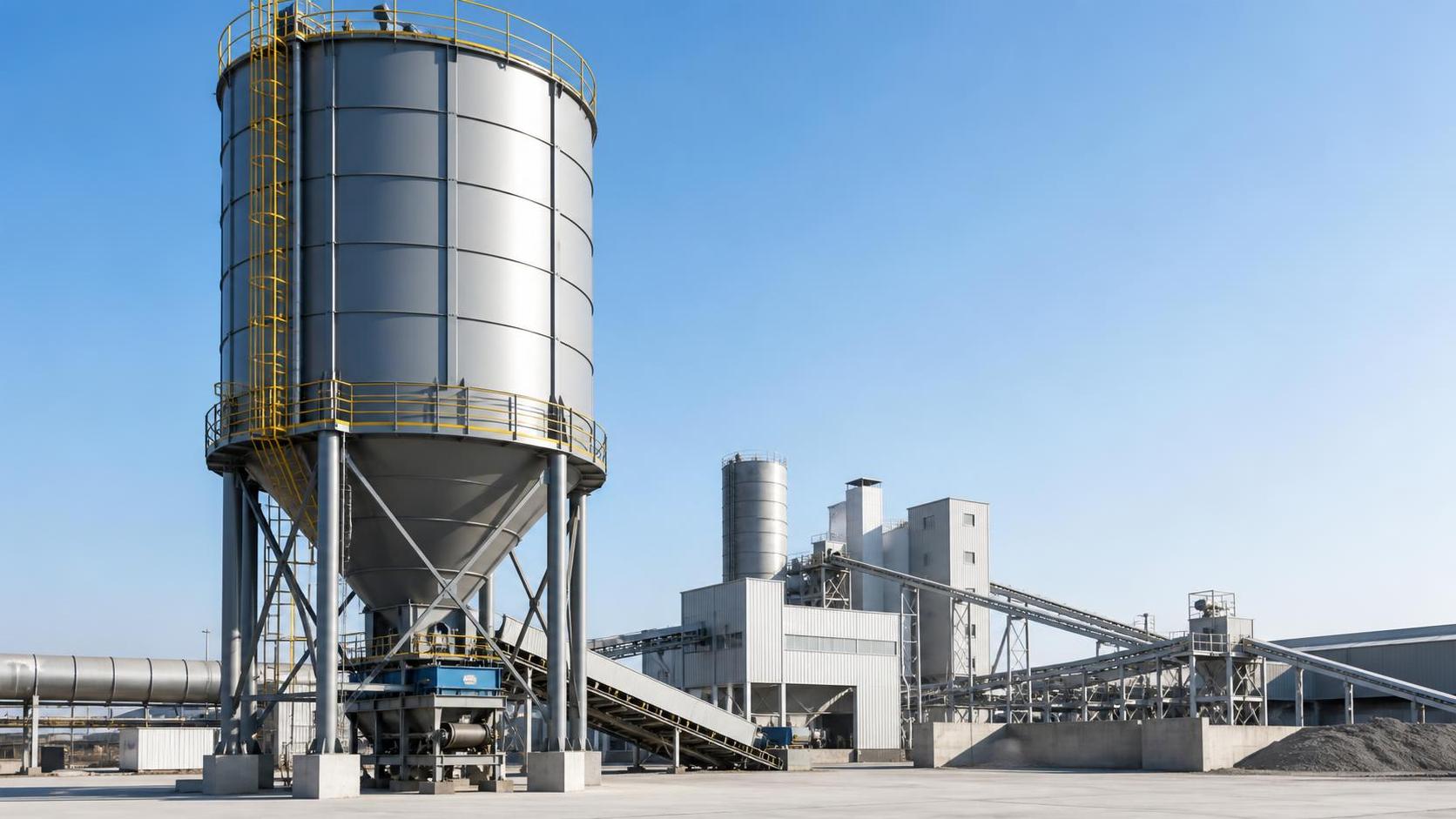
Welded Steel Silo Design Considerations for Heavy Bulk Material Loads
Designing a welded steel silo for heavy bulk material loads is not a matter of sizing a cylindrical shell around a target storage volume. The difficult work lies in understanding how the stored material behaves, how that behavior changes during filling and discharge, and how the resulting forces travel through the shell, hopper, supports, and foundation. A silo that appears adequate under a simple static load calculation may still face serious serviceability, fatigue, flow, corrosion, or safety problems after it enters operation.
This is particularly relevant for dense, abrasive, cohesive, or moisture-sensitive materials. Cement, fly ash, mineral powders, clinker fines, coal-related materials, fertilizers, chemical powders, and some grain products can impose very different demands despite having similar nominal storage capacities. For technical evaluation teams, the central question is not merely “How many tonnes can the silo hold?” It is whether the complete welded steel silo system can sustain realistic operating conditions over its intended service life.
Start with the Bulk Solid, Not the Steel Plate
Bulk material properties are the starting point for every credible design decision. Bulk density affects vertical and lateral pressure, but it is only one part of the picture. Particle size distribution, moisture content, wall friction, internal friction, abrasiveness, compressibility, temperature, and tendency to cake or segregate all influence the load pattern inside a silo.
A free-flowing dry powder may discharge in a mass-flow pattern when hopper geometry and wall finish are appropriate. A cohesive or partially damp material may instead form a stable channel above the outlet, leaving stagnant zones against the wall. These two behaviors create different pressure distributions. Eccentric discharge, rat-holing, bridging, and asymmetric filling can generate localized stresses that are not captured by an assumption of uniform vertical loading.
Material characterization should therefore be requested early. If representative samples are available, flow-property testing can help establish wall friction and flow-function data for hopper and outlet design. Where test data are unavailable, a conservative preliminary basis may be necessary, but it should be identified as an assumption rather than treated as a confirmed material property. This distinction matters when a project moves from tender-stage sizing to fabrication drawings.
The operating envelope also deserves attention. A material that flows acceptably in a controlled plant environment may behave differently after exposure to humidity, long storage periods, repeated vibration, or temperature variation. For silos in building-material, power-generation, and chemical applications, storage time can be just as relevant as daily throughput.
Load Cases Must Reflect How the Silo Will Actually Be Used
Heavy bulk storage produces more than a single gravity load. The shell must resist filling pressures, stored-material pressures, discharge pressures, wind, seismic effects where applicable, temperature effects, equipment loads, and local forces introduced by platforms, pipe supports, access ladders, filters, and conveyors. A sound design review examines these combinations rather than checking each item in isolation.
Filling is often underestimated. Pneumatic delivery can introduce air, pressure fluctuations, and uneven distribution of material. Mechanical conveying can create concentrated impact zones. If material consistently enters near one side of the roof or through a poorly located inlet, the load path may become eccentric before the silo is even full. The roof structure, inlet reinforcement, and upper shell courses should be evaluated for the actual loading arrangement, not a generic central-fill assumption.
Discharge is frequently the more demanding condition. When an outlet is off-center, when one of several outlets is used independently, or when flow initiates unevenly, the stored solid can impose non-symmetrical wall pressures. In severe cases, local shell instability may become the governing risk. Operational controls can reduce this exposure, but design should not depend entirely on ideal operator behavior. The intended discharge sequence, reclaim equipment, and emergency procedures should be visible in the engineering basis.
Overpressure and vacuum conditions need the same practical treatment. A filter blockage, pneumatic filling event, closed isolation device, or rapid withdrawal of air can affect a thin-walled structure quickly. Venting capacity, pressure-relief arrangements, and the allowable pressure or vacuum limits of the vessel need to be coordinated with the process design. These are not accessories added after structural design; they are part of the load definition.
Shell Stability Is Often More Critical Than Strength
In a welded steel silo, simply increasing steel thickness does not automatically solve every structural concern. Cylindrical shells are efficient under uniform membrane stresses but can be sensitive to buckling when subjected to compression, vacuum, localized loading, or uneven material pressure. Geometry, stiffener spacing, weld detailing, openings, and support conditions all influence stability.
The lower shell and hopper transition are especially important because forces converge there. A change in geometry can create stress concentrations, particularly around outlet frames, reinforcement plates, support brackets, and welded transitions. A design review should examine whether the hopper is carrying material in a predictable way and whether its connection to the cylindrical body permits a clean transfer of loads.
Openings require more than nominal reinforcement. Inspection doors, level-switch nozzles, manholes, inlet pipes, and aeration connections interrupt shell continuity. Their location relative to stiffeners, weld seams, and areas of high pressure should be considered. Large openings near heavily loaded zones may need more detailed analysis than a standard detail can provide.
Applicable silo and structural standards should be identified in the project specification at an early stage. Depending on the market and contract requirements, the design basis may refer to standards addressing actions on silos, steel structures, wind, seismic design, welding, and local building requirements. The selected standard set should be compatible rather than assembled from unrelated references. Technical evaluators should ask for a clear design basis document showing the governing load cases, material assumptions, safety factors, and limits of use.
Welding Quality Is a Structural and Maintenance Issue
Welded construction offers flexibility in diameter, height, hopper configuration, and integration with site-specific equipment. It also means that fabrication control has a direct effect on performance. Longitudinal and circumferential welds, attachments, stiffeners, and transitions must be produced under an appropriate welding procedure and inspection plan. Distortion control is important because an out-of-round shell can reduce buckling resistance and complicate the fit-up of roof, hopper, and support components.
For heavy-duty service, it is useful to distinguish between primary structural welds and secondary attachments. A small bracket may appear minor, yet repeated vibration from connected equipment can turn its weld toe into a fatigue-sensitive point. Weld termination details, attachment placement, and access for inspection all deserve attention. Internal weld profiles can also affect product buildup, particularly with sticky powders or materials prone to accumulation.
A practical quality plan commonly defines material traceability requirements, welding procedures, welder qualifications where required by contract or applicable rules, dimensional checks, visual examination, and any specified non-destructive testing. The exact scope should match the risk and project standard; not every weld requires the same inspection method. What matters is that acceptance criteria are agreed before fabrication rather than interpreted after delivery.
Foundation and Support Design Cannot Be Separated from the Silo
A fully loaded silo concentrates substantial vertical force at its base or supporting legs. The foundation design must account for vertical load, overturning, horizontal actions, anchor forces, soil conditions, settlement behavior, drainage, and the stiffness of the support interface. Even a robust steel structure can develop alignment issues if differential settlement affects the ring foundation or leg supports.
The connection between steelwork and civil works should be defined precisely: anchor bolt layout, tolerances, base plate details, grout requirements, embedded items, and elevation references. This is particularly important when the silo is fabricated off-site and erected in sections. Ambiguous interface dimensions can lead to field modification, which is rarely desirable around primary load-bearing connections.
Support selection changes the design logic. A ground-supported flat-bottom silo distributes load differently from a hopper-bottom silo on legs or a structural frame. Elevated arrangements improve discharge clearance and may simplify process integration, but they generally introduce larger concentrated reactions and greater sensitivity to wind and seismic action. The right arrangement depends on material flow requirements, available footprint, maintenance access, and local civil constraints—not only on the cost of steel.
Corrosion, Abrasion, and Product Contamination Need Different Answers
External corrosion protection should reflect the installation environment: indoor or outdoor exposure, coastal conditions, industrial emissions, rainwater retention points, and access for coating maintenance. Internal conditions may be entirely different. Some materials are abrasive but chemically neutral; others are mildly abrasive yet corrosive in the presence of moisture. A coating that performs well on the exterior may not be appropriate for the stored product or may create contamination concerns.
Abrasion tends to concentrate at inlets, impact zones, hopper valleys, outlet transitions, and locations where material changes direction. Wear liners, replaceable impact plates, or changes in chute geometry may be more effective than increasing shell thickness across the entire vessel. The objective is to protect the location where wear occurs without introducing inaccessible crevices or making future repairs unnecessarily difficult.
For food-related grain applications, surface condition and cleanability can be decisive. For chemical materials, compatibility with the product and cleaning agents may govern. In all cases, the material contact surfaces, coatings, seals, and accessories should be assessed as a system.
Flow Design Has to Match the Operating Objective
The distinction between mass flow and funnel flow is not academic. Mass flow supports first-in, first-out movement and can reduce stagnant inventory, but it may require steeper hoppers, smoother wall surfaces, and larger outlets. Funnel flow can be acceptable for some non-degrading materials and may allow a less demanding hopper geometry, yet it carries greater risk of stagnant regions, segregation, and inconsistent discharge.
A discharge aid should not be used as a substitute for poor geometry. Aeration pads, vibrators, air cannons, mechanical agitators, and fluidizing devices may be appropriate for specific materials, but each one changes the operating and structural environment. Vibration can affect connections and welds; aeration can alter bulk density and flow behavior; mechanical devices add maintenance demands. The best choice depends on tested material behavior and the required discharge rate.
This is also where smaller, mobile storage solutions can have a role. On temporary or space-constrained construction projects, Mobile Small Cement Tanks for Construction Site may be evaluated separately from permanent high-capacity storage. Their operating assumptions, transport restraints, support arrangement, and filling frequency differ from those of a large fixed welded structure, so the two should not be assessed using the same simplified checklist.
Safety Provisions Must Be Designed into the Arrangement
Silo safety includes structural integrity, access safety, dust management, and operational control. Safe access to level instruments, filters, inspection points, vents, and roof equipment should be considered during layout development. A ladder may satisfy an access requirement on paper while still making routine maintenance difficult or hazardous in practice. Platforms, guardrails, walkways, lighting provisions, and rescue considerations should suit the expected maintenance tasks.
Dust hazards require material-specific assessment. Where combustible dust may be present, the applicable area classification, explosion protection approach, venting arrangements, grounding, and operating procedures should be determined under relevant local requirements. It is not appropriate to assume that all powders present the same hazard level, nor that a general-purpose vent arrangement is suitable for every material.
Instrumentation can prevent many avoidable incidents. High-level alarms, independent overfill protection where justified, pressure monitoring, level measurement suitable for the product, and clear interlocks between delivery equipment and silo capacity help control filling events. Their usefulness depends on calibration, inspection, and operator response procedures. A level sensor installed in a difficult-to-reach location is not a complete risk control.
What a Technical Evaluation Should Request Before Approval
A technically complete proposal for a welded steel silo should make its assumptions visible. Capacity alone is insufficient. Evaluators should be able to review the material design basis, bulk density range, flow characteristics where known, silo geometry, hopper angle, outlet size, intended filling and discharge methods, structural design standard, environmental loads, corrosion strategy, foundation reactions, and equipment interface loads.
It is equally useful to request general arrangement drawings, structural calculation scope, fabrication and inspection documentation, coating specifications, erection sequence, and a list of exclusions or site responsibilities. Questions about utility connections, compressed air quality, electrical control boundaries, delivery pressure, and site lifting capacity often reveal gaps before they become construction issues.
Shandong Guokai International Trade Co., Ltd. combines development, manufacturing, and sales activities for steel storage silos and supports silo project construction across grain, building materials, electric power, and chemical applications. For projects in these sectors, the useful starting point is a disciplined exchange of material data and operating conditions rather than a rapid comparison of nominal tonnage and shell thickness. The final configuration should be checked against the actual loading pattern, local design requirements, foundation conditions, and maintenance strategy before fabrication begins.
Related Posts
- ▶ How a Dry Bulk Silo Handles Pneumatic Filling and Gravity Discharge
- ▶ What Is a Dry Bulk Silo, and When Does a Factory Need One?
- ▶ Can dry bulk storage silos be integrated into existing PLC-controlled batching systems?
- ▶ Do dry bulk silos designed for API 650 compliance meet ASME Section VIII requirements?
- ▶ Is almacénamiento de sólidos a granel en silos de acero inoxidable viable for small-scale agrochemical distributors?
- ▶ How do vibration-based level sensors perform in stainless steel silos with powder coating?
Online Message