





Estimating Spiral Steel Silo Payback Through Faster Installation and Capacity
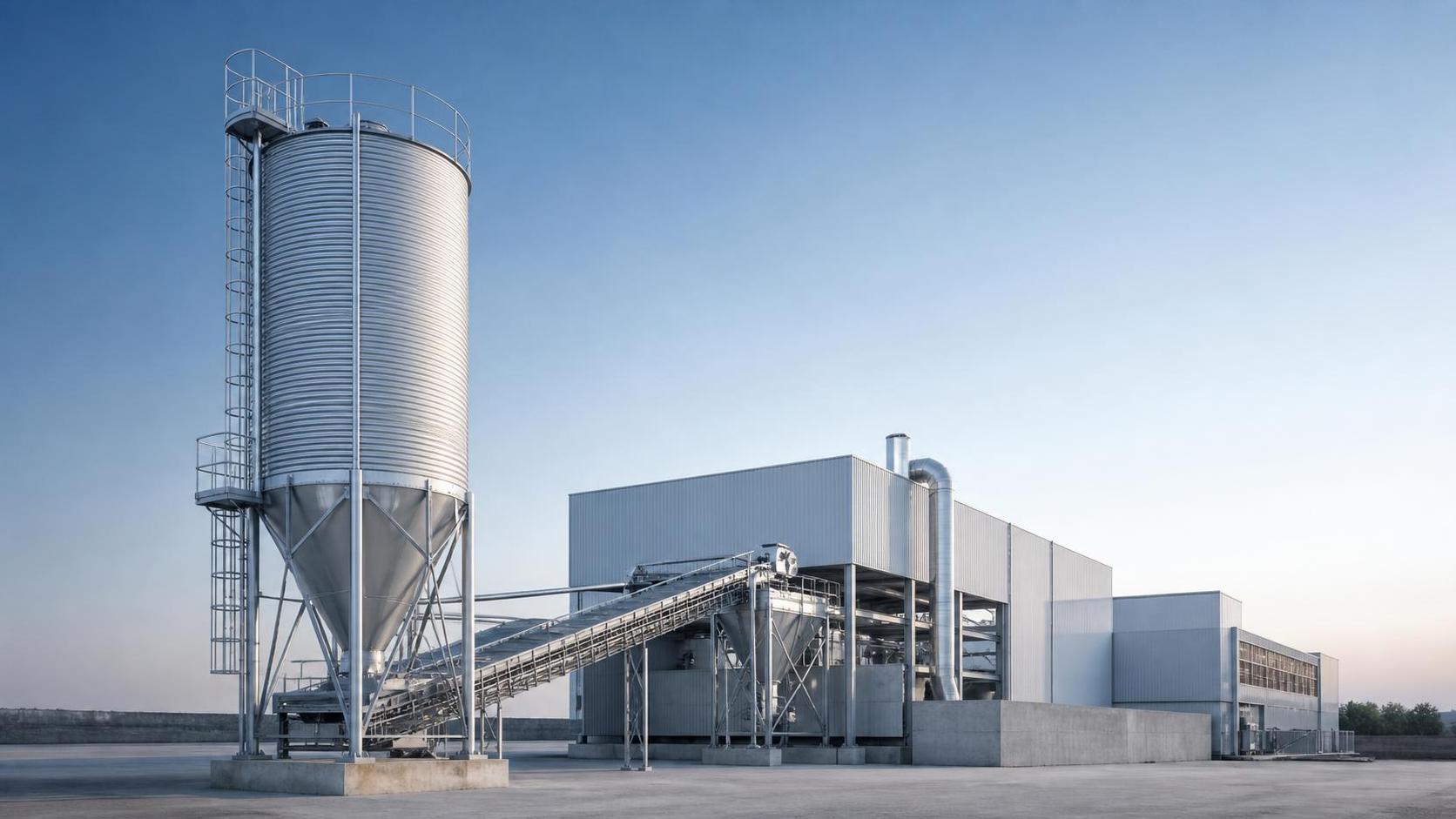
It often starts with a project meeting that seems simple: a storage bottleneck has been identified, production is waiting on more buffer capacity, and several silo quotations are on the table. The immediate question is usually, “Which option has the lowest purchase price?” Yet that question can hide the cost that matters most. If a storage structure takes longer to install, requires more site work, or delays commissioning, the apparent saving can disappear before the facility begins normal operation.
This is especially common where materials arrive continuously but storage expansion is treated as a stand-alone construction purchase. Grain processors, powder-handling plants, building-material operations, and chemical facilities may all face the same practical tension. They need more capacity, but they also need to avoid tying up funds in a project that remains incomplete while material flow, staffing plans, and downstream scheduling are already changing. A spiral steel silo can be evaluated more clearly when installation speed and usable capacity are treated as inputs to payback, not as secondary technical details.
Start with the business interruption the project is meant to reduce
Before comparing silo types or requesting a revised quotation, define the operating problem in financial terms. “Need more storage” is not yet a decision model. The more useful question is: what is happening today because available storage is insufficient, poorly located, unreliable, or difficult to expand?
In some facilities, trucks must wait because receiving capacity is constrained. In others, production slows when material cannot be staged near the process. Seasonal purchasing opportunities may be missed because there is nowhere to hold additional inventory. A plant may rely on short-term external storage, extra handling, or inconvenient delivery schedules. Each condition has a different economic effect, so it should not be compressed into one vague estimate of “lost efficiency.”
For a procurement review, separate the impact into categories that can be discussed with operations, engineering, and accounting:
- avoidable off-site storage, rental, or transfer costs;
- additional labor and equipment movements caused by poor material flow;
- receiving delays, demurrage exposure, or shipment rescheduling;
- production disruption associated with unreliable material availability;
- margin opportunities that depend on buying, storing, or processing material at a different time;
- working-capital effects created by holding more inventory than the business can use effectively.
The purpose is not to claim that every hour of earlier completion produces revenue. In many operations, it does not. The purpose is to identify which costs truly stop, decrease, or become more controllable once the new storage is available. This gives the payback calculation a defensible base.
The installation date is a financial variable, not just a construction milestone
A common mistake is to compare only delivered equipment prices. That approach assumes two systems become operational at roughly the same time and impose similar site demands. In reality, the interval from contract award to usable storage can affect project economics in several ways.
A spiral steel silo is generally formed through a continuous spiral process, which can reduce the number of separate wall components handled during erection compared with designs assembled from many individual panels. The actual installation outcome still depends on site access, foundation readiness, equipment availability, weather, safety procedures, discharge equipment, and the scope of surrounding civil and mechanical work. It should never be assumed that a silo’s forming method alone guarantees a particular schedule.
Even so, a faster and more predictable installation path can influence cost through reduced site labor duration, shorter equipment rental periods, fewer temporary logistics arrangements, and earlier commissioning. It can also lower the risk that the storage project overlaps with a seasonal receiving period or planned shutdown. These are not identical benefits, and they should be modeled separately.
When reviewing schedule claims, ask the supplier to distinguish between “structure erected” and “ready for operational handover.” A vessel standing on its foundation is not necessarily available for material. The schedule should identify foundations, access platforms, conveyors, electrical connections, ventilation or aeration where relevant, level measurement, discharge arrangements, testing, cleaning, and operator preparation. The financial value begins when the storage system can be used safely within the intended process, not when the shell looks complete.
A practical way to value earlier availability
Use a monthly or weekly timeline rather than a single annual estimate. First, establish the expected operational start date for each option. Then identify the net avoidable cost or operational contribution during each period before the slower option would be ready. If storage demand is highly seasonal, the timing of the gap may matter more than the length of the gap.
For example, an earlier installation may allow a facility to avoid interim storage only during a short peak receiving window. That benefit should be counted only for that window. Conversely, if the project removes a daily internal handling constraint, its value may begin immediately and recur throughout the operating year. A credible model matches benefits to the actual operating pattern instead of applying a uniform benefit rate to every month.
Capacity only creates value when it is usable
Another recurring error is to use nominal storage volume as though it were economically identical across every design. A large number on a datasheet may be relevant, but it does not answer whether the capacity fits the material, turnover pattern, receiving rate, discharge system, and inventory policy.
Start with the material’s bulk density and its likely variation. A silo specified by volume must be translated into practical tonnage using the material conditions expected in service, not an optimistic generic value. Moisture variation, particle size, compaction, flow behavior, and material segregation can all affect how storage performs. For powders and pellets, the issue may not be only how much material fits, but whether it can be discharged consistently and cleaned or changed over appropriately.
Then look at working capacity. Some inventory is operationally inaccessible because of minimum stock requirements, discharge geometry, batch separation, quality control, or the need to keep a buffer above a process line. If the planned operating policy requires a reserve, the payback model should use the volume available above that reserve rather than the silo’s theoretical maximum.
A useful internal discussion is to estimate the occupancy pattern over time. Will the new silo be near full for a few seasonal weeks, moderately utilized throughout the year, or used as a fast-turn buffer? The answer changes the economic logic. Seasonal capacity may support purchasing flexibility or receiving continuity. A daily buffer may reduce process interruptions. A low-turn inventory silo may primarily serve risk management. These are different business cases and should not be forced into the same savings formula.
Build the investment number from installed scope, not equipment price
The purchase price of a spiral steel silo is one component of capital cost. A payback estimate becomes misleading when major supporting scope is handled as a later “allowance.” The practical investment total should include the work required to make the storage unit function in its actual location.
Depending on the project, this may include foundation engineering and construction, unloading and conveying interfaces, loading arrangements, access ladders and platforms, electrical supply, controls, instrumentation, dust-management interfaces, safety provisions, freight, installation supervision, testing, and commissioning support. Not every item belongs to every project, but every item should be assigned either to the supplier, the owner, or another contractor.
This is also where comparison discipline matters. One quotation may include a basic shell while another includes a broader functional package. Neither is inherently better until the scope boundaries are aligned. Put competing proposals into a common matrix: included equipment, excluded equipment, civil assumptions, installation responsibility, schedule assumptions, warranty boundaries, and commissioning involvement. If an item is uncertain, show it as a separate allowance rather than quietly excluding it from one option.
For corrosive or chemically sensitive materials, material compatibility deserves its own review rather than being treated as a minor add-on. In applications involving chemical powder or pellets, a project team may also consider equipment such as Anti-Corrosion Tanks for Chemical Powder & Pellets where the storage duty, corrosion conditions, and handling arrangement call for a different containment approach. The decision should follow the material and process requirements, not a preference for one vessel type across all duties.
A restrained payback model is usually more useful than an aggressive one
A simple payback calculation divides the total installed investment by expected annual net benefit. It is easy to understand, but the quality of the answer depends entirely on the assumptions underneath it. For an approval-stage estimate, it is often better to show a base case plus a conservative case than to present a single precise-looking result.
The annual net benefit can be structured as:
avoidable annual operating cost + contribution from improved material availability + time-sensitive savings from earlier startup − additional annual operating and maintenance cost.
Earlier startup benefits should be treated separately if they occur only once. Instead of adding them to recurring annual savings, place them in the first-period cash flow. This prevents a short installation advantage from being accidentally multiplied across every year of operation.
Capacity-related benefits should also be limited by realistic utilization. If expanded storage creates the option to purchase larger lots, reduce transport interruptions, or avoid external storage, estimate only the portion that operations can actually use. Confirm that purchasing, quality control, working capital, and downstream consumption can support the planned inventory level. Extra capacity that sits empty may still provide resilience, but resilience should be described honestly rather than converted automatically into cash savings.
For larger or longer-life projects, it may be appropriate to supplement simple payback with discounted cash-flow measures, sensitivity analysis, and a review of residual value or future expansion options. Those methods do not replace practical judgment. They simply reveal whether the proposal depends heavily on one uncertain variable, such as future utilization, avoided downtime, or a narrow installation window.
Test the assumptions that can change the decision
When a proposed project appears attractive, the next question should not be “Can we make the number look better?” It should be “Which assumptions could make this number wrong?” In storage projects, a few variables often have more influence than the rest.
- Foundation readiness: Can the site deliver the required civil work when the erection team is available?
- Material behavior: Has the design basis considered flow, bridging, segregation, caking, abrasion, or corrosion risks relevant to the stored material?
- Actual throughput: Will receiving and discharge equipment move material at rates compatible with the planned operating schedule?
- Utilization: Is there a documented reason the added capacity will be filled and turned as expected?
- Interface ownership: Are conveyors, controls, power supply, and safety-related connections clearly assigned?
- Operating burden: Have inspection, cleaning, maintenance access, and future repair requirements been considered?
These questions are not a reason to delay every purchase until all uncertainty disappears. They are a way to distinguish manageable uncertainty from unsupported optimism. If a project’s return remains acceptable when installation takes longer, utilization is lower, or enabling works cost more than expected, it is generally more robust than a project that works only under ideal conditions.
Use capacity growth as an option, not an assumption
Scalability can strengthen the case for a spiral steel silo, but only if it is connected to an actual expansion pathway. A site may have room for additional units, a layout that can accommodate future conveying lines, or a foundation and utility plan that avoids rework later. Those features can reduce the disruption of a future expansion, yet they do not justify charging today’s project with benefits from demand that has not been validated.
A clearer approach is to value current needs first and document future flexibility separately. Record what can be expanded, what would need to be redesigned, and what site constraints may limit growth. This helps avoid two opposite mistakes: paying for unnecessary capacity today because growth is assumed, or choosing a low-cost layout that makes a later expansion disproportionately difficult.
Make the approval decision traceable
The strongest storage proposal is not the one with the shortest payback statement. It is the one where another reviewer can trace the logic from operational problem to installed scope, commissioning date, usable capacity, and cash-flow assumptions. A concise approval file should show the source of each important number, distinguish recurring benefits from one-time timing benefits, and state where engineering confirmation is still required.
When installation speed is assessed alongside capacity utilization and lifecycle scope, the discussion changes. The question is no longer simply whether a silo costs less to buy. It becomes whether the selected storage arrangement can enter service at the right time, support the required material flow, and produce benefits that remain credible after conservative assumptions are applied. That is the more reliable way to judge the payback potential of a spiral steel silo project.
Related Posts
- ▶ How a Dry Bulk Silo Handles Pneumatic Filling and Gravity Discharge
- ▶ What Is a Dry Bulk Silo, and When Does a Factory Need One?
- ▶ Can dry bulk storage silos be integrated into existing PLC-controlled batching systems?
- ▶ Do dry bulk silos designed for API 650 compliance meet ASME Section VIII requirements?
- ▶ Is almacénamiento de sólidos a granel en silos de acero inoxidable viable for small-scale agrochemical distributors?
- ▶ How do vibration-based level sensors perform in stainless steel silos with powder coating?
Online Message