





Storage Tank Types and Their Best Fit for Industrial Liquid Storage
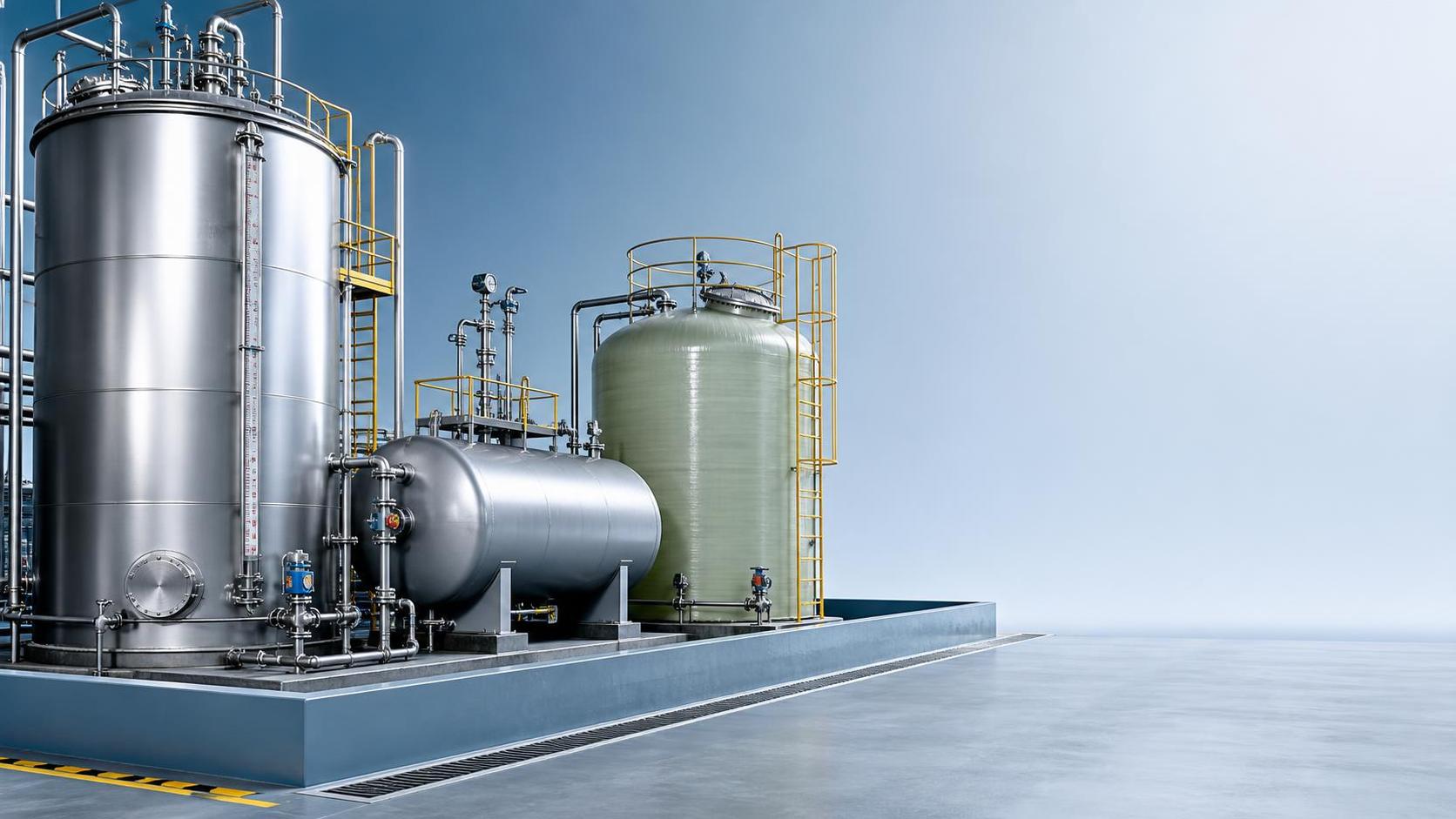
Storage tank selection begins with the liquid itself. A tank that performs well for untreated water may be unsuitable for a solvent, a concentrated acid, a heated oil, or a fluid that produces vapors. The correct storage tank must tolerate chemical contact, expected temperature and pressure, filling frequency, cleaning methods, and the conditions around the installation site. Shape and material affect far more than capacity: they influence drainage, inspection access, vapor control, structural loading, and the consequences of a leak.
Industrial liquid storage commonly involves water, fuels, lubricants, process chemicals, wastewater, food-grade liquids, and intermediate products held between production stages. Some fluids remain stable during storage. Others separate, settle, crystallize, absorb moisture, evaporate, or react with oxygen. Before comparing tank styles, it is useful to define the liquid's composition, concentration range, density, viscosity, flash point where applicable, operating temperature, and likely contaminants. A storage tank should be specified for the full operating range rather than for a single nominal condition.
Vertical Cylindrical Tanks for Large Static Volumes
Vertical cylindrical tanks are a common choice where a substantial liquid volume must be stored on a permanent foundation. Their footprint is relatively compact compared with a horizontal vessel of similar capacity, and their geometry works well for outdoor tank farms, utility water storage, fire-water reserves, bulk oils, and many process-liquid applications.
Steel is often used for large vertical tanks because it can be fabricated into wide diameters and adapted with stiffening rings, roofs, nozzles, platforms, ladders, level instruments, and internal fittings. Carbon steel may suit compatible water, oils, and certain non-corrosive fluids when a suitable coating or lining is used. Stainless steel is considered where corrosion resistance, cleanliness, or product purity has greater importance. The grade, weld treatment, surface finish, and gasket materials still need to match the stored medium.
Tank bottoms deserve close attention. A flat bottom is common for large atmospheric tanks, but drainage performance depends on the outlet location, floor slope, sediment behavior, and whether the liquid needs complete batch recovery. Water containing solids may require a low-point drain and periodic removal of accumulated material. Thick liquids can need heating coils, external tracing, insulation, or recirculation connections to remain pumpable.
Roof design follows vapor behavior and exposure conditions. A fixed roof can be appropriate for many atmospheric liquids. Fluids with notable evaporation, oxygen sensitivity, or vapor concerns may require additional vapor-space management. Depending on the process, this can include pressure-vacuum venting, inert-gas blanketing provisions, vapor recovery connections, or a roof arrangement intended to limit vapor losses. These features must be engineered as part of the whole system; adding them late can create conflicts with access platforms, instrumentation, and emergency venting requirements.
Horizontal Tanks Where Footprint and Access Differ
Horizontal storage tanks are generally practical for smaller to medium liquid inventories, especially when a lower profile is preferred. They are frequently installed above ground on saddles, mounted within equipment skids, or placed below grade when site conditions and maintenance practices allow. Their elongated form can fit along boundaries, beneath pipe racks, or beside loading areas where vertical height is restricted.
Fuel oils, diesel, lubricants, water, and compatible process liquids are typical applications. A horizontal configuration may simplify loading from road tankers or support gravity flow to nearby equipment. However, liquid level changes create a different surface area pattern than in vertical tanks. This can affect level measurement, vapor volume, internal cleaning, and the interpretation of volume tables. Calibrated charts or properly configured level transmitters are needed when inventory accuracy matters.
Support design is a structural issue rather than a minor installation detail. Saddles must distribute shell loads without creating damaging local stresses, while anchors must account for wind, seismic movement where relevant, thermal expansion, and accidental impact. Outdoor tanks also need a clear plan for rainwater drainage, access around the shell, and protection from vehicle contact. A tank installed tightly against walls or equipment may be difficult to inspect, repaint, repair, or remove later.
Although intended primarily for dry bulk materials rather than liquids, Horizontal Bulk Powder Storage Tanks illustrate why vessel orientation should be linked to material flow and discharge behavior. Powder bridging, liquid sedimentation, and viscous-liquid hold-up are different problems, but each requires the outlet geometry and internal surfaces to be considered early rather than after installation.
Stainless Steel Tanks for Cleanliness and Corrosion Resistance
Stainless steel storage tanks are widely associated with food, beverage, pharmaceutical, cosmetic, and high-purity chemical duties, but their use is not limited to those fields. They are also considered for liquids that would corrode unprotected carbon steel or where product discoloration from corrosion products cannot be accepted. The appropriate alloy depends on chloride exposure, acidity, temperature, cleaning chemistry, and crevice conditions around fittings and gaskets.
A polished internal surface may reduce residue retention and make cleaning easier, but the required finish should reflect the process. Excessive polishing can add cost without improving a non-sensitive utility application. Conversely, a rough surface, poor weld finishing, dead legs in piping, or inaccessible internals can make sanitation difficult where cleanability is required. Weld quality is especially important because weld discoloration, incomplete penetration, and unpassivated areas may become localized corrosion points.
For liquids that need agitation, stainless tanks can be fitted with top-entry or side-entry mixers, baffles, recirculation loops, temperature probes, and spray devices. The mixer should be chosen according to viscosity, solids content, density differences, and the required mixing objective. Gentle blending, suspension of solids, heat transfer, and emulsion formation place very different loads on the vessel and demand different impeller arrangements.
Plastic and Composite Tanks for Compatible Chemicals
Polyethylene, polypropylene, polyvinyl chloride, and fiber-reinforced plastic tanks are often used for selected acids, alkalis, water-treatment chemicals, and other corrosive liquids. Their main attraction is chemical resistance and low weight. They can reduce the need for internal linings that might otherwise be required in a metal tank, but compatibility must be verified against the exact chemical concentration and temperature.
Plastic tanks have different mechanical limitations from steel. They may expand under load, become less rigid at elevated temperature, degrade under prolonged ultraviolet exposure unless formulated or protected for outdoor use, and require carefully designed support surfaces. A flat-bottom plastic tank needs a level, continuous foundation. Point loads from uneven concrete, protruding bolts, or debris beneath the base can lead to distortion or cracking. Side nozzles and connected pipework should be independently supported so the piping does not impose excessive loads on the tank wall.
Fiber-reinforced plastic can offer higher structural strength and is often made with corrosion-resistant liners selected for the chemical duty. Manufacturing quality matters greatly because laminate thickness, resin selection, curing, flange construction, and nozzle reinforcement determine long-term performance. For strong oxidizers, solvents, or high-temperature chemicals, a material that appears generally resistant may still be inappropriate under actual operating conditions.
Lined Steel Tanks and Specialized Chemical Duties
Lined steel tanks combine the mechanical strength of a steel shell with an internal barrier chosen for the stored liquid. Rubber linings, polymer linings, glass-based linings, and other protective systems may be used depending on chemical resistance, operating temperature, abrasion, and permeability requirements. This arrangement can be useful when a plastic tank lacks the needed structural capacity or when external conditions favor steel construction.
The lining is a critical component, not a generic coating. Its thickness, adhesion, seam construction, repair method, and inspection requirements should be defined before fabrication. Nozzles, manways, internal supports, and drain connections are common high-risk areas because changes in geometry can interrupt lining continuity. Any field modification that penetrates the shell may require a controlled lining repair before the tank returns to service.
Chemical storage also benefits from secondary containment. A bund, dike, double-wall arrangement, or contained room may be needed depending on the liquid and site requirements. Containment volume, drainage isolation, compatibility with leaked material, and rainwater management should be resolved together. An open containment area that fills with rainwater can create avoidable operational problems and complicate response to a release.
Pressure Vessels Are Not Ordinary Storage Tanks
A tank intended for atmospheric service should not be treated as a pressure vessel merely because it has a closed top. Pumping conditions, blocked outlets, thermal expansion, vapor generation, and gas blanketing can create pressure or vacuum conditions that exceed an atmospheric tank's design limits. Likewise, a vessel designed for pressure service has different fabrication, testing, relief, and documentation requirements from a standard bulk storage tank.
Compressed gases, liquefied gases, volatile solvents, and heated liquids may require pressure-rated vessels or dedicated process equipment. The distinction should be established at the process-design stage. Attempting to solve an unexpected pressure issue later by fitting a stronger cap, reducing a vent opening, or changing a valve setting can introduce serious risks.
Details That Determine Whether a Tank Works in Service
A suitable shell material and capacity do not complete the specification. Inlets should be located to avoid unnecessary splashing, static accumulation, foam generation, or disturbance of settled material. Outlets need to support required drainage and avoid drawing sediment when clean liquid is needed. Overflow routing must lead to a controlled location rather than onto access areas or adjacent equipment.
- Level measurement should match the liquid's conductivity, vapor conditions, foam tendency, density changes, and required accuracy. A sight gauge may be useful for local confirmation, while a remote instrument may be needed for routine monitoring or alarms.
- Manways and inspection openings require enough clearance for access, covers, and lifting arrangements. Their placement should not force maintenance work into congested or hazardous locations.
- Vent lines need consideration of vapor compatibility, weather ingress, flame-control requirements where applicable, and the possibility of plugging from crystallization, insects, dust, or condensed material.
- Heating systems should include a means of controlling temperature and preventing localized overheating, particularly with temperature-sensitive liquids or lined tanks.
Tank capacity should include operating margin. Filling a vessel to its geometric maximum can leave insufficient space for thermal expansion, foam, mixing displacement, or upset conditions. The usable volume also changes when an internal coil, mixer, floating device, or sloped bottom occupies space. These factors should be reflected in the capacity basis used for process planning.
Installation, Inspection, and Change Control
Foundation preparation starts with soil conditions, settlement expectations, drainage, and the loaded tank weight. A level base reduces uneven stress, but it is not the only requirement. The foundation must also suit the tank type: ring walls, slabs, saddles, piers, and containment structures distribute loads differently. Underground installations add concerns about buoyancy, groundwater, external corrosion, access, and leak detection.
Before commissioning, the completed system should be reviewed as an assembly. Verify nozzle orientation, valve tags, flow direction, vent routing, support gaps, instrument connections, grounding or bonding provisions where needed, and access to drains. A hydrostatic or other appropriate test may be part of the agreed inspection scope, but test media and disposal routes must be compatible with the tank and surrounding system. Residual water can be problematic in tanks intended for water-reactive or contamination-sensitive liquids.
Routine inspection focuses on changing conditions: corrosion around seams and nozzles, coating damage, settlement, leaks at flanges, distorted supports, blocked vents, and unreliable level indication. Internal inspections should be planned around the stored product's hazards, required cleaning, and confined-space controls. A tank that appears sound externally can still have internal corrosion, sludge buildup, lining damage, or blocked outlets.
Changes in chemical concentration, temperature, cleaning agent, or fill rate should trigger a compatibility review. Storage problems often begin after a process modification rather than at initial installation. Keeping the tank's design basis, drawings, material records, and inspection history available makes these reviews more reliable and prevents assumptions from replacing verified information.
Related Posts
- ▶ How a Dry Bulk Silo Handles Pneumatic Filling and Gravity Discharge
- ▶ What Is a Dry Bulk Silo, and When Does a Factory Need One?
- ▶ Can dry bulk storage silos be integrated into existing PLC-controlled batching systems?
- ▶ Do dry bulk silos designed for API 650 compliance meet ASME Section VIII requirements?
- ▶ Is almacénamiento de sólidos a granel en silos de acero inoxidable viable for small-scale agrochemical distributors?
- ▶ How do vibration-based level sensors perform in stainless steel silos with powder coating?
Online Message