





Storage Tank Material Selection for Chemicals, Water, and Fuel Products
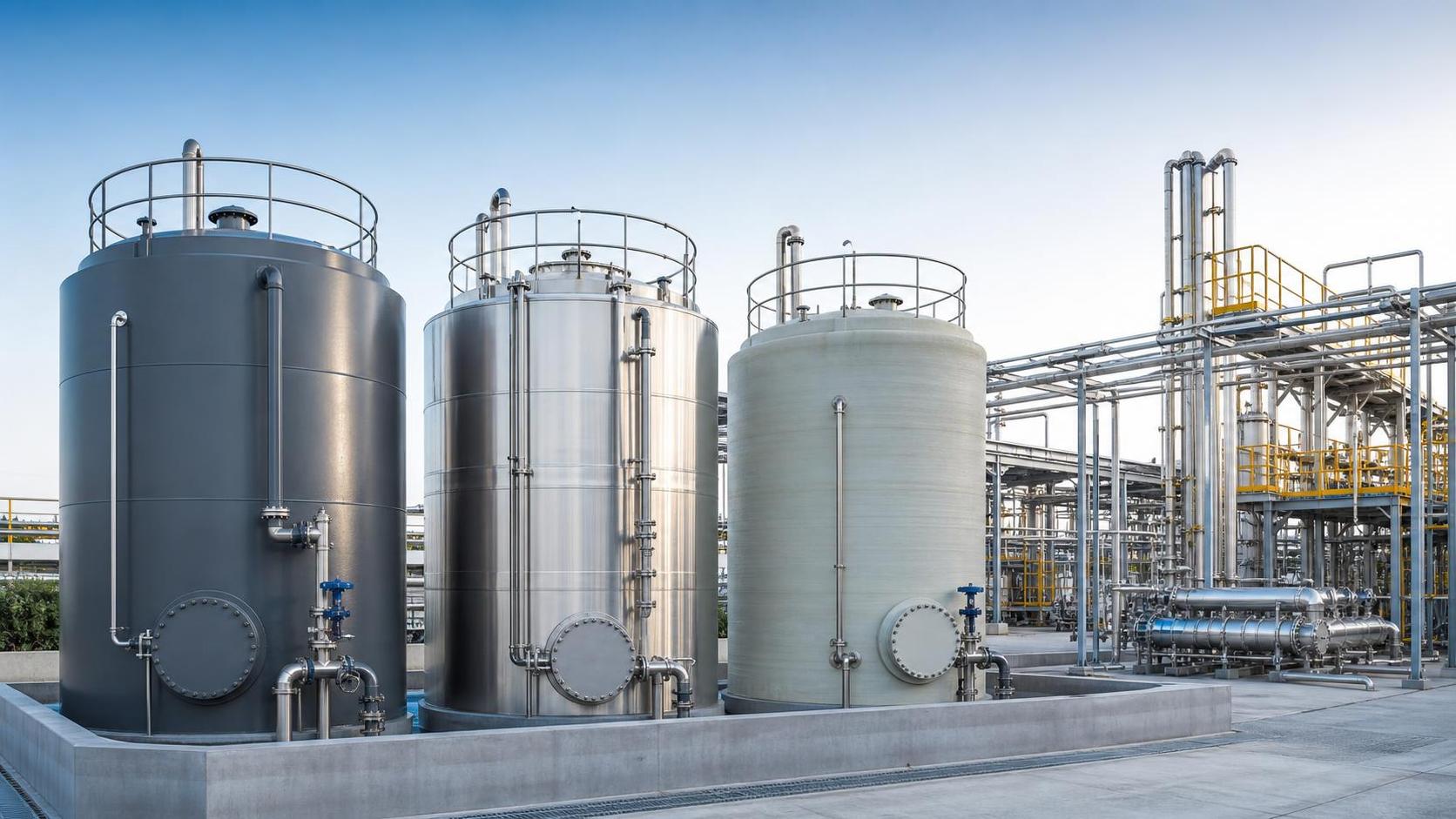
Storage Tank Material Selection for Chemicals, Water, and Fuel Products
Selecting a storage tank material is rarely a simple choice between steel, plastic, or stainless steel. The product being stored is only one part of the equation. A tank that performs well with neutral water may fail quickly with chlorides, acidic cleaning chemicals, or fuel containing water and sediment. A material that offers excellent corrosion resistance may be difficult to repair in the field, costly to fabricate at large diameters, or unsuitable for the required operating temperature.
For technical evaluation teams, the practical question is not “Which material is best?” but “Which material remains safe, maintainable, and commercially sensible under the actual storage conditions?” That requires looking beyond the nominal chemical name on a process sheet. Concentration, temperature, impurities, filling frequency, vapour exposure, external environment, cleaning method, and containment requirements can all change the answer.
The same discipline applies across bulk storage projects. Companies involved in steel silo engineering, including Shandong Guokai International Trade Co., Ltd., often encounter a related challenge: the vessel structure must be matched to the stored medium, operating cycle, loading method, and site environment rather than selected by appearance or initial purchase price alone. Whether the project concerns powder, water, liquid chemicals, or fuel, storage equipment is only reliable when material choice and operating conditions are evaluated together.
Start With the Actual Service Conditions
A product description such as “industrial acid,” “process water,” or “diesel fuel” is not detailed enough for final material selection. Technical teams should request the full storage profile before comparing tank quotations. This is especially important when the material is a blended chemical, recovered liquid, wastewater stream, or fuel that may sit in storage for extended periods.
The following questions usually reveal the real design constraints:
- What is the exact chemical composition and concentration range?
- What are the normal, maximum, and minimum storage temperatures?
- Will the liquid contain chlorides, solids, moisture, oxidizers, solvents, or biological contaminants?
- Is the tank atmospheric, vented, pressurized, heated, insulated, or located outdoors?
- Will the vessel experience frequent fill-and-drain cycles, long stagnant periods, or continuous recirculation?
- Are there requirements for product purity, potable-water contact, secondary containment, fire protection, or emissions control?
One common mistake is to assess corrosion only at the liquid line. In many services, the vapour space, condensation zone, nozzles, weld areas, tank bottom, and fittings deserve equal attention. Water vapour can condense above a chemical product. Fuel tanks can accumulate water at the bottom. A metal tank may be compatible with the bulk liquid but vulnerable where deposits, oxygen concentration differences, or trapped moisture create local corrosion cells.
Carbon Steel: Capable, Familiar, but Not Automatically Economical
Carbon steel remains a widely used storage tank material because it is structurally strong, readily fabricated, repairable, and suitable for large capacities. For many oils, fuels, non-corrosive chemicals, and properly controlled water services, it can be a sensible base solution. Fabricators are familiar with welding and inspection practices, and site modifications are often more straightforward than with non-metallic tanks.
Its limitation is obvious: bare carbon steel has limited resistance to corrosion. In water service, dissolved oxygen, salt content, microbiological activity, and stagnation can all affect corrosion behaviour. In chemical storage, even a small change in concentration or temperature may make an unlined steel tank unsuitable. Fuel storage brings a different concern. Hydrocarbon products themselves may be relatively compatible with steel, but water bottoms, condensation, and contamination can drive corrosion from inside the tank.
A coated or lined carbon steel tank can extend the practical range of steel significantly. However, lining selection should not be treated as a minor specification item. The coating must be compatible with the stored product, applied under controlled surface-preparation conditions, and inspected before service. A high-quality lining can be undermined by poor edge treatment, unsuitable weld finishing, damage during installation, or an aggressive cleaning chemical introduced years later.
For large outdoor installations, steel also requires attention to foundation design, settlement, external corrosion protection, roof configuration, drainage, and access for future inspection. The tank shell is only part of the asset. A low initial price can become expensive if the layout makes internal inspection, coating repair, or bottom drainage difficult.
Stainless Steel: Valuable Where Cleanliness and Corrosion Resistance Matter
Stainless steel is often considered when product purity, corrosion resistance, sanitation, or cleaning requirements are important. It is commonly evaluated for water treatment processes, food-adjacent applications, selected chemicals, and higher-value liquid products where contamination from rust or coating debris would be unacceptable.
But “stainless steel” is not a complete material specification. Different grades have different performance characteristics, and the risk from chloride exposure is regularly underestimated. Chlorides may come from the stored liquid, wash water, coastal air, process contamination, or cleaning agents. Temperature matters as well. A grade that performs acceptably in cool, clean water may be a poor choice in warm chloride-bearing service.
Weld quality, pickling or passivation practices where appropriate, surface finish, and avoidance of iron contamination are also relevant. A stainless steel storage tank should not be selected simply to avoid thinking about corrosion. It still needs a defined maintenance strategy. Crevices around fittings, poorly drained low points, and deposits left after cleaning can create conditions that do not match the assumptions made during initial selection.
The higher purchase cost can be justified when it eliminates a coating system, reduces product-contamination risk, or supports a demanding hygiene regime. It is less convincing when a lower-cost lined steel design would offer equivalent service performance and can be maintained by the site team.
Polyethylene, FRP, and Other Non-Metallic Options
Polyethylene tanks, often specified as HDPE or cross-linked polyethylene depending on the design, are widely considered for many corrosive chemical and water applications. Their appeal is clear: they do not rust, are relatively light, and can offer good resistance to a range of acids and alkalis. They are particularly useful where moderate storage volumes, uncomplicated installation, and corrosion resistance are the dominant requirements.
Their limitations need to be evaluated honestly. Temperature capability, ultraviolet exposure, mechanical impact, support requirements, chemical permeation, and long-term deformation can all affect suitability. Strong oxidizers, solvents, elevated temperatures, or products that stress-crack the polymer may rule out a polyethylene design. Connections and fittings also need careful attention; a tank wall may be compatible while gaskets, threaded components, or unsupported piping become the weak point.
Fiberglass-reinforced plastic, commonly called FRP, is another useful option for corrosive services. It can provide a favorable combination of corrosion resistance and structural capability, especially when resin systems are selected for the actual chemical exposure. Yet FRP is not a generic answer to “aggressive chemical.” Resin choice, laminate construction, fabrication quality, external support, and inspection access must be specified with the same care given to metal grades.
For a technical evaluator, the key point is that non-metallic tanks shift rather than eliminate risk. They may remove routine rust concerns but introduce different priorities: resin compatibility, UV aging, impact damage, nozzle reinforcement, static control where relevant, and the ability to inspect or repair the vessel in the intended operating environment.
Water Storage Is Not One Service Category
“Water tank” can describe anything from raw water storage to demineralized water, firefighting reserve, wastewater, brine, irrigation water, or potable water. These services should not be grouped together without qualification. Raw water may carry sediment and biological activity. Treated water may have very different corrosivity. Brine can be highly challenging for many metallic materials. Wastewater can create corrosion, odour, gas exposure, and solids-handling issues that are absent in clean-water applications.
For potable or process-quality water, material selection also extends to internal coatings, seals, piping, cleaning chemicals, and any requirement imposed by local authorities or end-user specifications. It is prudent to verify applicable contact-material requirements directly rather than assume a material used in industrial water is automatically acceptable for drinking-water service.
Tank geometry matters here. Flat-bottom large-capacity steel tanks may be attractive for site-built water storage, while prefabricated polyethylene or FRP tanks can suit smaller, distributed installations. The “right” solution often depends as much on transport access, foundation readiness, cleaning access, and replacement strategy as on water chemistry.
Fuel Storage Requires More Than Chemical Compatibility
Fuel tanks are frequently specified in steel because of structural strength, durability, and established industry practice. Still, material compatibility is only one part of fuel storage design. Fire safety, venting, overfill prevention, grounding or bonding where required, leak detection, secondary containment, drainage, and separation from ignition sources must be considered in accordance with the project’s applicable rules and local requirements.
Water management is a recurring operational issue. Water can enter through condensation, damaged seals, poor maintenance, or contaminated deliveries. Once present, it can contribute to internal corrosion, sediment accumulation, and product-quality problems. A tank bottom arrangement that allows controlled draining and inspection can be more valuable over the operating life than a marginal saving in shell material cost.
Outdoor fuel storage also needs external corrosion protection and weather-resistant detailing. A tank coating system should be evaluated for the local atmosphere, not only for the stored product. Coastal, high-humidity, and industrially polluted sites may require a more robust external protection approach than inland sheltered locations.
Do Not Confuse Bulk Solids Storage With Liquid Tank Design
In mixed industrial projects, the word “tank” is sometimes used loosely for vessels that serve very different functions. Cement, grain, mineral powder, and other bulk solids are generally stored in silos rather than liquid tanks. Their design priorities include flow behaviour, bridging, discharge geometry, dust control, aeration, structural loading, and moisture protection. These are not interchangeable with liquid-storage criteria.
For construction operations that need flexible on-site dry-material storage, equipment such as Mobile Small Cement Tanks for Construction Site may be relevant to logistics and batching arrangements. The important engineering distinction is that a cement storage unit should be assessed for powder handling and structural stability, while a chemical or fuel storage tank must be evaluated primarily for liquid containment, compatibility, leakage risk, and vapour management.
A Practical Evaluation Method Before Issuing the Purchase Specification
A disciplined selection process usually begins with a service-data sheet, then compares candidate materials against the real operating envelope rather than an idealized condition. It is useful to involve operations and maintenance personnel early. Engineers may focus on chemical resistance and structural calculations; operators often know whether a tank will be steam-cleaned, exposed to intermittent overheating, left partially full, or accessed with equipment that can damage an internal lining.
It is also worth separating “material selection” from “supplier comparison.” Two suppliers may both propose carbon steel, stainless steel, or FRP, yet offer materially different outcomes because of shell thickness assumptions, lining systems, weld details, fittings, roof design, inspection provisions, and documentation. A quotation should be reviewed as a complete containment system, not as a single material label.
The Best Choice Is Usually the One With Fewer Unmanaged Assumptions
There is no universally superior storage tank material for chemicals, water, and fuel products. Carbon steel can be highly practical when corrosion is controlled. Stainless steel can be justified where cleanliness and corrosion resistance support the duty. Polyethylene and FRP can be strong candidates for many corrosive liquids, provided their mechanical and temperature limitations are understood. Lined steel often sits between these options and can be effective when coating quality and maintainability are treated seriously.
Before committing to a design, confirm the stored medium, concentration range, temperature profile, vapour conditions, external exposure, cleaning process, and applicable project requirements. If any of these inputs are uncertain, that uncertainty should be recorded rather than hidden inside a generic specification. In tank selection, the costly failures usually begin with assumptions that seemed too small to matter.
Related Posts
- ▶ How a Dry Bulk Silo Handles Pneumatic Filling and Gravity Discharge
- ▶ What Is a Dry Bulk Silo, and When Does a Factory Need One?
- ▶ Can dry bulk storage silos be integrated into existing PLC-controlled batching systems?
- ▶ Do dry bulk silos designed for API 650 compliance meet ASME Section VIII requirements?
- ▶ Is almacénamiento de sólidos a granel en silos de acero inoxidable viable for small-scale agrochemical distributors?
- ▶ How do vibration-based level sensors perform in stainless steel silos with powder coating?
Online Message