





Steel Silo Procurement: What Affects Price the Most?
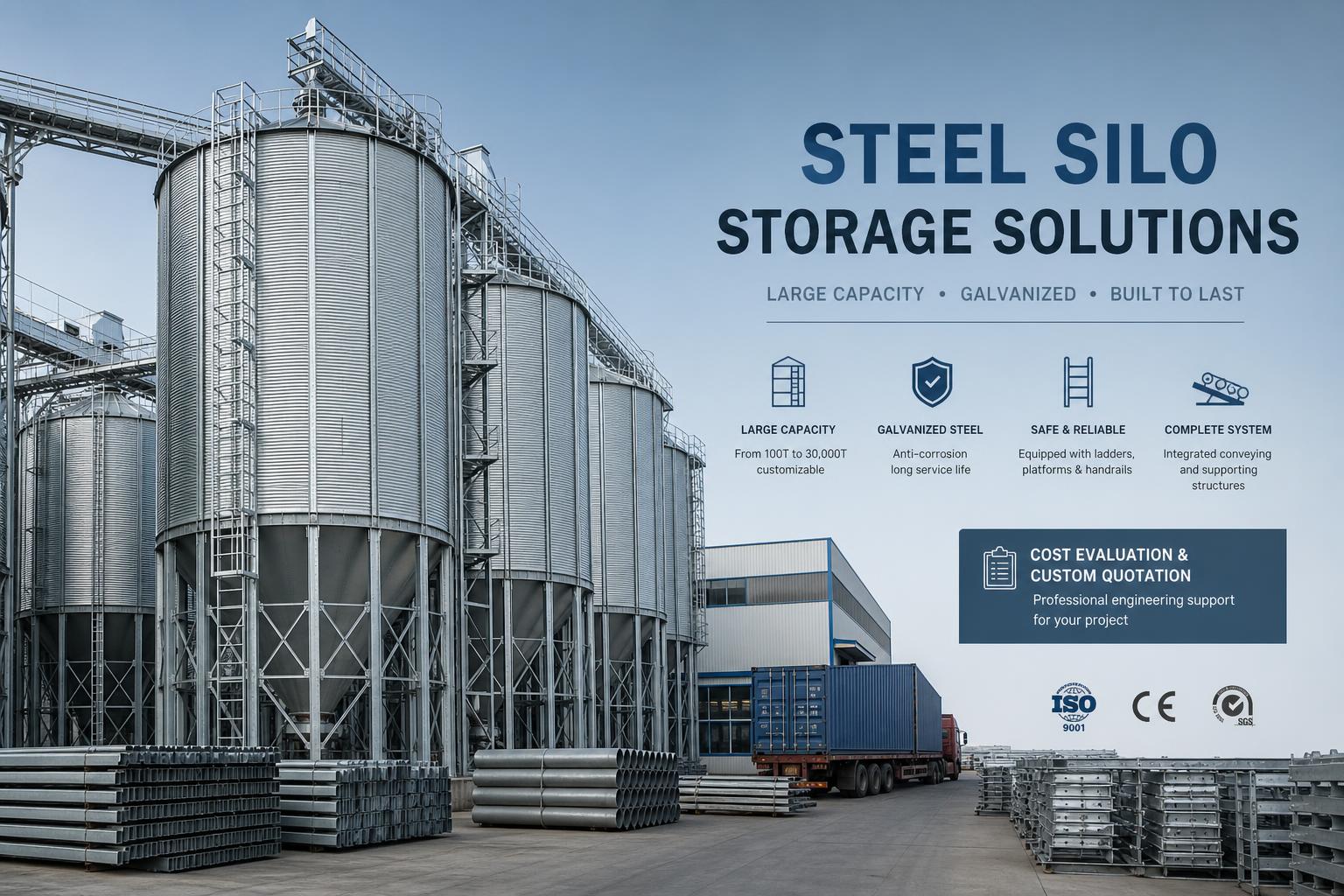
Steel Silo Procurement: What Affects Price the Most?
When sourcing a steel silo, price is never shaped by material costs alone.
The final quotation usually reflects capacity, steel grade, design complexity, fabrication standards, transport distance, and installation scope.
That is why steel silo procurement needs more than price comparison.
A lower initial offer may hide weaker corrosion protection, simplified structural design, or missing site services.
In practical purchasing work, the most useful question is simple: what exactly is driving the steel silo price?
Shandong Guokai International Trade Co., Ltd. develops, manufactures, and supplies steel storage silos for grain, building materials, electric power, and chemical applications.
With that market background in mind, this article breaks down the main cost factors behind a steel silo project.
The goal is to help purchasing teams compare offers clearly, control budget risk, and select a solution with long-term value.
1. Silo Capacity and Dimensions Set the Base Price
Capacity is usually the first price driver in any steel silo quotation.
A larger steel silo needs more steel plates, stronger support members, and a more demanding foundation interface.
But cost does not rise in a perfectly straight line.
Diameter, height, discharge layout, and storage medium all influence the structure.
For example, a tall narrow silo may require different reinforcement than a wider, lower configuration.
This affects steel consumption, fabrication time, and erection complexity.
- Higher tonnage usually means a higher total project price.
- Unusual dimensions can increase the unit cost of the steel silo.
- Low turnover storage may allow simpler design choices.
- High-frequency loading cycles often require stronger structural consideration.
At quotation stage, the storage volume alone is not enough. Basic operating conditions should be defined early.
2. Steel Grade and Corrosion Protection Matter More Than Many Expect
Raw material quality directly shapes steel silo cost and service life.
Different steel grades offer different strength, ductility, and environmental resistance.
A silo used for grain in a dry region is not priced like one exposed to chemical dust or coastal humidity.
Galvanized coating thickness also changes the quotation in a noticeable way.
The same applies to paint systems, anti-corrosion treatment, and interior surface requirements.
In many projects, the cheapest material option creates higher maintenance cost later.
This is especially true when the stored material is abrasive, moist, or chemically active.
A better way to judge steel silo value is to match the material specification with the actual operating environment.
Questions worth confirming with suppliers
- What steel standard is being used?
- What is the zinc coating thickness or paint specification?
- Is the quoted steel silo designed for corrosive or dusty conditions?
- Are material certificates included in the offer?
3. Design Complexity Changes Both Manufacturing and Installation Cost
Two steel silo projects with similar capacity can still show very different prices.
The reason is often design complexity.
Cone-bottom silos, flat-bottom silos, multiple discharge points, level monitoring, aeration systems, and explosion protection all add cost.
The same goes for ladders, platforms, roof access, maintenance ports, and insulation requirements.
These items may look secondary, but they affect fabrication detail and field assembly time.
In some industrial sites, buyers compare silo prices while one quotation excludes supporting accessories.
That creates a misleading price gap.
A complete steel silo offer should clarify what is included in mechanical, electrical, and safety-related scope.
This is also where lifecycle thinking becomes useful, especially for plants planning future expansion.
4. Fabrication Standards and Quality Control Influence Real Cost
Manufacturing quality is one of the less visible parts of steel silo pricing.
Still, it has a direct effect on fit-up accuracy, installation speed, and long-term operating stability.
Precision cutting, rolling, welding, bolt hole processing, and surface treatment all require production control.
When a supplier follows stricter standards, the steel silo price may be higher, but field problems are usually lower.
This includes fewer alignment issues, less rework, and better sealing performance.
From a procurement angle, quality documents are not just paperwork.
They are part of cost control because they reduce uncertainty.
In projects with strict compliance needs, this can be a deciding factor during supplier evaluation.
Useful checkpoints before order confirmation
- Review fabrication drawings and tolerance control.
- Ask for inspection procedures and material traceability.
- Confirm packing method for steel silo panels and accessories.
- Check whether trial assembly or pre-delivery inspection is available.
5. Transportation and Site Conditions Often Shift the Final Quote
Freight is a major part of steel silo procurement, especially for overseas or remote projects.
Panel size, total weight, packing density, port access, and inland delivery all affect logistics cost.
More noticeably, the installation site itself can push the project price upward.
Limited crane access, high wind zones, restricted working hours, and difficult foundations create additional work.
Some suppliers quote only ex-works manufacturing, while others include delivery and on-site guidance.
That means steel silo prices must be compared on the same scope basis.
In broader storage planning, some buyers also compare related equipment such as Oil Storage Tanks to align transport and installation schedules.
That kind of coordination can improve procurement efficiency across a plant project.
6. Installation Scope and After-Sales Support Should Be Priced Clearly
Installation services are often handled differently from one supplier to another.
Some provide only drawings and remote guidance.
Others provide supervisors, full erection teams, commissioning support, and operator training.
These differences can strongly affect the total steel silo price.
The same is true for warranty response, spare parts availability, and technical follow-up.
A supplier with proven project support may not be the lowest bidder, but often reduces operational risk.
This is important when the steel silo is linked to continuous production.
Downtime cost can easily outweigh small savings made during purchasing.
7. How to Compare Steel Silo Quotations More Accurately
A practical comparison method is to standardize the inquiry before suppliers quote.
That reduces unclear assumptions and makes steel silo pricing easier to evaluate.
When reviewing bids, ask every supplier to respond to the same technical sheet.
That sheet should define material type, density, moisture, throughput, environmental conditions, and required accessories.
Without that discipline, steel silo price comparisons usually become unreliable.
8. Focus on Total Procurement Value, Not Just the Lowest Number
The biggest factors behind steel silo price are usually capacity, material specification, design detail, fabrication quality, logistics, and installation support.
Each one can change the quotation in meaningful ways.
More importantly, each one can affect operating reliability after delivery.
A smart steel silo purchasing decision comes from matching price with technical fit, service scope, and long-term cost control.
That is the point where a quotation becomes a useful business decision instead of a simple number.
For projects involving multiple storage systems, it can also help to review supporting products such as Oil Storage Tanks within the same planning cycle.
Start with a clear specification, compare like-for-like offers, and use the steel silo quote to judge value across the full project lifecycle.
Related Posts
- ▶ How a Dry Bulk Silo Handles Pneumatic Filling and Gravity Discharge
- ▶ What Is a Dry Bulk Silo, and When Does a Factory Need One?
- ▶ Can dry bulk storage silos be integrated into existing PLC-controlled batching systems?
- ▶ Do dry bulk silos designed for API 650 compliance meet ASME Section VIII requirements?
- ▶ Is almacénamiento de sólidos a granel en silos de acero inoxidable viable for small-scale agrochemical distributors?
- ▶ How do vibration-based level sensors perform in stainless steel silos with powder coating?
Online Message