





Is foundation design different for stainless steel silos versus carbon steel silos of equal capacity?
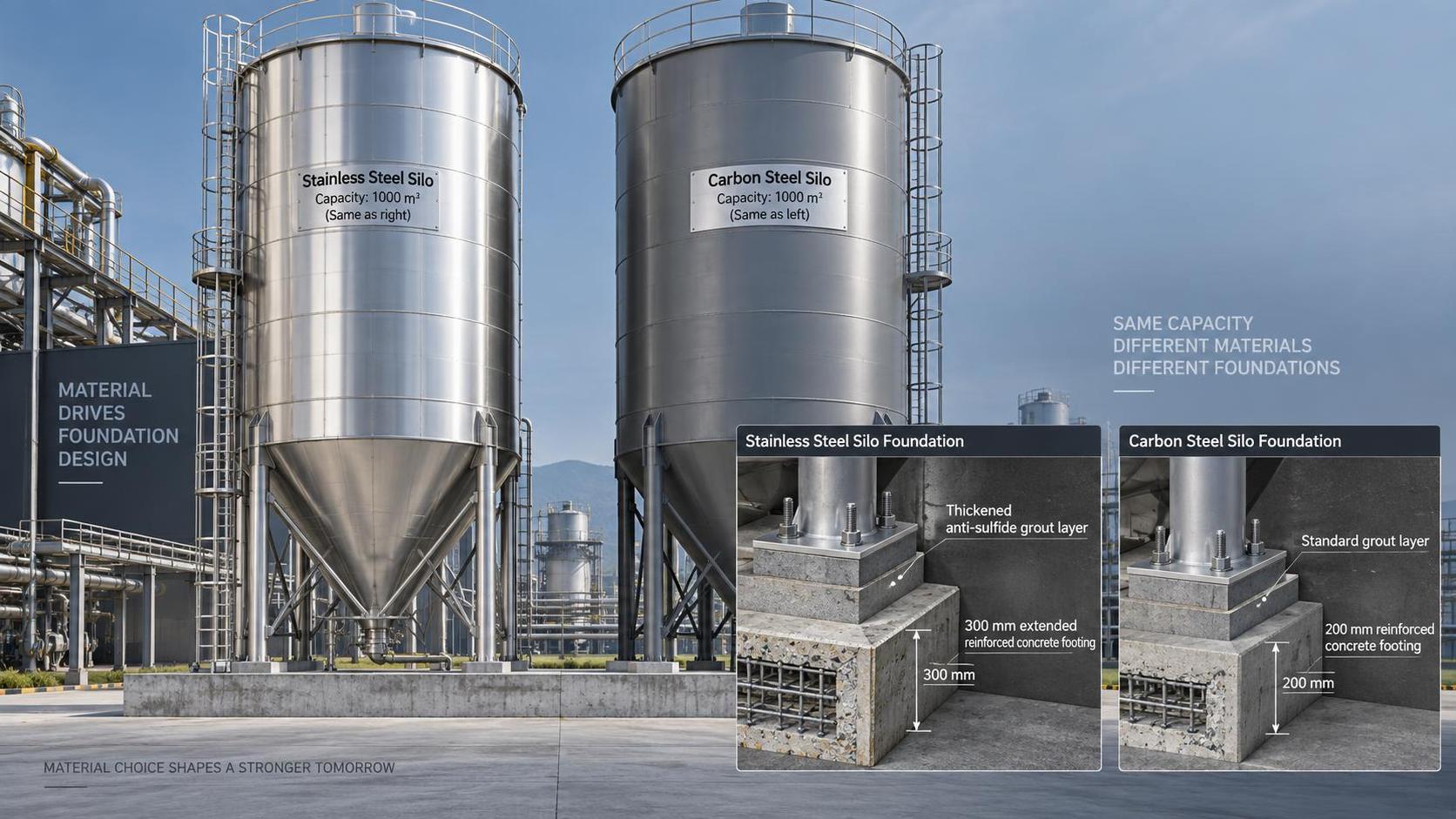
Yes—foundation design for stainless steel silos differs from that for carbon steel silos of equal capacity, though the differences are not always obvious at first glance. The divergence arises not from gross structural load differences—since both silos hold the same volume and material density—but from how material properties influence long-term behavior, thermal response, and interface interaction with supporting soil and concrete. Project managers overseeing silo installation often assume foundation specifications can be reused across material types; this assumption risks underestimating settlement sensitivity, differential expansion effects, or corrosion-related interface degradation over time.
Stainless steel’s higher modulus of elasticity (typically 190–200 GPa versus 200 GPa for carbon steel in some grades, but more critically its lower coefficient of thermal expansion—about 16–17 × 10−6/°C compared to 12 × 10−6/°C for carbon steel—and its immunity to rust-induced bond deterioration at the base plate-concrete interface introduce distinct mechanical and durability considerations. These factors shift the emphasis in foundation design from pure static bearing capacity toward long-term compatibility, restraint behavior, and interface longevity—especially in humid, saline, or chemically aggressive environments common in grain terminals, power plant fly ash handling, or chemical bulk storage facilities.
Key Design Implications Rooted in Material Behavior
Three interrelated material-driven effects govern how foundations must be adapted:
- Thermal expansion mismatch during seasonal cycling: Stainless steel expands more than carbon steel under identical temperature fluctuations. When anchored rigidly to a concrete mat, this can generate higher localized shear stresses at anchor embedment zones—particularly where silo skirts meet the foundation. Over decades, repeated cycles may fatigue grout or crack perimeter concrete if reinforcement layout doesn’t account for restrained expansion.
- Reduced long-term bond degradation at the base plate interface: Carbon steel base plates corrode over time, especially where moisture accumulates beneath skirt welds or in poorly drained pads. This corrosion weakens mechanical interlock and can reduce effective bearing area. Stainless steel eliminates this mechanism—so foundation designers cannot rely on conservative assumptions built into legacy carbon steel silo standards (e.g., EN 1993-4-1 Annex D) that implicitly factor in progressive bond loss. Instead, the full theoretical contact area remains active, altering stress distribution patterns and potentially requiring revised dowel spacing or grout thickness.
- Different mass distribution due to wall thickness variation: For equivalent capacity and pressure rating, stainless steel silos often use thinner walls than carbon steel counterparts—thanks to higher yield strength (e.g., AISI 304: ~215 MPa vs. S235: ~235 MPa, but with better strain hardening). However, because stainless steel density (~7,930 kg/m³) is slightly higher than carbon steel (~7,850 kg/m³), and because wall thinning is rarely linear across height, the center of gravity and moment arm for wind/seismic loads may shift subtly. This affects overturning moment calculations and thus footing size and anchorage depth.
Where Standard Practices Fall Short
Many engineering firms apply carbon steel silo foundation templates directly to stainless steel projects—relying on generic soil reports and standard concrete grades like C30/37 without recalibrating for interface behavior. This works acceptably for short-term service or benign environments, but becomes problematic when:
- The silo sits on compressible clay or organic fill where long-term consolidation interacts with sustained vertical load—and stainless steel’s lack of corrosion-induced settlement “buffer” means initial settlement predictions remain valid for decades, not just years;
- Chemical exposure (e.g., ammonium nitrate dust, sulfuric acid mist, or wet cement powder) would accelerate carbon steel corrosion but leave stainless steel unaffected—making the foundation’s durability dependent entirely on concrete quality and detailing, not passive metal degradation;
- Adjacent structures or piping impose lateral restraints that interact differently with stainless steel’s stiffer, more thermally responsive shell—potentially amplifying anchor bolt tension beyond nominal design values.
In such cases, foundation reinforcement must be reviewed—not just for ultimate limit state (ULS), but for serviceability limit state (SLS) criteria including crack width control in grout zones and deflection compatibility between silo skirt and pad edge.
Practical Adjustments During Design and Construction
No universal “stainless steel foundation specification” exists—adjustments depend on site-specific geotechnical data, environmental class, and operational duty cycle. But three consistent modifications appear across validated projects:
- Grout specification refinement: Replace standard non-shrink grout with sulfate-resistant, low-permeability formulations (e.g., ASTM C1107 Type III) and specify minimum 50 mm thickness under base plates—even when carbon steel designs used 25 mm. This compensates for tighter tolerances required to prevent micro-movement at the stainless steel-concrete interface.
- Anchorage detailing revision: Increase anchor bolt embedment depth by 15–20% relative to carbon steel equivalents, particularly in high-wind or seismic zones. Use headed bolts or epoxy-set anchors instead of straight-threaded rods where possible—stainless steel’s smoother surface reduces friction-based pullout resistance.
- Footing edge detailing: Extend reinforced concrete footings beyond the silo skirt by at least 300 mm (vs. 200 mm typical for carbon steel) and add 10–12 mm diameter perimeter dowels at 200 mm c/c. This mitigates cracking from thermal expansion pushing against unreinforced edge zones.
These changes aren’t arbitrary—they respond directly to measurable performance gaps observed in field monitoring of stainless steel silos installed using carbon steel foundation specs. Settlement rates remained within predicted bounds, but localized spalling at footing edges and premature grout debonding occurred where thermal expansion wasn’t accommodated.
Integration with Silo System Selection
Material choice cascades into foundation decisions—but the reverse is also true. If site conditions demand deep piles or raft foundations due to poor bearing strata, stainless steel’s higher initial cost may be offset by reduced long-term maintenance and extended service life, making it economically viable despite foundation adjustments. Conversely, in stable, well-drained gravel sites with low thermal amplitude, the foundation differences narrow significantly—allowing greater reuse of existing carbon steel design logic.
For mineral handling applications—where abrasion resistance and hygiene matter—Mineral Powder Silos benefit particularly from stainless steel construction. Their typical operating environments (damp limestone fines, hydrated lime, or silica flour) accelerate carbon steel corrosion at discharge hoppers and transition zones. In these cases, foundation design must align with the silo’s extended design life—often 30+ years—rather than the 15–20 year horizon assumed for carbon steel units.
Verification Prior to Pour
Before casting foundation concrete, verify three items specific to stainless steel silos:
- That base plate surface finish meets Ra ≤ 3.2 μm—rougher finishes increase risk of air entrapment under grout, reducing effective bond area;
- That anchor bolt threads are fully cleaned of oil or anti-seize compound before grouting—residue inhibits chemical adhesion between grout and steel;
- That thermal expansion joints in adjacent structures (e.g., conveyor galleries or control rooms) won’t impose unintended restraint on the silo skirt during commissioning.
None of these steps require new software or exotic materials—only awareness of how stainless steel’s physical and electrochemical stability changes the boundary conditions for foundation performance. At Shandong Guokai International Trade Co., Ltd., our engineering team applies this understanding across all silo projects, ensuring foundation systems match the material’s real-world behavior—not just its nominal strength class.
Related Posts
- ▶ How a Dry Bulk Silo Handles Pneumatic Filling and Gravity Discharge
- ▶ What Is a Dry Bulk Silo, and When Does a Factory Need One?
- ▶ Can dry bulk storage silos be integrated into existing PLC-controlled batching systems?
- ▶ Do dry bulk silos designed for API 650 compliance meet ASME Section VIII requirements?
- ▶ Is almacénamiento de sólidos a granel en silos de acero inoxidable viable for small-scale agrochemical distributors?
- ▶ How do vibration-based level sensors perform in stainless steel silos with powder coating?
Online Message