





How long do dry bulk silos last when storing abrasive materials like cement or fly ash?
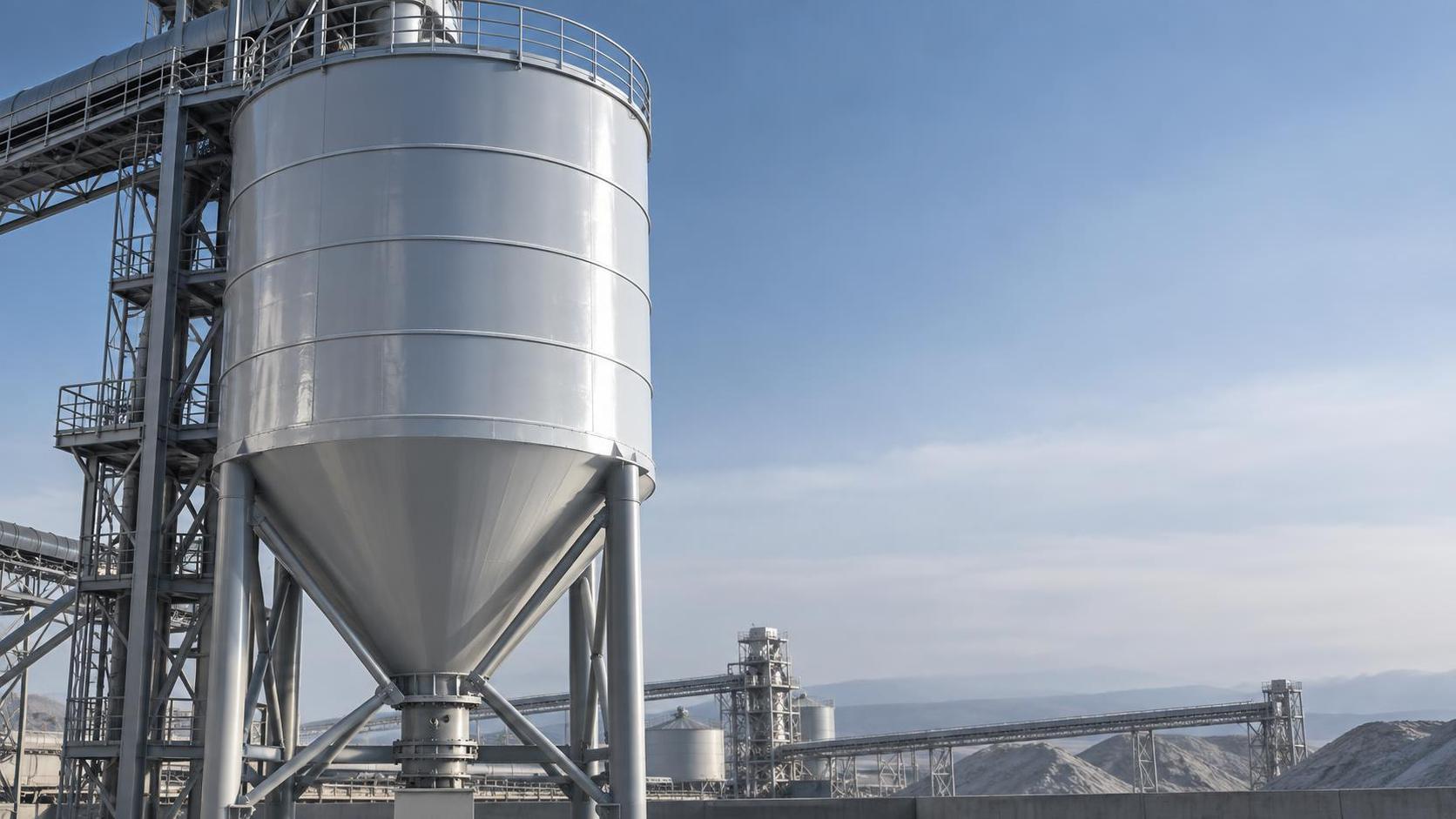
When managing large-scale material handling projects, understanding how long a dry bulk silo lasts under abrasive conditions—like cement or fly ash storage—is critical for ROI, safety, and operational continuity. Abrasive materials accelerate wear on steel silo walls, hoppers, and discharge systems, directly impacting service life. At Shandong Guokai International Trade Co., Ltd., we engineer dry bulk silos with reinforced wear-resistant linings, optimized geometry, and corrosion-resistant coatings—specifically for demanding applications in building materials, power, and chemical industries. Discover how smart design choices extend silo lifespan beyond industry averages.
A dry bulk silo storing cement or fly ash rarely fails from structural collapse—but from localized wear that compromises integrity, flow reliability, or containment. The question isn’t whether it will wear, but where, how fast, and what design variables control the rate. For project managers overseeing multi-year infrastructure investments, predicting service life isn’t about calendar years alone; it’s about quantifying wear progression against operational thresholds: when hopper wall thickness drops below safe residual limits, when outlet geometry distorts enough to cause bridging, or when liner delamination introduces contamination risk.
Cement and fly ash are not equally abrasive—but both fall into the high-wear category due to particle hardness (Mohs 5–7), angularity, and fine-grained consistency that enables deep mechanical erosion. Fly ash, especially Class C, often contains unburned carbon and reactive lime, adding chemical corrosion potential alongside mechanical wear. Cement’s alkalinity mitigates some corrosion but doesn’t reduce abrasion—and its hydration sensitivity means moisture ingress during downtime can accelerate pitting beneath surface wear. These dual mechanisms mean wear isn’t linear: early-stage erosion may appear slow, then accelerate once protective mill scale or initial coating is breached.
Standard mild steel silos (Q235 or ASTM A36) exposed to continuous cement or fly ash flow typically show measurable wall loss—0.5–1.2 mm/year—in high-velocity zones: hopper transition radii, outlet throats, and inlet impact areas. In poorly designed geometries—sharp hopper angles, undersized discharge openings, or turbulent inlet configurations—wear rates double or triple. Field data from silos operating in cement plants across Southeast Asia and Eastern Europe show median service life of 12–15 years before major refurbishment, assuming annual inspection and no catastrophic event. But “major refurbishment” isn’t uniform: replacing a worn hopper cone may cost 30–40% of new silo value, while full shell replacement is rarely economical.
The real determinant of longevity lies not in base material thickness—but in wear-path management. Thicker steel alone delays failure only marginally if abrasion remains concentrated. Effective mitigation requires redirecting energy and particles away from vulnerable surfaces. This starts at geometry: hopper angles above 60° from horizontal reduce sliding friction and particle dwell time; smooth transitions between cylindrical shell and conical hopper eliminate turbulence-induced scouring; and offset inlet placement avoids direct impingement on opposite walls. These aren’t optional optimizations—they’re load-path controls that shift wear from unpredictable hotspots to predictable, inspectable zones.
Liner selection further separates functional life from nominal life. Rubber liners resist impact but degrade under sustained heat and UV exposure common in outdoor installations. Ceramic tiles offer extreme hardness but suffer from thermal expansion mismatch and brittle fracture under vibration. Polyurethane composites provide balanced abrasion resistance and flexibility but require precise bonding and edge sealing—failure points often traced to installation gaps rather than material limits. The most durable field-proven solution for cement and fly ash is weld-overlay hardfacing (e.g., chromium carbide or tungsten carbide alloys) applied to critical zones. Applied post-fabrication, it delivers 3–5× the wear resistance of base steel—without altering structural calculations—and allows selective renewal without full component replacement.
Corrosion protection interacts critically with abrasion resistance. Zinc-rich primers alone fail rapidly under abrasive flow—the zinc layer erodes within months, exposing bare steel. Epoxy phenolic coatings withstand chemical attack but chip under particle impact. The optimal approach combines barrier and sacrificial protection: a thermally sprayed aluminum (TSA) undercoat (100–150 µm) provides galvanic protection and thermal stability, topped with a polyurethane topcoat formulated for abrasion resistance (e.g., 80 Shore D hardness). This system maintains integrity through 15+ years in fly ash service—provided surface preparation meets SSPC-SP10/NACE No. 2 standards before application. Skipping blast cleaning or allowing humidity during coating leads to premature adhesion loss—not gradual wear, but sudden delamination.
Inspection protocols determine whether wear remains manageable or becomes a liability. Ultrasonic thickness testing (UT) at fixed grid points is essential—but insufficient if limited to vertical shell locations. Critical wear occurs in hopper cones, particularly along the 30–60° zone from apex, where flow velocity peaks. Project managers should mandate UT mapping of full hopper surfaces every 24 months, not just annual visual checks. Thermographic imaging can detect subsurface delamination in lined systems before visible cracking appears. And flow performance monitoring—tracking discharge time consistency, required air pressure for fluidization, or frequency of manual interventions—often signals wear progression earlier than physical measurement.
Lifecycle cost analysis reveals why upfront engineering matters more than initial price. A $280,000 silo with standard steel and basic coating may require $95,000 in hopper replacement at year 10—and another $70,000 at year 15. A $340,000 silo with optimized geometry, TSA+polyurethane coating, and hardfaced hopper outlets typically defers major intervention until year 18–20, with lower maintenance labor and zero unplanned shutdowns. The difference isn’t just $60,000 capital outlay—it’s 3–5 fewer days of production loss over 20 years, avoided emergency procurement premiums, and reduced safety incident risk from confined-space repairs.
Material variability also affects predictability. Fly ash composition varies by coal source and boiler type—high-calcium ash increases reactivity; high-carbon ash increases combustibility risk during silo cleaning. Cement fineness (Blaine surface area) directly correlates with wear rate: 350 m²/kg cement wears steel 1.7× faster than 280 m²/kg material under identical flow conditions. Project specifications must define not just material type—but key physical parameters, so silo design accounts for actual service severity.
For applications where long-term reliability is non-negotiable—such as clinker feed silos feeding kiln lines or fly ash storage supporting flue gas desulfurization—design redundancy becomes necessary. Dual outlet systems with staggered wear zones, or modular hopper sections allowing phased replacement, extend functional life without halting operations. These features increase complexity but align with total cost of ownership logic: a single outage in a cement plant can cost $120,000/hour in lost output.
One practical reference point: the Soybean Steel Silo platform demonstrates how geometry-first thinking applies across material classes—even where abrasion isn’t dominant. Its tapered hopper design and seamless shell-to-hopper transition were validated in grain handling, but the same principles govern cement flow dynamics. The underlying logic transfers: flow efficiency reduces residence time, which reduces particle-wall contact duration, which directly suppresses wear accumulation.
Ultimately, silo lifespan under abrasive service isn’t predetermined—it’s engineered. It depends less on generic “steel quality” and more on how well the system manages kinetic energy, directs flow, isolates corrosion drivers, and enables verification. Project managers who treat wear as an inevitable decay process miss the opportunity to control it. Those who integrate wear-path analysis into structural specification—from inlet location to hopper angle to liner metallurgy—gain not just longer service life, but predictable maintenance cycles, lower lifecycle cost, and demonstrable safety assurance.
Related Posts
- ▶ How a Dry Bulk Silo Handles Pneumatic Filling and Gravity Discharge
- ▶ What Is a Dry Bulk Silo, and When Does a Factory Need One?
- ▶ Can dry bulk storage silos be integrated into existing PLC-controlled batching systems?
- ▶ Do dry bulk silos designed for API 650 compliance meet ASME Section VIII requirements?
- ▶ Is almacénamiento de sólidos a granel en silos de acero inoxidable viable for small-scale agrochemical distributors?
- ▶ How do vibration-based level sensors perform in stainless steel silos with powder coating?
Online Message