





Do stainless steel silos resist corrosion better than carbon steel in humid bulk storage environments?
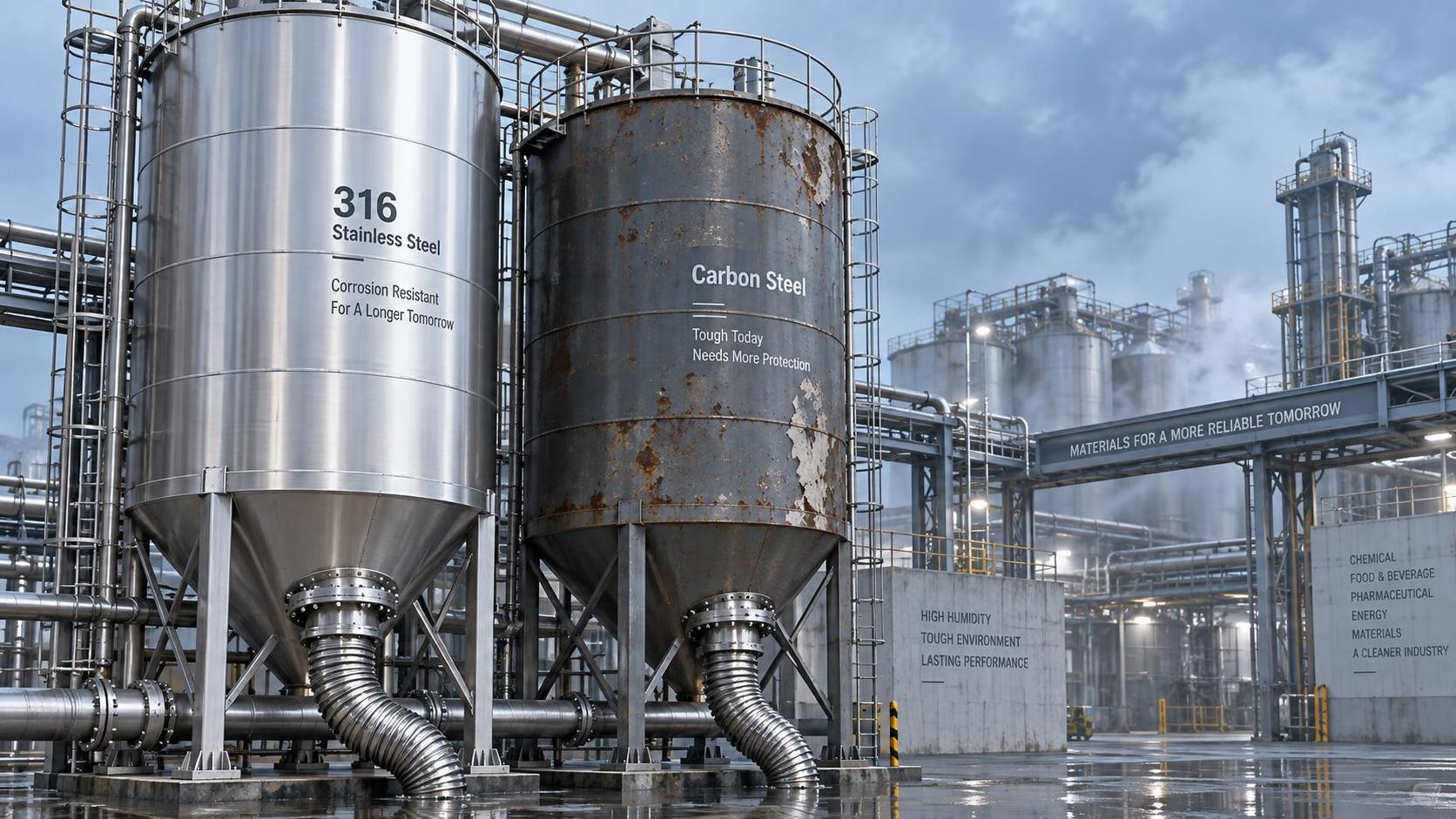
When humidity clings to the air like a second skin—condensing on metal surfaces, pooling in seams, and accelerating electrochemical reactions—the question isn’t *if* corrosion will occur, but *how fast*, and *what it will cost*. For technical assessors overseeing bulk storage infrastructure in grain terminals, chemical blending facilities, or thermal power plants, material choice isn’t theoretical. It’s a frontline decision with decades-long consequences.
Stainless steel silos don’t just *delay* corrosion—they reframe the entire lifecycle calculus. Not because they’re impervious (no metal is), but because their resistance emerges from atomic structure, not surface coatings. Carbon steel relies on paint, zinc, or epoxy to hold back moisture—a defense that degrades, chips, or fails at welds and abrasion points. Stainless steel embeds corrosion resistance into its alloy matrix: chromium forms a self-healing oxide layer; molybdenum tightens that barrier against chlorides and organic acids; nickel stabilizes austenite for uniform performance under thermal cycling. That difference becomes decisive where relative humidity regularly exceeds 75%, ambient temperatures swing between 5°C and 40°C, and stored materials—like damp barley, ammoniated fertilizers, or fly ash—introduce localized acidity or hygroscopic salts.
Consider a typical inland grain terminal in eastern China. Summer brings monsoon-laden air; winter brings condensation inside unheated silos. Carbon steel silos installed there often show visible rust streaking within 3–5 years—not just on exterior walls, but along internal stiffeners and hopper transitions where moisture lingers. Maintenance crews report recurring touch-ups near discharge outlets, increased inspection frequency, and unplanned shutdowns for patch welding. By year 12, structural integrity assessments begin flagging pitting depth exceeding 1.2 mm in critical zones—triggering costly reinforcement or replacement planning. Stainless steel silos in identical environments? Surface inspections reveal only minor discoloration—no active pitting, no flaking, no loss of wall thickness measurable by ultrasonic testing over a decade.
That durability stems from metallurgical intent—not marketing claims. Grade 304 stainless offers solid general-purpose resistance, but in humid, chloride-adjacent settings (e.g., coastal feed mills or silos handling salted additives), Grade 316—with its 2–3% molybdenum content—delivers markedly better performance. At Shandong Guokai International Trade Co., Ltd., we specify alloy selection based not on catalog defaults, but on site-specific environmental profiling: dew point history, airborne salinity levels, stored material pH range, and cleaning protocol aggressiveness. A silo holding malted barley in Shandong’s humid spring months faces different stressors than one storing dry limestone powder in Inner Mongolia’s arid climate—even if both are “humid” on paper. Our engineers cross-reference ASTM G48 (pitting corrosion testing) and ISO 9223 (corrosivity classification) data—not just to select material, but to validate design margins.
Fabrication matters as much as composition. Welding stainless steel improperly—using carbon steel tools, skipping post-weld pickling, or allowing iron contamination—can create micro-galvanic cells that initiate crevice corrosion faster than bare carbon steel would corrode. We use orbital TIG welding for critical joints, perform acid passivation on all internal surfaces post-assembly, and verify oxide layer continuity via ferroxyl testing. These aren’t optional extras; they’re non-negotiable steps to preserve the alloy’s inherent advantage. A poorly fabricated stainless silo performs worse than a well-maintained carbon one—and undermines trust in the entire material class.
Then there’s the matter of total cost of ownership. Yes, stainless steel silos carry higher upfront investment—typically 2.5–3.5× the cost of equivalent carbon steel structures. But technical assessors know the real metric isn’t sticker price—it’s cost per ton-year of safe, uninterrupted storage. When you factor in reduced inspection labor (no annual coating surveys, no holiday detection scans), eliminated recoating cycles (every 5–7 years for carbon steel), lower downtime risk (no emergency repairs during harvest windows), and extended service life (30+ years vs. 15–20 for carbon steel under similar conditions), the breakeven point often arrives before year 10. And that doesn’t include secondary savings: consistent product purity (no rust particulates contaminating food-grade barley), lower insurance premiums (reduced fire and structural failure risk), and simplified regulatory compliance (fewer corrosion-related deviations in GMP or ISO 22000 audits).
One practical reality many overlook: stainless steel doesn’t eliminate maintenance—it changes its nature. You won’t be sandblasting and repainting every half-decade. Instead, you’ll inspect for mechanical damage, verify gasket integrity at access hatches, and monitor for biofilm buildup in humid zones where condensation meets organic residue. That shift—from reactive remediation to predictive stewardship—aligns with modern asset management philosophies. It also means your team spends less time managing decay and more time optimizing flow, monitoring quality, and planning capacity.
Which brings us to application nuance. Not every silo needs full 316 stainless construction. Hybrid approaches—stainless steel hoppers and discharge sections paired with carbon steel upper shells—deliver targeted protection where corrosion risk peaks (moisture accumulation + abrasive flow), while controlling capital expenditure. Or consider Barley Steel Silo configurations optimized for high-moisture cereal storage: double-skin insulation to suppress condensation, sloped internal liners to minimize residue retention, and seamless transition zones between materials to prevent galvanic coupling. These details reflect deep operational understanding—not generic engineering.
Still, skepticism persists—and rightly so. Some assessors cite isolated failures: stainless silos showing staining after five years, or unexpected pitting near manways. In nearly every verified case, root cause analysis traced back to either improper alloy selection (e.g., using 304 where 316 was warranted), fabrication flaws (inadequate cleaning before welding), or operational misuse (aggressive caustic cleaning without rinsing, or storing highly acidic by-products beyond design specs). Corrosion rarely lies—it reveals exactly where assumptions broke down.
What’s clear is this: in humid bulk storage environments, stainless steel silos don’t merely *resist* corrosion better than carbon steel—they resist it *differently*. Carbon steel fights moisture with barriers; stainless steel integrates resistance into its identity. One degrades visibly, predictably, and repairably. The other degrades invisibly, slowly, and insidiously—unless you understand how to preserve its passive layer. That understanding—of metallurgy, environment, fabrication, and operation—is what separates durable infrastructure from deferred failure.
For technical assessors weighing long-term resilience, the choice isn’t really between two metals. It’s between managing decay—or designing for continuity. And continuity starts not with a spec sheet, but with asking the right questions: What’s the actual chloride load? Where does condensation pool? How aggressive are cleaning agents? What’s the consequence of a 48-hour unplanned outage? Answer those—not just “which material is stronger?”—and the path forward clarifies itself. At Shandong Guokai, we build silos that answer those questions before steel hits the shop floor. Because infrastructure shouldn’t be maintained. It should be trusted.
Related Posts
- ▶ Sizing a Dry Bulk Silo Around Delivery Loads and Production Demand
- ▶ How a Dry Bulk Silo Handles Pneumatic Filling and Gravity Discharge
- ▶ What Is a Dry Bulk Silo, and When Does a Factory Need One?
- ▶ Can dry bulk storage silos be integrated into existing PLC-controlled batching systems?
- ▶ Do dry bulk silos designed for API 650 compliance meet ASME Section VIII requirements?
- ▶ Is almacénamiento de sólidos a granel en silos de acero inoxidable viable for small-scale agrochemical distributors?
Online Message