





How does moisture content above 12% impact flowability in dry bulk storage silos?
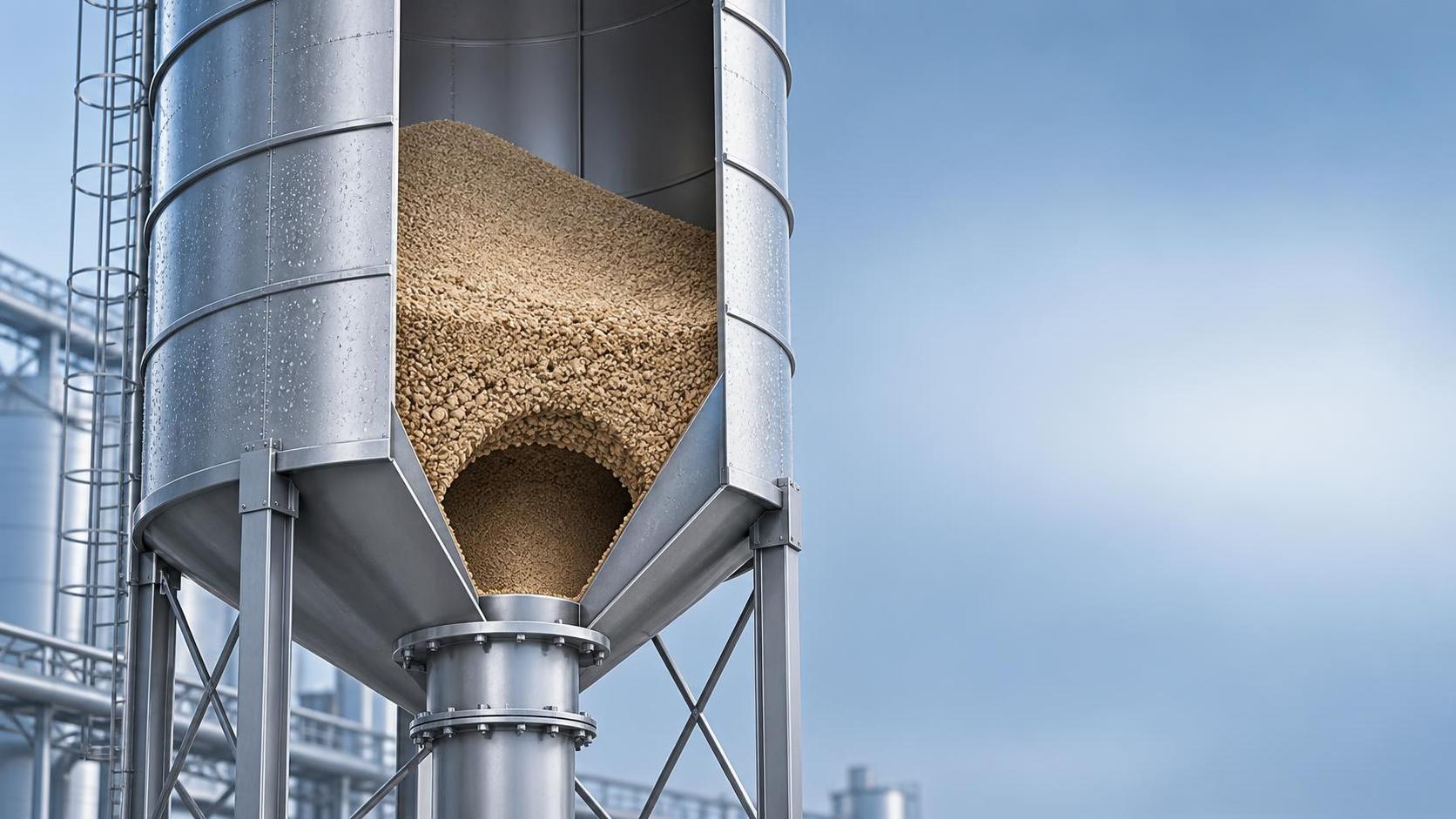
Moisture content above 12% isn’t just a number on a lab report—it’s the tipping point where many dry bulk storage operations shift from reliable flow to unpredictable stoppages. For operators managing steel silos in grain handling, cement distribution, coal stockpiling, or chemical batching, this threshold marks where material behavior changes fundamentally—not gradually, but often abruptly.
The 12% figure isn’t arbitrary. It reflects a practical convergence of material science and field experience: below this level, most hygroscopic powders and granules retain enough internal friction and particle separation to maintain mass flow under gravity. Above it, capillary forces, surface adhesion, and localized dissolution begin dominating over gravitational shear. The result? Not slower flow—but failed flow mechanisms entirely.
Why 12% Triggers Flow Failure—Not Just Slowing
Flowability in dry bulk storage depends less on average moisture and more on how water distributes across particle surfaces and interstitial spaces. At ≤12%, moisture typically exists as adsorbed monolayers—thin, discontinuous films that don’t bridge particles. But once moisture climbs past that point, three physical changes accelerate simultaneously:
- Capillary bridging intensifies: Liquid menisci form between adjacent particles, generating strong attractive forces (up to several kilopascals) that resist separation during discharge.
- Interparticle friction increases nonlinearly: Wetted surfaces increase static friction coefficients by 30–100%, depending on material type—enough to stall funnel flow even in steep-walled silos.
- Localized agglomeration begins: In materials like fly ash, limestone fines, or soybean meal, moisture enables micro-caking long before visible clumps appear. These weak agglomerates break under shear in conveyors—but re-form instantly in stagnant zones inside silos.
This isn’t theoretical. Field data from grain terminals in humid climates consistently show discharge interruptions rising sharply between 11.5% and 13.5% moisture—especially during seasonal transitions when ambient humidity fluctuates rapidly. Operators often misattribute these events to “silo design flaws” or “worn discharge equipment,” when the root cause is moisture-driven rheology change occurring upstream, during storage.
What Actually Happens Inside the Silo
When moisture exceeds 12%, flow failure rarely manifests as uniform slowing. Instead, it appears in three distinct, operationally disruptive modes:
Bridging occurs at the outlet or hopper transition—where a stable arch forms across the opening, completely blocking flow. This is especially common with fine, angular particles (e.g., ground gypsum or pulverized coal) stored in conical hoppers without adequate slope angles or flow aids.
Ratholing happens when only a central column discharges while material near the walls remains static—forming a vertical channel surrounded by compacted, moisture-locked cake. This is typical in flat-bottom silos or when material has been stored for extended periods without agitation.
Caking against walls is often overlooked. Moisture migrates toward cooler silo surfaces overnight or during temperature drops. The resulting wall-bound layer can be millimeters thick—but mechanically bonded enough to restrict withdrawal volume by 15–25% before any bridging occurs. Unlike bridging, this doesn’t trigger alarms; it silently reduces effective capacity and alters withdrawal patterns.
Material-Specific Sensitivity Matters More Than the 12% Rule
The 12% benchmark applies most directly to moderately cohesive, medium-density materials like wheat, corn, cement clinker, or lignite coal. But real-world dry bulk storage involves wide variation:
- Materials with high clay or fine silt content (e.g., some bentonites or wet-milled limestone) may lose flowability well below 10%—because surface area and ion exchange dominate over moisture volume.
- Hydrophobic materials like polyethylene pellets or certain plastic resins remain free-flowing up to 16–18%, but become sticky and electrostatically clinging beyond that—causing different kinds of blockages.
- Materials with soluble salts (e.g., ammonium nitrate fertilizer or sodium sulfate) can deliquesce at surprisingly low moisture levels—sometimes as low as 7–9%—if ambient RH exceeds their critical relative humidity.
So while 12% serves as a useful operational red line for general planning, relying on it alone invites misdiagnosis. What matters operationally is not the absolute number—but whether moisture has crossed the *material-specific* threshold where interparticle forces exceed gravitational driving force under your actual silo geometry and discharge rate.
Mitigation Isn’t About Drying—It’s About Managing Water Distribution
Many operators instinctively reach for drying systems when flow issues arise. But adding heat or airflow downstream doesn’t fix moisture already distributed unevenly inside a filled silo—and can even worsen segregation or dust generation. More effective strategies focus on control points where moisture interacts with storage conditions:
First, isolate moisture sources. Rain ingress through roof seams, condensation on cold walls during humid nights, or vapor migration from damp foundations are far more common than over-moist feedstock. A thermal imaging survey of a filled silo often reveals unexpected cold spots—indicating condensation-prone zones needing insulation or ventilation redesign.
Second, adjust withdrawal patterns. For materials prone to ratholing, intermittent high-rate discharge (even briefly) breaks up stagnant zones better than continuous low-rate withdrawal. This works because dynamic shear disrupts weak agglomerates before they consolidate—a principle built into modern bin activators and fluidized discharge systems.
Third, match silo geometry to moisture risk. Steep conical hoppers (>60°) reduce bridging risk but increase wall pressure. Mass-flow designs require careful slope and surface finish selection—not just angle. For materials consistently stored above 12% moisture, engineered solutions like 800-1500 Tons Silos incorporate reinforced hopper liners and adjustable discharge orifices calibrated for higher-cohesion materials.
Real-World Checks You Can Do Today
You don’t need lab equipment to assess moisture-related flow risk. Try these field-verifiable checks:
- The “pinch test”: Squeeze a handful tightly, then open your palm. If it holds shape or crumbles slowly—not freely—moisture is likely above critical cohesion thresholds.
- The “drop test”: Let material fall freely from waist height onto a hard surface. If it forms a defined pile with steep sides (angle >45°), cohesion is elevated—even if lab reports say moisture is “within spec.”
- The “wall tap”: Gently tap the silo wall near the outlet during discharge. A dull thud—not a sharp ring—suggests caked material adhering to the interior surface.
These aren’t substitutes for moisture measurement—but they reveal what moisture *does*, not just what it *is*. And in dry bulk storage, behavior—not numbers—dictates operability.
When to Reconsider Your Silo System
If you’re regularly seeing bridging, ratholing, or wall buildup despite consistent feedstock moisture below 12%, the issue may lie in system interaction—not material alone. Temperature cycling, vibration transmission from nearby conveyors, or even seasonal barometric shifts can mobilize and redistribute moisture within stored material over time. In such cases, upgrading to purpose-engineered steel silos—designed for thermal stability, controlled discharge dynamics, and material-specific wall finishes—addresses the root cause, not just symptoms.
For mid-capacity applications requiring robustness across variable moisture conditions, systems like the 800-1500 Tons Silos integrate structural reinforcement with flow-optimized geometries—providing margin where standard designs falter.
Ultimately, moisture above 12% doesn’t “reduce” flowability—it redefines it. The goal isn’t to keep moisture below that number at all costs, but to understand how your specific material behaves at that boundary—and engineer storage accordingly.
Related Posts
- ▶ How a Dry Bulk Silo Handles Pneumatic Filling and Gravity Discharge
- ▶ What Is a Dry Bulk Silo, and When Does a Factory Need One?
- ▶ Can dry bulk storage silos be integrated into existing PLC-controlled batching systems?
- ▶ Do dry bulk silos designed for API 650 compliance meet ASME Section VIII requirements?
- ▶ Is almacénamiento de sólidos a granel en silos de acero inoxidable viable for small-scale agrochemical distributors?
- ▶ How do vibration-based level sensors perform in stainless steel silos with powder coating?
Online Message