





How Spiral Steel Silos Are Manufactured for High-Capacity Grain Storage
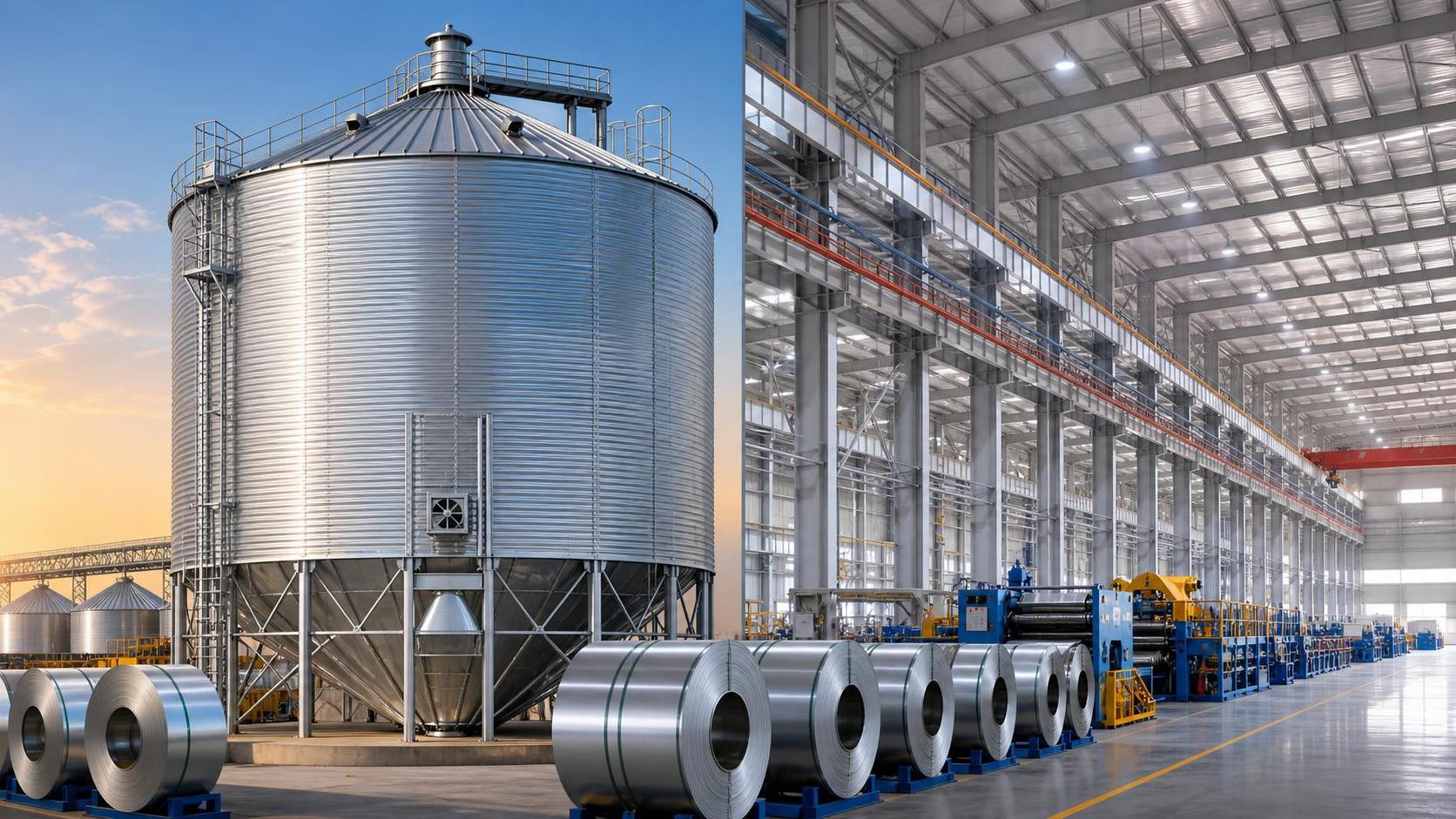
A spiral steel silo is manufactured by continuously forming galvanized steel strip into a cylindrical shell, then locking each turn into a helical seam under controlled pressure. The principle sounds straightforward, but storage reliability depends on much more than the visible spiral line. Steel grade, strip thickness, seam geometry, foundation accuracy, corrosion protection, roof design, and discharge details all influence whether a high-capacity grain silo remains safe, dry, and operable over years of loading cycles.
For a grain storage project, the manufacturing method should be reviewed as part of the structural system, not as a production detail. A silo may look uniform from the outside while carrying weaknesses in its seams, wall transitions, or sealing interfaces. The right assessment starts with understanding how the shell is made and where quality control must be applied.
How a Spiral Steel Silo Shell Is Formed
The defining feature of a spiral steel silo is its continuous helical seam. Instead of stacking prefabricated wall panels and bolting horizontal rings together, a forming machine feeds steel coil through a set of rollers. The steel strip is shaped progressively into a curved profile, and the two edges of each new turn are folded and mechanically interlocked with the preceding turn.
The result is a cylindrical shell with a visible spiral seam running from the base toward the roof. Depending on the project design, the shell may be produced at ground level and raised during assembly, or formed directly into its final vertical position with specialized equipment. This method reduces the number of conventional bolted wall joints, but it does not eliminate the need for careful joint control. It simply changes where the critical checks are made.
The basic production sequence usually includes:
- inspection and preparation of steel coil;
- continuous roll forming of the strip profile;
- mechanical locking of the spiral seam;
- dimension control for diameter, roundness, and vertical alignment;
- integration of openings, reinforcements, roof structures, and discharge components;
- coating repair and final sealing checks where attachments interrupt the shell.
The seam is not merely a connection line. It contributes to shell stiffness and affects how the wall responds to stored grain pressure. A properly formed seam should be consistent in shape and engagement along the full circumference. Irregular seam compression, damaged coating, strip-edge distortion, or poor alignment can create local points that deserve closer review before commissioning.
Material Preparation Is Where Long-Term Performance Begins
Steel coil selection is often treated as a purchasing item, yet it is one of the first engineering decisions. The material must be suitable for forming, structurally adequate for the design loads, and protected against the expected storage environment. Grain storage introduces more than static vertical weight. The wall is exposed to lateral grain pressure, filling impact, discharge flow patterns, wind, thermal movement, roof loads, and sometimes abrasive dust.
Galvanized steel is widely used because the zinc layer provides practical corrosion protection. Still, “galvanized” is not a complete specification. The required coating mass, base steel thickness, yield properties, surface condition, and treatment of cut or worked edges should be defined in the project documentation. Where humidity is high, grain is stored for extended periods, or fertilizer and chemical dust may be present nearby, the corrosion assessment needs to be more conservative.
A common mistake is to compare silos only by nominal capacity and wall thickness. Thickness matters, but it is not a substitute for engineering verification. A larger diameter changes wall stress patterns. A taller shell increases vertical load. Hopper supports introduce concentrated loads. Openings for aeration ducts, access doors, level sensors, and conveyors interrupt the shell and may require local reinforcement. The useful question is not “How thick is the steel?” but “How has the complete structure been designed for its actual operating condition?”
The Spiral Seam: Strength, Sealing, and Limits
A continuous seam can provide a robust connection when it is correctly formed and supported by a suitable structural design. The manufacturing machine must maintain stable feed, pressure, alignment, and seam geometry. Variations in coil width or material properties can affect forming behavior, which is why incoming material inspection and in-process monitoring are relevant.
Sealing performance requires a separate discussion. The mechanical seam itself is not automatically a guarantee against moisture ingress. Rainwater commonly finds its way through poorly detailed roof penetrations, wall openings, transitions around access points, or interfaces between the shell and foundation. In grain storage, even a small and persistent water path can become a quality issue because condensation, caking, mold risk, and insect activity are linked to moisture control.
Many buyers focus on the wall seam because it is visually distinctive. In practice, a silo with excellent spiral seams can still perform poorly if the roof sheet laps, vent openings, manholes, or unloading interfaces are inadequately sealed. A technical review should therefore follow the whole water-management path: roof slope, flashing, vent configuration, inspection hatch sealing, wall penetrations, base detail, drainage around the foundation, and the route taken by any condensate.
Spiral construction is not automatically the best choice for every bulk material application. It is well suited to many grain storage projects where efficient erection, large storage volume, and a continuous steel shell are advantageous. However, unusual internal pressures, aggressive chemicals, highly abrasive materials, demanding temperature conditions, or complex flow requirements may call for a more specialized design. Capacity alone should never decide the silo type.
Structural Design Must Account for the Material Inside
Stored grain does not behave like water, and it does not apply the same pressure in every operating state. Filling, static storage, and discharge can produce different loads. Eccentric filling, uneven discharge, bridge formation, and partial emptying can create localized stresses that a simple “full silo” calculation may not capture.
This is particularly important in facilities with multiple receiving points, conveyor distribution systems, or reclaim equipment. If grain repeatedly enters near one side of the roof opening, the loading condition may be less uniform than assumed. If discharge is off-center or several outlets are opened inconsistently, the shell and hopper can experience non-symmetrical loading. These are operating realities, not just theoretical concerns.
Design documentation should identify the intended stored material, bulk density range, moisture condition where relevant, filling method, discharge method, internal equipment, wind exposure, seismic requirements where applicable, and foundation assumptions. Applicable local building requirements and recognized bulk-storage design standards should be confirmed for the project location. A generic drawing from a different climate, grain type, or operating method should not be accepted without checking those assumptions.
The foundation deserves equal attention. A well-made shell cannot compensate for differential settlement. The base must provide uniform support, maintain the specified circular geometry, and include appropriate anchoring and moisture management. Before installation, verify foundation levelness, diameter, embedded components, concrete condition, and drainage provisions. Errors at this stage are difficult and expensive to correct once the shell is erected.
Manufacturing Does Not End at the Wall Shell
The silo body is only one part of the working storage system. The roof must carry its own load and any supported equipment, while allowing controlled ventilation. The hopper or flat bottom must match the desired discharge method. Aeration systems need a sensible layout, especially where grain quality depends on temperature control. Access points need to be safe and sealed. Level measurement, temperature cables, explosion protection measures, and dust collection arrangements may be necessary depending on the facility design and local requirements.
For projects in the mid-capacity range, equipment selection is often driven by operating frequency rather than rated storage volume alone. A facility that receives and dispatches grain occasionally may have very different conveyor, aeration, and inspection needs from a facility operating daily during harvest. The same principle applies when reviewing 800-1500 Tons Silos: capacity is a useful starting point, but it should be paired with a clear definition of grain type, turnover rate, site layout, discharge arrangement, and future expansion plans.
A practical manufacturing review asks how attachments are incorporated into the shell. Openings cut after forming should be properly reinforced where required, and exposed steel edges should receive suitable corrosion protection. Welded brackets, ladders, platforms, and piping supports must not be treated as casual additions. They can introduce local stresses or damage protective coatings if their installation is poorly controlled.
Quality Checks That Matter Before Delivery and Erection
Paperwork alone cannot prove production quality, but missing paperwork is a warning sign. A disciplined supplier should be able to provide traceable information for the steel material, relevant design documentation, inspection records, and installation instructions. The exact document package will vary by project, yet there are several checks that consistently matter.
- Coil verification: confirm steel grade, nominal thickness, coating specification, and material traceability against the approved design.
- Seam consistency: inspect the helical seam for uniform formation, damage, incomplete engagement, and visible distortion.
- Geometry: check diameter, verticality, roundness, and base alignment during erection rather than waiting until completion.
- Openings and reinforcements: verify that doors, ducts, supports, and roof penetrations match approved drawings.
- Protective coating condition: inspect scratches, cut edges, field modifications, and areas affected by handling.
- Functional checks: test discharge gates, aeration components, access systems, monitoring devices, and weather sealing before grain is loaded.
Visual inspection is useful, but it should not replace dimensional and documentary control. For example, a silo may appear round to the eye while being outside the tolerances needed for proper roof fit-up or equipment alignment. Similarly, a clean external finish says little about whether a hopper transition has been designed for the expected flow behavior.
Why Installation Control Is Part of Manufacturing Quality
Spiral silos are frequently associated with efficient on-site assembly, but installation speed should not become the primary acceptance criterion. Wind conditions, lifting arrangements, temporary stability, anchoring sequence, roof installation, and the safe handling of formed shell sections all affect the finished result.
Commissioning should be gradual. Initial filling provides an opportunity to observe wall behavior, support performance, discharge flow, and the response of monitoring equipment. Any unexpected deformation, leakage, unusual vibration, or non-uniform discharge should be investigated before the system enters normal service. Loading a new silo to full capacity without a sensible inspection plan adds avoidable risk.
Shandong Guokai International Trade Co., Ltd. develops, manufactures, and supplies steel storage silo systems and supports projects across grain, building materials, electric power, and chemical applications. That broader project exposure is relevant because silo evaluation should connect fabrication quality with site conditions, material behavior, and operating equipment rather than treating the steel shell as an isolated product.
Questions to Settle Before Selecting a Spiral Steel Silo
The best procurement discussions begin with operating data, not a request for the lowest price per ton. Confirm the storage capacity required at working volume, not just theoretical volume. Define the grain varieties, moisture range, expected storage duration, daily intake and discharge rates, cleaning method, site wind and climate conditions, and whether the facility needs aeration, monitoring, or automated unloading.
Also ask what happens when the silo is not used exactly as intended. Can operators safely inspect the interior? What is the procedure for handling a blocked outlet? Is off-center loading expected? Can future conveyors or sensors be added without weakening the shell? These questions expose the difference between a silo that is merely manufactured and a system that is ready for long-term operation.
Near the end of the selection process, return to the essentials: a spiral steel silo should be assessed through verified material quality, controlled seam formation, project-specific structural design, well-detailed sealing, and competent site installation. When those elements are aligned, the spiral manufacturing method can provide an efficient and dependable solution for high-capacity grain storage. When any of them is assumed rather than checked, the apparent simplicity of the silo can hide expensive operational problems.
Frequently Asked Questions
Is a spiral seam weaker than a bolted silo joint?
Not inherently. Strength depends on the seam design, forming quality, steel properties, shell geometry, and the loads considered by the structural design. The connection type should be evaluated as part of the complete silo system.
Can a spiral steel silo store grain outdoors in humid conditions?
It can, provided the corrosion protection, roof sealing, ventilation, foundation drainage, and grain-management practices are suitable for the local environment. Humidity control is a system issue, not only a wall-material issue.
What is the most overlooked inspection point?
Interfaces are often missed: roof penetrations, access doors, base transitions, ducts, and attachments. These locations are more likely to affect weather sealing and coating integrity than the broad wall surface.
Should capacity be the first criterion when comparing silo options?
No. Capacity should be matched with grain characteristics, throughput, discharge method, structural loads, available footprint, and maintenance access. A correctly sized but poorly configured silo can still create operational bottlenecks.
Internal Link Anchor Text Suggestions
- Grain silo aeration system design: technical guide or product category page
- Steel silo foundation requirements: installation guidance page
- Grain storage temperature monitoring: equipment or solution page
- Flat-bottom versus hopper-bottom silos: comparison article
- Steel silo maintenance checklist: service or knowledge-base page
External Authority Source Suggestions
- Recognized agricultural engineering or bulk solids handling standards related to grain storage structure and loading
- Government agricultural extension resources covering safe grain storage, moisture management, and aeration
- Academic research or industry association guidance on grain flow behavior, dust hazards, and silo operation
Related Posts
- ▶ How a Dry Bulk Silo Handles Pneumatic Filling and Gravity Discharge
- ▶ What Is a Dry Bulk Silo, and When Does a Factory Need One?
- ▶ Can dry bulk storage silos be integrated into existing PLC-controlled batching systems?
- ▶ Do dry bulk silos designed for API 650 compliance meet ASME Section VIII requirements?
- ▶ Is almacénamiento de sólidos a granel en silos de acero inoxidable viable for small-scale agrochemical distributors?
- ▶ How do vibration-based level sensors perform in stainless steel silos with powder coating?
Online Message