





How Dry Bulk Storage Tanks Prevent Segregation in Powder Handling Lines
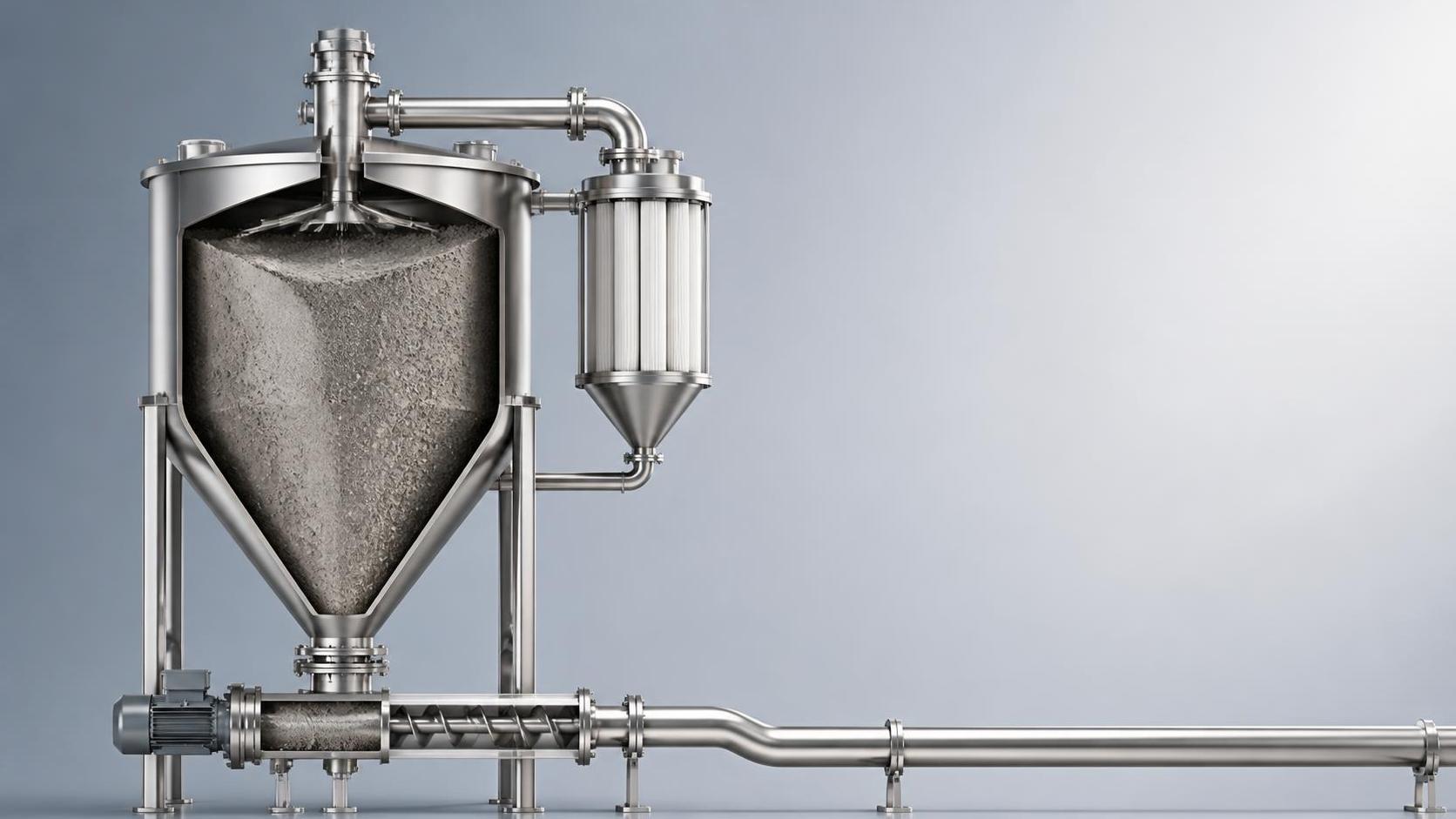
A powder line can look stable for most of a shift and still create trouble at the point where the material matters most. A blend enters storage with an acceptable particle-size distribution, but the material leaving the hopper or silo becomes visibly inconsistent: fine particles appear in one batch, coarse fractions in another, or the bulk density changes enough to disturb dosing and conveying. Operators may first blame the feeder, the conveyor, or the mixer downstream. In many cases, however, the separation began earlier—inside storage.
This is a familiar issue in plants handling mineral powders, dry chemicals, cementitious materials, feed ingredients, or other free-flowing bulk solids. It can lead to unstable process settings, rejected material, excessive intervention at discharge points, and uncertainty during commissioning. The difficult part is that segregation is not always obvious when looking into a filled vessel. It develops through particle movement during filling, settling, storage, and discharge. The design and operation of dry bulk storage tanks therefore deserve attention as part of the material-handling line, not as an isolated storage decision.
Where separation usually starts
Segregation occurs when particles with different sizes, shapes, densities, or surface properties do not move together. A powder described by one product name may still contain a broad distribution of particles. During transport and storage, those fractions respond differently to impact, air movement, vibration, and gravity.
One common situation occurs during filling. Material enters near the top of a vessel and forms a pile. Larger or more mobile particles may roll toward the outside of that pile, while finer particles remain closer to the center. If each new layer repeats this pattern, the vessel can develop zones with different material characteristics. A centered inlet does not automatically prevent this; the fill velocity, drop height, and internal geometry all affect the result.
Another situation develops during discharge. If the material moves only through a narrow central channel while most of the stored inventory remains near the wall, the first material discharged may not represent the average composition of the tank. This is known as funnel flow. It can produce a sequence in which material from the center exits first, followed later by material that has remained stagnant or has changed condition during storage.
Segregation is also encouraged when powder is repeatedly transferred. A material may be lifted pneumatically, dropped into a day bin, reclaimed, and then conveyed again before reaching use. Each transfer point creates another opportunity for fractions to separate. This is why a line that performs acceptably in short trials may become inconsistent after storage cycles are added.
The first mistake: treating every flow problem as a feeder problem
When discharge becomes irregular, it is tempting to increase feeder speed, add more vibration, or adjust the air supply. Those actions may keep material moving for a while, but they do not necessarily correct the flow pattern above the feeder. In some cases, aggressive vibration can worsen separation by allowing smaller particles to migrate downward through gaps between larger particles. Excess aeration can create air channels, flushing, or unstable density at the outlet.
A better starting point is to distinguish among three symptoms:
- Segregation: the material composition or particle distribution changes over time at discharge.
- Flow obstruction: material bridges, arches, ratholes, or stops moving even though inventory remains.
- Rate instability: the composition may be consistent, but the mass flow rate fluctuates because of feeder settings, pressure changes, or poor interface design.
These conditions can occur together, but they call for different corrections. If a feeder is receiving non-uniform material from above, refining feeder controls alone will not create a uniform output. The storage vessel, hopper transition, and discharge arrangement must be considered as one flow system.
Start with the powder, not the tank drawing
A reliable design discussion begins with material behavior. Generic descriptions such as “fine powder” or “free-flowing material” are not enough to determine whether a storage arrangement will limit segregation. The relevant questions are practical: Does the powder contain both coarse granules and fines? Does it absorb moisture? Does it compact under its own weight? Is it sensitive to attrition? Does it fluidize easily? Has its source or formulation changed?
For an existing line, samples should be taken from several points rather than from one convenient location. Compare incoming material, material near the beginning of discharge, material from the middle of the discharge period, and material near the end. Differences in particle distribution, moisture, bulk density, or appearance can show whether the vessel is contributing to separation.
It is also useful to document the operating sequence. A tank emptied immediately after filling behaves differently from one held for days. A vessel replenished while discharging behaves differently from one run batch by batch. Even an apparently minor change—such as switching from continuous top filling to intermittent truck unloading—can change the internal material pattern.
Questions that reveal the real design condition
Before selecting or modifying dry bulk storage tanks, clarify the expected storage duration, normal fill rate, peak fill rate, discharge rate, discharge frequency, and whether the vessel will be fully emptied between materials. Ask whether multiple grades will share one vessel, whether downstream equipment requires a steady bulk density, and whether the material is expected to arrive warm, wet, or aerated. These details influence the correct cone angle, outlet size, inlet arrangement, and flow-assistance method.
Material testing is especially valuable when the consequences of inconsistency are significant. A flow-property assessment can help determine wall friction, cohesive strength, permeability, compressibility, and the likely outlet dimensions needed to support the desired flow regime. It does not replace sound mechanical design, but it prevents decisions based only on nominal particle size.
Designing for controlled material movement
The central objective is usually to encourage mass flow where feasible. In mass flow, material moves across the full cross-section of the vessel as discharge occurs. The inventory near the wall is not left behind while a central channel empties. This reduces residence-time variation and makes it more likely that material leaving the vessel reflects the stored bulk as a whole.
Mass flow is not achieved by selecting a steep cone from a catalog without further review. The hopper walls must be sufficiently steep and smooth for the specific powder, and the outlet must be large enough to avoid stable arches or ratholes. Wall material, liners, weld quality, internal seams, and accumulated residue can all change the effective friction condition. A cone that works with one product may perform poorly after a raw-material change.
For round vessels, the transition from the vertical shell to the hopper is particularly important. A long vertical section provides storage volume, but it does not determine discharge quality. The hopper and outlet control the way stored material is reclaimed. If the transition is too shallow or the outlet is undersized, stagnant regions can develop even when the tank has adequate overall capacity.
Internal features should be used carefully. Some inserts can improve flow patterns or reduce the drop distance during filling, while others create ledges where material accumulates. Any internal device should be evaluated for cleanability, wear, inspection access, and whether it introduces a new segregation path. The simplest effective geometry is often easier to operate over time than an arrangement with multiple hard-to-maintain components.
Filling arrangements matter as much as discharge
It is possible to build a well-designed hopper and still introduce segregation during filling. A high-speed stream falling through open space can strike the pile, create dust, and allow coarse particles to travel outward. The issue is not merely housekeeping; the shape and energy of the incoming stream influence how fractions distribute inside the vessel.
Several approaches can reduce this effect, depending on the material and capacity:
- Reduce uncontrolled drop height where the vessel layout permits it.
- Use a fill arrangement that directs material predictably rather than allowing repeated off-center impact.
- Match inlet capacity to the receiving vessel so that filling does not create excessive air displacement.
- Provide appropriate venting and filtration to control air movement without restricting the fill operation.
- Avoid allowing a partially empty vessel to receive sharply different material grades without a defined transition procedure.
These are not universal prescriptions. For example, a spreader arrangement that improves distribution for a granular product may create buildup with a cohesive fine powder. The selected method should follow material behavior and cleaning requirements, not a general preference for more internal equipment.
For projects requiring substantial storage capacity, vessel selection should include the fill and discharge philosophy from the beginning. Equipment such as 3000-6000 Tons Silos may be considered within a capacity plan, but volume alone does not determine performance. The inlet, venting path, hopper geometry, outlet interface, and reclaim sequence remain critical to controlling segregation.
Connect the outlet to the feeder without creating a new problem
The interface below the hopper is frequently overlooked. A feeder may be correctly sized for average throughput but still receive uneven loading because the outlet geometry concentrates material on one part of its inlet. This can cause variable screw fill, uneven belt loading, or pulsation into a rotary valve.
Review whether the feeder inlet is fully active, whether the transition contains dead pockets, and whether the feeder is being asked to extract material uniformly across a wide outlet. A short, abrupt connection may be convenient to fabricate but can cause material to preferentially load one side. Conversely, a long transition with poor angles can become another stagnant zone.
Rotary valves, screws, slide gates, and belt feeders each influence the material after it leaves the hopper. A screw can compact some powders; a rotary valve may create pressure-related effects in pneumatic systems; a slide gate may provide isolation but is rarely a precise flow-control device by itself. The right selection depends on the required rate, pressure conditions, material sensitivity, and how stable the upstream flow is.
A practical way to troubleshoot an existing line
When inconsistency is already occurring, major modifications should not be the first action. Start by observing one complete cycle: filling, storage, startup, normal discharge, low-level discharge, and refill. Note the material level at which the problem appears. If the issue begins only near the end of a run, stagnant material or a changing flow channel is more likely than a feeder calibration error. If it appears immediately after filling, the fill pattern or air condition may be the stronger suspect.
Next, compare the current operating method with the intended one. Was the vessel designed for full emptying but operated as a continuously topped-up bin? Has a new material grade been introduced? Are operators using vibration routinely because discharge is otherwise unreliable? Has dust accumulation narrowed a vent path or changed a level sensor reading? Small operating changes can gradually override the assumptions made during design.
Then make one controlled change at a time. Adjusting the fill sequence, discharge rate, aeration setting, vibration practice, and feeder speed simultaneously makes it difficult to identify the actual cause. Record the material condition and process response after each change. This approach may feel slower at first, but it avoids locking a system into compensating controls that conceal the original problem.
Changes that deserve engineering review
Some actions should not be improvised during production. Enlarging an outlet, changing hopper angle, adding air pads, installing vibrators, or fitting internal inserts can alter loads, dust behavior, material degradation, and process safety conditions. Any modification affecting a vessel’s structure, pressure relief, support system, or access arrangements requires appropriate engineering assessment. The same caution applies when a powder changes from dry and free-flowing to moisture-sensitive or cohesive.
Keeping performance stable after commissioning
Good storage performance is maintained through operating discipline. Keep material specifications and incoming-condition records available to the people who investigate process variations. Clean residue from locations where it can accumulate and alter wall friction. Inspect seals, vent filters, and level devices because poor venting or inaccurate level information can lead to unsuitable filling practices.
Where material consistency is critical, establish a clear rule for grade transitions and partial inventory. Mixing two nominally similar powders without a defined procedure can produce a discharge period that is difficult to interpret. If full cleanout is impractical, identify the expected transition zone and manage it intentionally rather than assuming the tank instantly becomes uniform.
The most useful principle is simple: storage should preserve the material condition needed by the next process step. Properly selected dry bulk storage tanks do more than hold inventory. They guide the way material enters, settles, and leaves the system. When filling conditions, vessel geometry, outlet design, and feeder integration are considered together, segregation becomes a controllable engineering issue rather than a recurring production mystery.
Related Posts
- ▶ How a Dry Bulk Silo Handles Pneumatic Filling and Gravity Discharge
- ▶ What Is a Dry Bulk Silo, and When Does a Factory Need One?
- ▶ Can dry bulk storage silos be integrated into existing PLC-controlled batching systems?
- ▶ Do dry bulk silos designed for API 650 compliance meet ASME Section VIII requirements?
- ▶ Is almacénamiento de sólidos a granel en silos de acero inoxidable viable for small-scale agrochemical distributors?
- ▶ How do vibration-based level sensors perform in stainless steel silos with powder coating?
Online Message