





Fly Ash Silo Procurement: The Documentation Needed for a Clean Buy
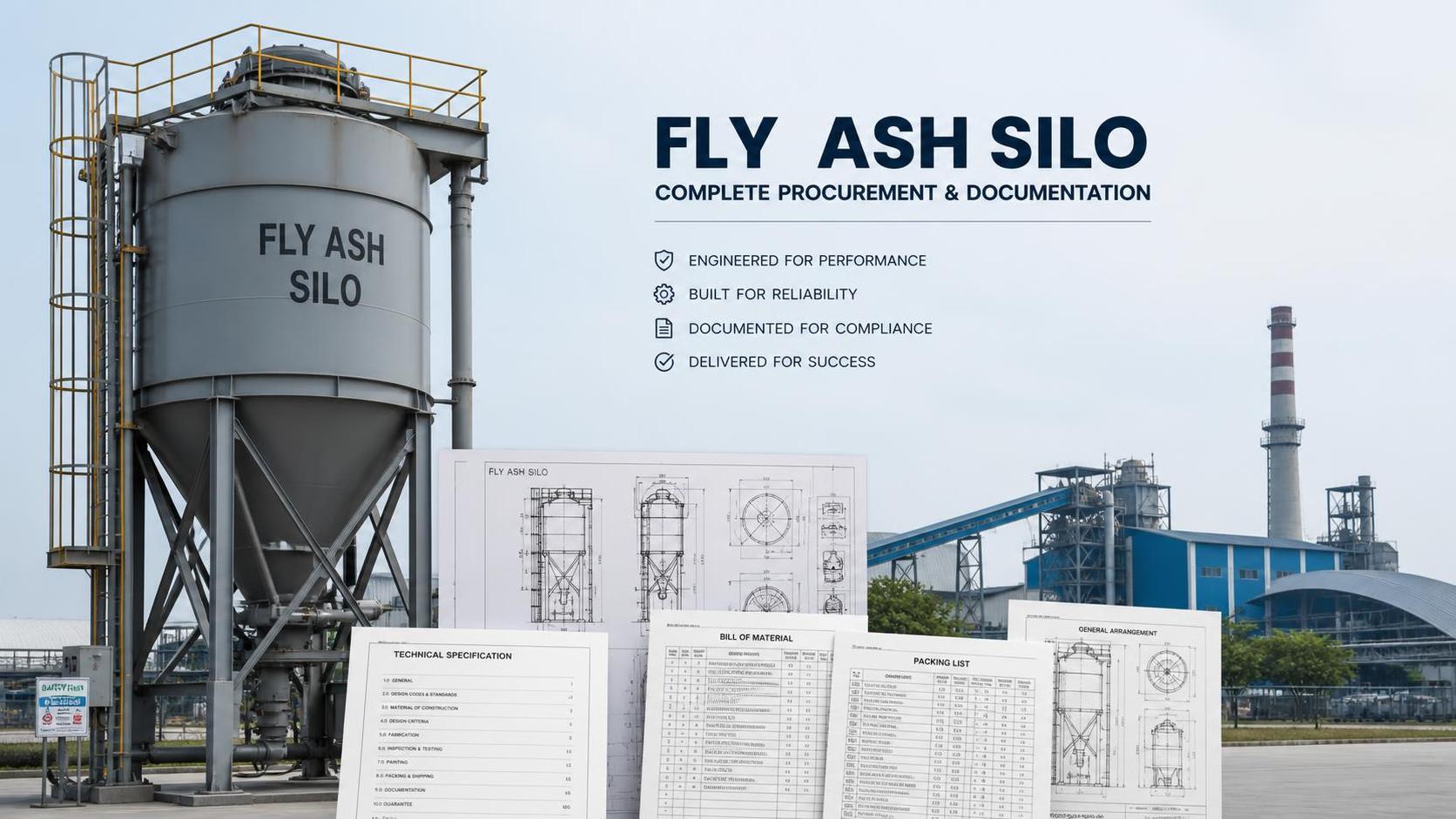
It often starts with a simple procurement task: a team needs a fly ash silo, several suppliers send quotations, and the first comparison happens on price, volume, and delivery time. Then the trouble begins. One quotation includes foundation loads, another only gives storage capacity. One supplier sends a polished drawing but no material specification. Another promises “complete documentation after order confirmation.” At that point, the buying decision is no longer about equipment alone. It becomes a document risk issue.
This is where many evaluations get delayed. If the paperwork is incomplete at the inquiry and contract stage, problems tend to surface later—during design review, civil preparation, transport planning, installation, or handover. A silo can look similar from the outside while differing in plate thickness, discharge arrangement, dust control interfaces, access systems, or corrosion protection details. When those details are missing from the procurement file, misunderstandings become expensive to correct.
For that reason, a clean purchase is usually built on documentation before it is built on steel. If you are reviewing a fly ash silo for a cement plant, power-related application, or bulk material handling project, the most useful question is not “Who quoted lowest?” but “Which supplier has documented the scope clearly enough that we can buy without hidden assumptions?”
Why documentation matters more than a polished quotation
A quotation can summarize price and basic parameters, but it rarely protects the buyer by itself. Fly ash storage involves material flow behavior, structural loads, pneumatic conveying interfaces, level monitoring, venting, discharge devices, and maintenance access. A supplier may understand these points internally, yet if they are not written into drawings, specifications, and contractual attachments, they remain open to interpretation.
That creates a familiar procurement gap: sales documents say one thing, engineering documents say another, and site conditions force a third version. Documentation closes that gap. It allows procurement, engineering, operations, and finance to assess the same scope with the same language.
In practice, the required documents are not just for legal formality. They help answer practical questions such as:
- Will the silo geometry support reliable discharge for the actual fly ash condition?
- Does the quoted scope include accessories needed for safe operation?
- Can the civil team design foundations using confirmed loads instead of estimates?
- Are transport splits and erection methods defined early enough to avoid site surprises?
- Is the final contract based on an identifiable technical baseline?
The first group of documents to request before comparing offers
Before moving to negotiation, ask every supplier to submit a common minimum package. Without this, comparison is mostly guesswork.
1. Technical specification or data sheet
This should do more than state nominal capacity. It should describe stored material, bulk density assumptions, moisture-related considerations if relevant, operating temperature if applicable, filling and discharge method, expected throughput, and basic environmental conditions. If the fly ash silo is being integrated into an existing line, the connection points and interface responsibilities also need to appear here.
One common mistake is accepting a generic silo description with a handwritten capacity note. That may be enough for budget discussion, but not enough for procurement approval. The technical sheet should make clear what the supplier is designing for and what the buyer is expected to provide.
2. General arrangement drawing
A general arrangement drawing is often the first document that reveals whether the quote has engineering depth behind it. It should show main dimensions, cone or hopper section, roof arrangement, inlet and outlet positions, manholes, ladder or stair access, platform areas if included, filter or vent locations, and any major support or skirt arrangement.
If the drawing is too conceptual, key conflicts can stay hidden until late. For example, a nozzle direction may not suit the plant layout, or maintenance clearance may be missing. Even at early procurement stage, a dimensioned layout is far better than a brochure image.
3. Scope-of-supply document
This is one of the most important papers in the file. It should list what is included and excluded: silo body, support structure, roof accessories, level indicators, pressure relief devices if specified, dust collector or vent filter if included, valves, aeration devices, instrumentation, ladders, platforms, anchor bolts, painting, insulation if any, erection supervision, and commissioning support.
Many disputes are not caused by poor equipment quality; they come from scope assumptions. A clear inclusion/exclusion table reduces that risk dramatically.
Documents that help you verify engineering suitability
Once an offer passes the initial comparison stage, the next step is not immediately commercial negotiation. It is technical verification. At this point, more detailed records matter.
Material and fabrication specification
You need a document that identifies the main steel grades, plate thickness principles, reinforcing approach, welding standards or fabrication method references, and surface treatment system. For a fly ash silo, internal wear exposure, moisture-related behavior, and long-term outdoor conditions can all affect material selection. Even when the final fabrication drawing set will come later, the procurement stage should still establish the material basis.
If corrosion protection is quoted, ask how it is defined. “Painted” is not a specification. The same applies to galvanized or other protective finishes. The document should state where the treatment applies and to which components.
Design basis note
This is often overlooked, yet it is one of the best tools for avoiding downstream rework. A design basis note should state the design assumptions: material properties used, load cases considered, site wind or seismic input if applicable, temperature assumptions, and operating conditions relevant to the structure.
You do not need a full calculation package before order in every case, but you do need a written basis showing the offer is linked to actual design conditions rather than generic assumptions.
Load and interface information for civil and plant teams
Procurement can stall when the civil side asks for support reactions or anchor loads and the supplier says those will be available after deposit. That timing can affect the whole project schedule. Request preliminary dead loads, operating loads, and interface loads early enough for foundation planning.
The same principle applies to inlet height, discharge centerline, vent connection, and instrument mounting points. A clean buy means other disciplines can continue their work without waiting for late clarification.
In some projects, buyers also compare related bulk storage categories during early planning, especially if future expansion may involve other powders or minerals. In that context, it can be useful to review adjacent configurations such as Mineral & Alumina Silos to understand how documentation expectations differ by stored material and discharge behavior. The goal is not to mix specifications, but to sharpen questions about structure, flow, and accessory scope.
Commercial documents that should never remain vague
Technical clarity is only half of the procurement file. The commercial side needs the same discipline, especially when equipment looks standardized but project responsibilities are not.
Formal quotation with revision control
Ask for a dated quotation with reference number and revision marking. This sounds basic, but many evaluation folders contain multiple emails, marked-up PDFs, and attachment versions with no clear final reference. When negotiation begins, only controlled versions should remain in circulation.
The quotation should tie back to the technical documents by document number or attachment list. If not, you may end up approving a price that is no longer linked to the drawing you reviewed.
Delivery definition and packing scope
For large silos, shipment condition matters. Is the silo delivered in plates, sections, or preassembled modules? Are supports, access systems, and auxiliaries packed separately? Who is responsible for transport frames or special lifting points? These questions affect logistics planning, receiving inspection, and installation sequencing.
When delivery terms are unclear, hidden costs can appear in freight coordination, site unloading, or damage handling. Packing and transport descriptions do not need to be overly complex, but they should be explicit.
Warranty and defect-handling terms
A short warranty clause is not enough if it avoids defining the trigger point and scope. The contract should identify when warranty starts, what documentation is needed at handover, and how nonconformities will be recorded and addressed. This matters because a documentation gap at acceptance often becomes a dispute later when trying to distinguish installation issues from fabrication issues.
The quality documents buyers tend to request too late
Another common pattern is waiting until manufacturing starts before asking about quality records. By then, it is harder to align expectations. During supplier evaluation, at least confirm the quality documentation framework.
Inspection and test plan, if applicable
You may not need a highly detailed plan for every procurement stage, but it is useful to know what inspections are expected for incoming materials, fabrication steps, dimensional checks, weld inspection where relevant, coating checks if specified, and final release. A supplier who can describe the inspection sequence clearly usually creates fewer handover issues.
Material certificates and traceability approach
If your internal process requires material certificates for major steel components, request this early. Do not assume they will be available in the exact form your project team expects. Clarify whether certificates will be included in the final document package and how components are traced to records.
Factory acceptance or pre-dispatch records
For a fly ash silo, final verification may focus more on dimensional conformity, accessory completeness, and document consistency than on running tests, depending on scope. Even so, define what pre-dispatch records will be provided. If that is not agreed before order, the handover file may arrive incomplete.
Contract attachments that should be treated as part of the purchase, not admin paperwork
A procurement decision becomes cleaner when the contract is built around attachments rather than broad wording. In many practical situations, the contract body stays short while the real technical commitment sits in annexes.
The most useful attachments usually include:
- Final agreed technical specification
- Approved general arrangement drawing
- Scope-of-supply and exclusion list
- Document submission schedule
- Inspection and acceptance basis
- Commercial quotation revision referenced by number
- Deviation list, if any
The deviation list deserves special attention. If the supplier has departed from the inquiry requirement in any area, that should be stated directly instead of being hidden in notes. Buyers sometimes focus on compliance claims and ignore exceptions buried in appendices. Those exceptions often explain the price difference.
Where confusion usually comes from during a fly ash silo purchase
Several recurring misunderstandings appear across procurement reviews.
One is treating the storage vessel as a standalone item when it is really part of a system. A fly ash silo may depend on proper venting, discharge assistance, instrumentation, and interface control to perform as expected. If the documents only define the shell and capacity, the evaluation is incomplete.
Another is assuming all silos for powdered materials can be reviewed in the same way. They cannot. Even when browsing alternatives such as Mineral & Alumina Silos, procurement teams should keep the actual flow and handling characteristics of fly ash at the center of the document review. Similar equipment categories can help frame questions, but they should not replace a material-specific specification.
A third source of confusion is relying on future clarification. In theory, unresolved details can be settled after order. In practice, they usually become schedule pressure points. The cleaner path is to move as many technical and documentary ambiguities as possible into the pre-award stage.
A practical way to review supplier submissions without overcomplicating the process
If you are handling multiple offers, it helps to review them in passes instead of trying to solve everything at once.
Start with completeness. Does the supplier provide a technical sheet, layout drawing, defined scope, and formal quotation? If not, the offer is not yet ready for fair comparison.
Then review consistency. Does the capacity in the quotation match the drawing? Do the listed accessories appear on the layout? Are exclusions stated clearly? Do delivery conditions align with the project schedule assumptions?
After that, look at dependency risks. Which points are still “to be confirmed”? Which missing documents would block civil design, plant interface design, or contract approval? Those are not minor omissions; they are schedule risks.
Finally, identify contract-critical records. Decide which documents must become binding attachments before purchase order release. This step is where many procurement files become stronger very quickly, because it turns discussion documents into agreed references.
Buying a silo cleanly is less about demanding paperwork for its own sake and more about preventing uncertainty from moving downstream. When the documentation is complete, the commercial review becomes easier, technical comparison becomes fairer, and the chance of late interpretation drops. For anyone evaluating a fly ash silo, that is usually the difference between a straightforward purchase and a project that keeps reopening the same questions.
Related Posts
- ▶ How a Dry Bulk Silo Handles Pneumatic Filling and Gravity Discharge
- ▶ What Is a Dry Bulk Silo, and When Does a Factory Need One?
- ▶ Can dry bulk storage silos be integrated into existing PLC-controlled batching systems?
- ▶ Do dry bulk silos designed for API 650 compliance meet ASME Section VIII requirements?
- ▶ Is almacénamiento de sólidos a granel en silos de acero inoxidable viable for small-scale agrochemical distributors?
- ▶ How do vibration-based level sensors perform in stainless steel silos with powder coating?
Online Message