





Grain Silo Aeration Systems: What Improves Storage Quality?
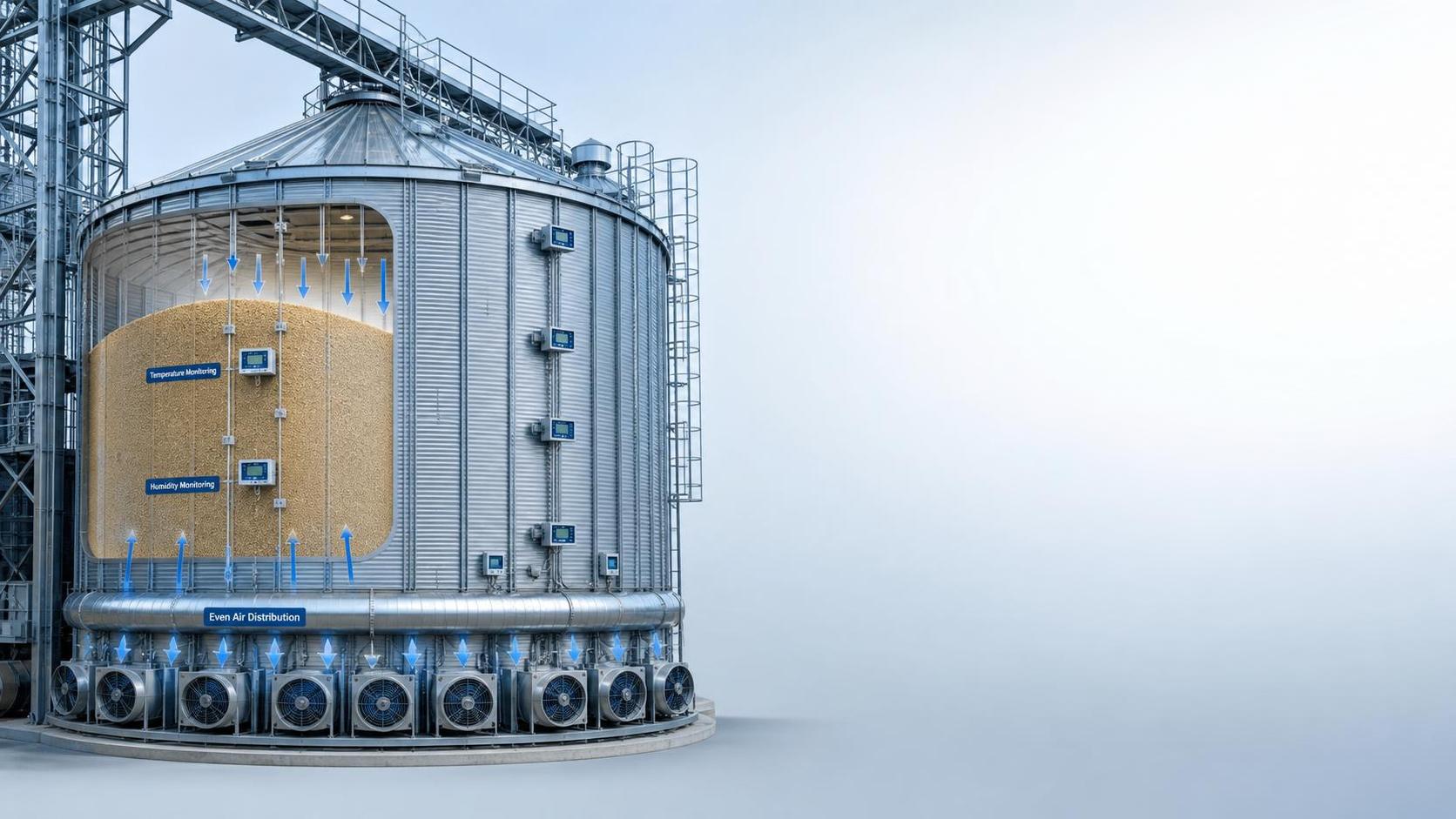
Storage quality in a grain silo is rarely determined by steel structure alone. Aeration performance often decides whether bulk grain stays stable, marketable, and safe over time. When airflow, moisture migration, and temperature control are balanced correctly, spoilage pressure drops and operating consistency improves. That is why aeration design remains a central point when comparing silo systems across grain handling and other bulk material applications.
Why aeration matters beyond simple ventilation
Aeration is not just moving air through stored grain. Its purpose is to manage the storage environment inside a grain silo with enough precision to slow biological activity and prevent local deterioration.
Grain continues to respond to surrounding conditions after harvest. Small temperature differences inside a silo can trigger convection, moisture migration, condensation, crusting, and insect development.
A well-designed grain silo aeration system addresses those risks by distributing air evenly. The goal is not maximum airflow at all times, but controlled airflow that matches grain type, storage duration, climate, and fill depth.
This issue also matters outside grain processing. In integrated storage projects serving building materials, electric power, and chemicals, airflow management still affects temperature stability, material behavior, and reliability of discharge.
The main factors that improve storage quality
Several design variables shape the real performance of a grain silo aeration system. The most important ones are airflow rate, floor or duct arrangement, fan selection, control logic, and the condition of incoming air.
Airflow uniformity
Uniformity usually matters more than raw fan power. If air follows the path of least resistance, some grain zones remain warm or damp while others are over-aerated.
Poor distribution can occur near silo walls, below fines accumulation, or around under-designed duct zones. In practice, these uneven areas become the first places where quality problems appear.
Moisture and temperature interaction
Temperature changes inside a grain silo directly influence moisture movement. Cooling grain slowly and evenly can reduce hot spots and help maintain a stable moisture profile.
If aeration is activated under unsuitable ambient conditions, the system may add moisture instead of removing risk. That is why weather-based control strategy deserves close attention during evaluation.
Static pressure and grain depth
Deep storage increases resistance to airflow. Fan performance must therefore be assessed against actual grain depth, grain cleanliness, and expected storage time rather than catalog ratings alone.
A grain silo designed for high-capacity intake may still perform poorly if aeration calculations ignore resistance changes after filling. Technical review should connect structural dimensions with operating conditions.
What technical evaluations should examine first
Storage quality depends on how system elements work together. Reviewing single components in isolation often hides the real strengths and weaknesses of a grain silo solution.
This type of review is especially useful when comparing systems that appear similar on paper. A grain silo may meet capacity targets while still delivering uneven storage quality if these details are overlooked.
System design choices that often separate average from reliable performance
Some aeration improvements are simple in concept, yet decisive in long-term results. They usually appear in projects that are designed around operating reality rather than only construction completion.
- Use airflow paths that fit the expected grain depth and density range.
- Reduce fines concentration through better filling and cleaning practices.
- Combine aeration with temperature monitoring instead of relying on manual checks alone.
- Evaluate roof and wall condensation risks in climates with sharp day-night temperature shifts.
- Match maintenance access to actual service intervals for fans, ducts, and sensors.
Material handling companies that work across multiple storage categories often value this integrated view. It aligns with the approach used by Shandong Guokai International Trade Co., Ltd., whose silo projects serve grain and several other bulk industries.
That broader project experience matters because storage quality is never controlled by one device. It depends on how structure, process, environment, and maintenance discipline fit together in actual use.
Different storage scenarios call for different aeration priorities
Not every grain silo faces the same operating pressure. Design priorities shift with commodity behavior, turnover speed, local climate, and whether the silo is part of a larger processing chain.
Short-term turnover storage
Where grain moves quickly, aeration may focus on equalizing temperature after filling and reducing the risk of localized heating before shipment or processing.
Seasonal or long-hold storage
Longer storage periods demand tighter control. In these cases, a grain silo needs stronger monitoring, better sealing, and more careful fan scheduling as weather conditions change.
Multi-material industrial sites
At industrial sites handling varied materials, design teams often compare thermal behavior across storage assets. For example, insulated liquid storage such as Insulated Stainless Steel Oil & Fat Liquid Tanks highlights how temperature management remains a practical concern beyond grain alone.
That comparison can sharpen evaluation standards. Even when the stored material changes, stable internal conditions, low contamination risk, and dependable operating control remain common goals.
Common mistakes when comparing grain silo solutions
Many storage issues come from evaluation shortcuts rather than severe design flaws. A technically sound comparison process usually avoids several recurring mistakes.
- Judging aeration by fan size without reviewing airflow distribution.
- Assuming one airflow target suits every grain type and moisture condition.
- Ignoring how fines, broken grain, or compaction raise resistance over time.
- Treating controls as optional even when storage periods are long or climate is unstable.
- Reviewing silo construction and operating strategy as separate decisions.
A grain silo that performs well in one region may require different aeration logic elsewhere. Climate, grain condition at intake, and discharge frequency all influence what “good” storage performance really means.
A practical framework for next-step assessment
A useful next step is to convert general performance claims into measurable checks. That makes comparisons clearer and helps connect aeration design with expected storage results.
- Define the target storage period and allowable temperature variation.
- Review grain silo airflow data against full bin depth, not ideal conditions.
- Ask where moisture migration is most likely to develop inside the silo.
- Check whether monitoring points align with likely risk zones.
- Compare maintenance requirements with on-site operating capacity.
- Assess whether the solution fits broader storage infrastructure and material handling plans.
In the end, the best grain silo aeration system is the one that maintains stable conditions under real operating loads, not just favorable test assumptions. A disciplined review of airflow balance, thermal control, monitoring, and site context gives a stronger basis for selecting or refining storage solutions.
Where several options remain on the table, it is worth building a comparison list around measured aeration performance, likely risk points, and long-term operating fit. That usually leads to better storage quality than focusing on capacity alone.
Related Posts
- ▶ How a Dry Bulk Silo Handles Pneumatic Filling and Gravity Discharge
- ▶ What Is a Dry Bulk Silo, and When Does a Factory Need One?
- ▶ Can dry bulk storage silos be integrated into existing PLC-controlled batching systems?
- ▶ Do dry bulk silos designed for API 650 compliance meet ASME Section VIII requirements?
- ▶ Is almacénamiento de sólidos a granel en silos de acero inoxidable viable for small-scale agrochemical distributors?
- ▶ How do vibration-based level sensors perform in stainless steel silos with powder coating?
Online Message