





Fly Ash Storage Costs: Silo Design, Handling, and Maintenance Factors
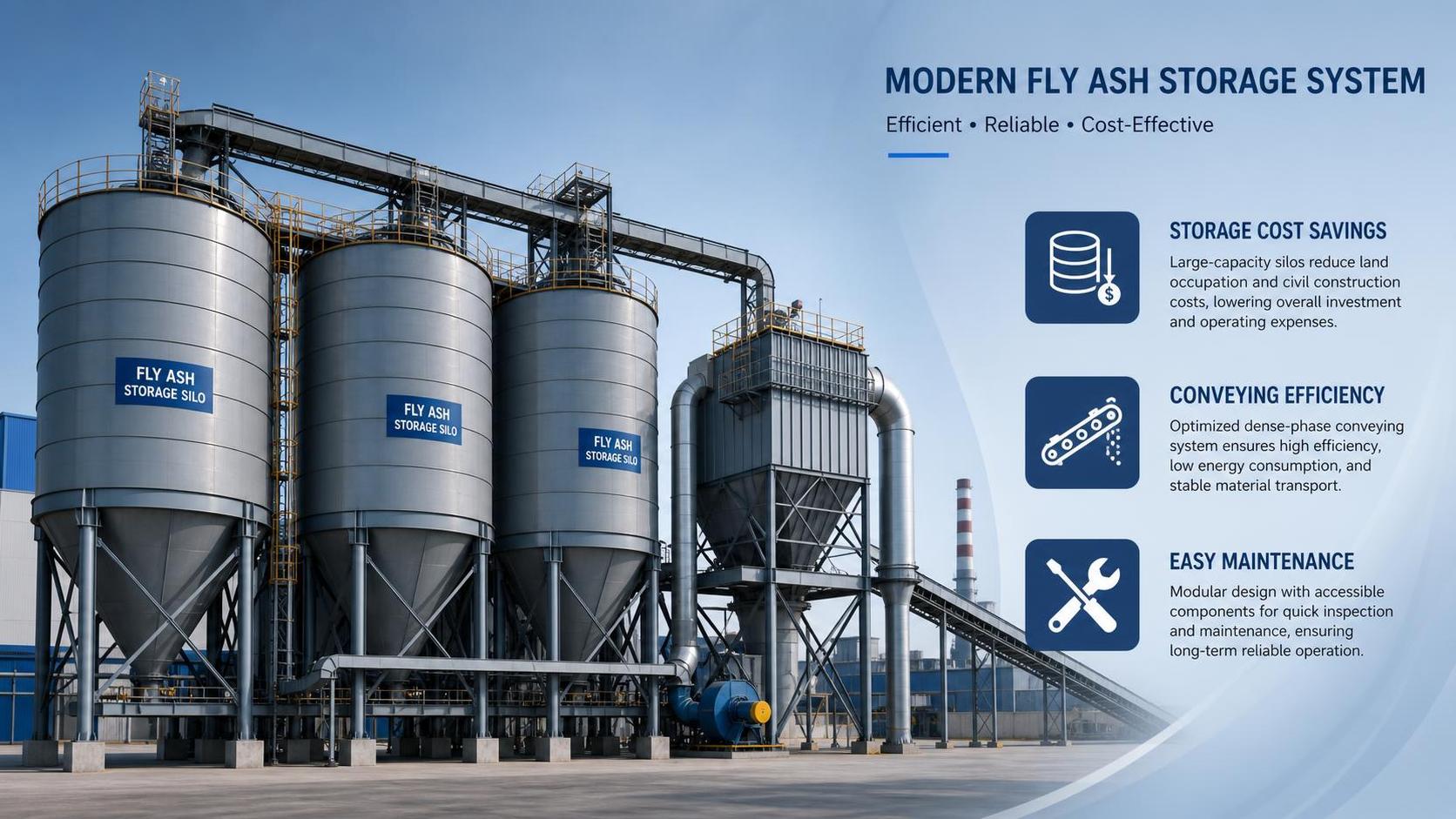
If you are evaluating fly ash storage options, the real question is not just what a silo costs to buy. The bigger issue is what the system costs to own: how much it adds to loading time, dust control, staffing, downtime risk, and routine maintenance. In practice, a low quote can become the expensive choice if the design is awkward, the handling line is underbuilt, or inspections are difficult to carry out.
That is why cost review for fly ash storage should start with use case, not equipment price. A silo that works well for one plant may be a poor fit for another site with different discharge rates, space limits, or operating schedules. For organizations comparing capital investment against operating stability, the right decision usually comes from looking at the whole system, not one line item.
What drives fly ash storage cost
The most visible cost is the silo itself, but that is only the starting point. In a typical industrial project, total cost is shaped by structural design, handling equipment, foundation work, access arrangements, dust collection, automation level, and maintenance access. The more demanding the operating environment, the more those details matter.
For example, a silo sized only for nominal capacity may look economical on paper, yet create problems if the plant needs frequent transfer cycles or if the ash has variable flow properties. Then the team pays for it later in stoppages, manual intervention, or cleaning work. This is why serious buyers ask not only “what does it cost?” but “what does it cost to run without interruption?”
Design choices that change the budget
Fly ash storage design affects both initial investment and the way the system behaves after commissioning. Shell thickness, roof structure, discharge geometry, ladder and platform layout, and whether the silo is fixed or modular all influence cost. So does the required corrosion protection, especially when the site environment is humid or chemically aggressive.
A taller silo is not automatically better. Sometimes height adds structural cost without improving the working process. A better approach is to match storage volume to actual consumption rate, truck or conveyor interface, and the number of unloading cycles expected each day. That is where many budget estimates go wrong: they calculate storage volume, but not operational rhythm.
For temporary works or projects with changing site conditions, modular options can reduce installation pressure and shorten deployment time. A product such as Detachable Bolt Silos for Temporary Engineering Storage may be worth reviewing when the buyer needs flexibility, relocation potential, or simpler transport logistics. It is not the answer for every site, but it can be practical where permanence is not the main requirement.
Handling system cost is often underestimated
Material handling is where fly ash storage projects often gain or lose efficiency. The silo itself may be sound, but if the conveying line, discharge device, feeder, or dust control setup is poorly matched, the system becomes harder to operate and more expensive to maintain.
Business evaluators should look at how fly ash enters the silo and how it leaves it. Pneumatic conveying, screw discharge, rotary valves, and bagging interfaces each come with different purchase and operating implications. Some systems are cheaper to install but require more attention to blockage risk, wear parts, or air consumption. Others cost more upfront but reduce handling labor and protect throughput.
One common mistake is to focus on storage capacity and ignore the transfer bottleneck. If discharge is slow, the silo does not act like a buffer; it becomes a queue. That creates hidden cost in labor, idle equipment, and missed production windows. The cheapest system is rarely the one with the lowest purchase order. It is usually the one that keeps material moving predictably.
Maintenance is part of the real purchase price
Maintenance should be treated as a cost driver from the start. Access doors, inspection points, dust-tight seals, level indicators, vibration devices, and safe working platforms all influence how easily the silo can be checked and serviced. If a team has to shut down more often or work around awkward access, the system becomes more expensive year after year.
Fly ash storage also needs regular attention to buildup, leakage, wear, and flow consistency. Fine powder behaves differently from bulk materials that discharge cleanly. When moisture enters the system, bridging and caking can appear quickly. The cost impact is not only in cleaning. It can also show up as production delay, extra labor, and premature wear on feeders and valves.
This is one reason experienced buyers ask for maintainability details before they ask for discounts. A slightly higher-spec design with better access and simpler inspection can lower the lifetime cost more than a cheaper unit that is hard to keep clean.
What business evaluators should compare
When comparing proposals, do not stop at silo price and delivery lead time. A useful review usually includes site conditions, discharge method, expected service life, maintenance frequency, and the contractor’s ability to support installation and commissioning. If a supplier works across grain, building materials, electric power, and chemicals, that breadth can be helpful because it often means the team understands different flow behaviors and site constraints. Shandong Guokai International Trade Co., Ltd. is one such enterprise focused on steel storage silos and project construction, and that kind of project background can matter when a buyer needs more than a basic vessel.
It also helps to ask whether the proposal is for a permanent asset or a transitional one. That distinction changes the economics. For a short-duration project, the lowest lifecycle cost may come from a system that is easier to dismantle, move, and reinstall. For a long-running plant, durability and service access usually deserve more weight than portability.
Another point that gets overlooked is compliance and site coordination. Dust management, civil foundation work, and lifting/installation requirements can affect the final budget even when the silo itself seems affordable. If those items are vague during quoting, the project is not fully priced yet.
A practical way to judge cost
For fly ash storage, a good buying decision usually comes from three questions: does the design fit the material behavior, does the handling system keep the line moving, and can the maintenance team service it without difficulty? If the answer is yes to all three, the project is more likely to hold its value over time.
In other words, the lowest purchase price is not always the lowest cost. The better measure is whether the system can store fly ash reliably, discharge it cleanly, and stay maintainable through normal operating wear. That is the level of judgment that keeps a procurement decision grounded in reality rather than a quotation sheet.
FAQ
How do I estimate fly ash storage cost without overbuying?
Start with actual daily throughput, peak discharge demand, and site constraints. Then size the system around operating rhythm, not just maximum volume.
What usually creates hidden cost in a silo project?
Poor discharge design, weak dust control, difficult access for maintenance, and added civil or installation work are the most common sources.
Is a modular silo always cheaper?
Not always. It can reduce transport and installation burden, but long-term value depends on service life, reuse plans, and operational demands.
Why does maintenance access matter so much?
Because hard-to-reach equipment costs more to inspect, clean, and repair. That usually shows up later as downtime and labor cost.
Further reading
- 锚文本:steel silo design comparison - product selection and engineering solutions
- 锚文本:bulk material handling system cost - procurement and lifecycle planning
- 锚文本:dust control for industrial silos - compliance and operating risk
- 锚文本:temporary engineering storage solutions - modular and relocatable systems
- 锚文本:maintenance planning for storage silos - inspection and service strategy
- Industry association guidance on bulk solids storage and handling
- Government or environmental regulator pages on particulate control and industrial emissions
- Manufacturer technical documentation for silo structure, discharge equipment, and maintenance access
Related Posts
- ▶ How a Dry Bulk Silo Handles Pneumatic Filling and Gravity Discharge
- ▶ What Is a Dry Bulk Silo, and When Does a Factory Need One?
- ▶ Can dry bulk storage silos be integrated into existing PLC-controlled batching systems?
- ▶ Do dry bulk silos designed for API 650 compliance meet ASME Section VIII requirements?
- ▶ Is almacénamiento de sólidos a granel en silos de acero inoxidable viable for small-scale agrochemical distributors?
- ▶ How do vibration-based level sensors perform in stainless steel silos with powder coating?
Online Message