





Fly Ash Silo Safety Features That Support Dust and Pressure Control
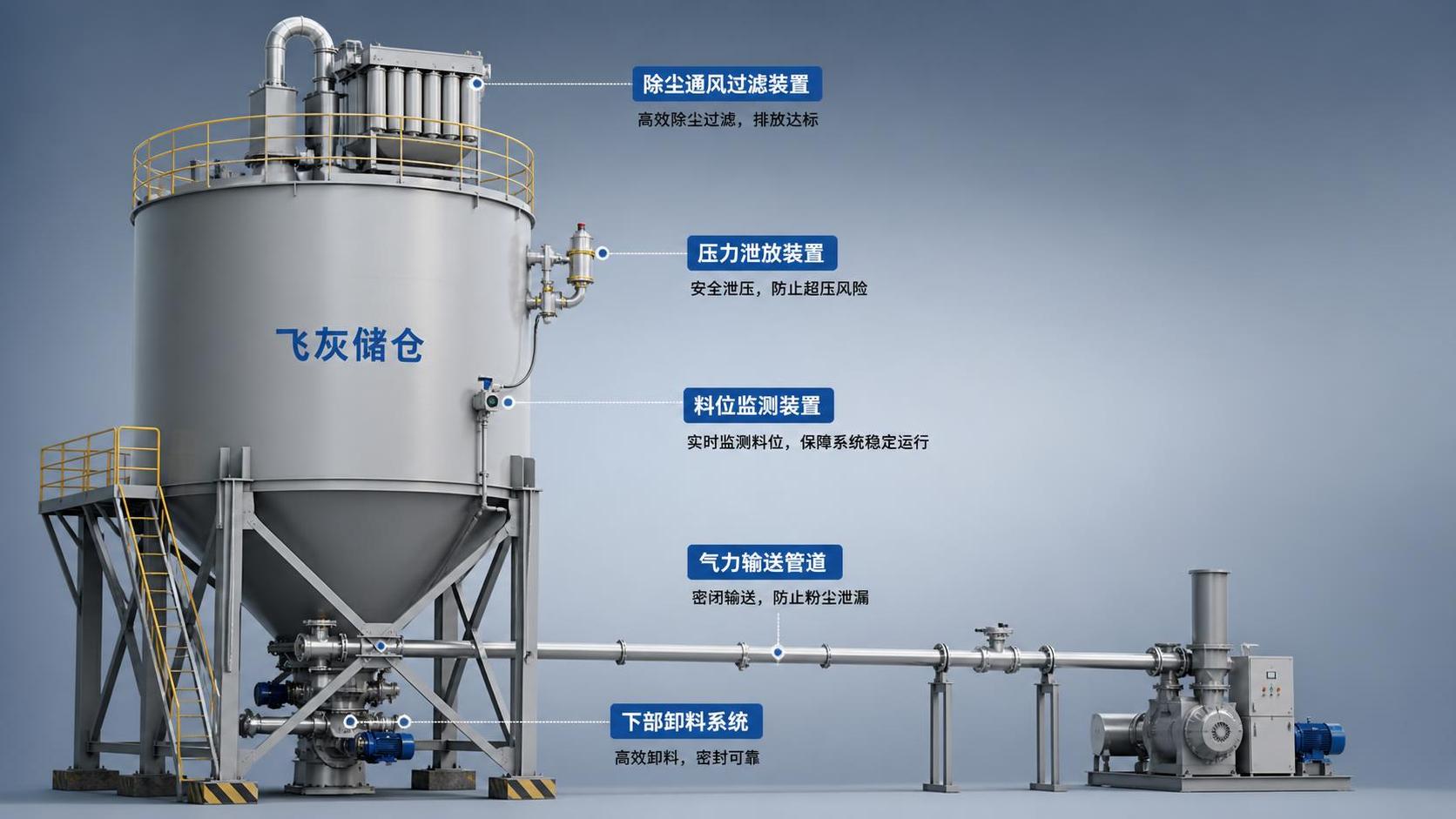
A well-designed fly ash silo is not just a storage vessel. In safety and quality terms, it is a controlled pressure boundary, a dust containment system, and a critical interface between bulk material handling equipment and the surrounding work environment. In power plants, cement terminals, concrete batching operations, and chemical facilities, many of the most serious silo-related incidents do not begin with dramatic structural failure. They begin with smaller control weaknesses: a blocked vent filter, a badly calibrated level switch, an improperly isolated air slide, a leaking flange, or a pressure relief device that was installed but not maintained.
For companies reviewing compliance, conducting risk assessments, or preparing equipment specifications, the practical question is not whether a fly ash silo includes “safety features” on paper. The real question is whether those features work together to control two linked hazards: fugitive dust and abnormal pressure.
That distinction matters because fly ash behaves differently from coarse bulk solids. It is fine, fluidizable, easily airborne, and sensitive to moisture. During pneumatic filling, discharge, aeration, and maintenance activities, even a small loss of containment can create housekeeping issues, exposure concerns, inaccurate inventory conditions, and in some cases a pathway to overpressure events. A safety review therefore has to look beyond the shell and hopper and examine the full system logic.
Why dust control and pressure control should be evaluated together
In practice, dust leakage and pressure problems often share the same root causes. A silo receiving ash pneumatically must release conveying air while retaining product. If venting capacity is insufficient, if the vent filter blinds, or if the cleaning system underperforms, internal pressure can rise. If sealing quality is poor, that pressure often shows up first as escaping dust around access covers, flanges, inspection doors, or instrument penetrations.
That is why safety managers should be cautious when suppliers describe dust-tightness and pressure protection as separate features. They are interdependent performance requirements. A silo that is well sealed but poorly vented may be exposed to damaging pressure conditions. A silo with nominal venting capacity but weak sealing may pass air but still contaminate the work area and compromise environmental control.
From a quality perspective, poor dust containment can also distort inventory control and contaminate nearby systems. From a safety perspective, recurring leakage is often an early warning that air balance, maintenance discipline, or component sizing is wrong.
Dust-tight sealing is more than a fabrication detail
Many site teams underestimate how much containment performance depends on basic mechanical execution. Dust-tight construction starts with weld quality, flange flatness, gasket compatibility, and the integrity of manholes, inspection ports, pipe connections, and bolted joints. For fly ash service, small gaps matter because the material is extremely fine and is often handled with air movement.
In specification review, “sealed” is too vague to be useful. Quality and safety teams should look for clearer definitions:
- Which connections are continuously welded and which are bolted?
- What gasket materials are used, and are they compatible with expected temperature and chemical conditions?
- How are access doors sealed after repeated maintenance cycles?
- Are roof penetrations and instrument nozzles protected against loosening caused by vibration or thermal movement?
- What inspection method is used to verify sealing quality before commissioning?
Sealing performance also depends on installation quality. A correctly designed silo can still become a dust source if field assembly introduces flange distortion, misalignment, or uneven bolt loading. This is one reason acceptance criteria should include site verification, not only factory documentation.
Venting systems are central to safe pneumatic filling
During truck unloading or pipeline transfer, the inflowing air volume must be safely discharged. The venting system, typically including a bin vent filter and associated cleaning mechanism, is not an accessory. It is a primary safeguard against pressure accumulation and product release.
Several recurring field problems deserve attention:
- Filter media selected for general powder service but not for very fine ash loading
- Undersized filter area relative to conveying rate
- Ineffective pulse cleaning or shaker performance
- Dust buildup that progressively reduces permeability
- Lack of differential pressure monitoring across the filter
When these issues develop, operators may first observe visible dust at the roofline or around joints. Treating that as a housekeeping issue misses the bigger risk. It may indicate that the silo is no longer venting within design conditions.
Good practice is to evaluate the expected maximum filling rate, conveying air characteristics, filter loading behavior, maintenance interval, and failure mode if the vent path becomes restricted. A pressure relief device should not be treated as the routine solution for an undersized or poorly maintained vent filter.
Pressure relief devices are essential, but they are not a substitute for system design
Pressure relief valves, emergency vents, or rupture protection devices are widely used on silos, but their presence alone should not create false confidence. Their role is to protect the vessel from abnormal internal pressure or vacuum conditions beyond normal operating limits. They are not intended to compensate for routine process imbalance.
For safety review purposes, several questions are more important than the simple presence of a relief unit:
- Was the set point selected according to the silo’s structural design basis?
- Is the relieving capacity aligned with credible upset conditions?
- Is the device suitable for dusty service and resistant to sticking or fouling?
- Is discharge routed or positioned to avoid creating additional personnel exposure?
- Is inspection access practical, so the device is actually maintained?
Applicable code requirements may vary by jurisdiction and project scope. Review against relevant local pressure, structural, and dust control requirements is necessary, and any code reference used for design should be verified during procurement and project approval. If a supplier cites a specific standard, the buyer should request the exact edition and the boundary of compliance rather than accepting broad claims.
Instrumentation often determines whether a hazard is detected early or late
Most silo incidents are preceded by missed signals. High-level alarms, pressure indicators, differential pressure monitoring on vent filters, and blockage detection on discharge equipment all help convert an invisible developing problem into an actionable maintenance or operating task.
For fly ash applications, the minimum discussion should usually include:
- High-level and high-high level detection to prevent overfill
- Internal pressure or pressure trend monitoring during filling
- Vent filter condition monitoring, often through differential pressure
- Discharge flow confirmation to identify bridging or no-flow conditions
- Interlocks that stop filling when critical faults occur
Instrumentation quality matters, but alarm philosophy matters just as much. A high-level switch that repeatedly false-trips may be bypassed informally. A pressure alarm without clear operator response steps may be acknowledged and ignored. For safety managers, the test is whether the instrument is credible in daily use and integrated into operating discipline.
This is similar to what is seen in other silo sectors as well. Even products outside ash handling, such as Insulated Moisture-Proof Grain Silos, depend on the same basic principle: storage safety is achieved not by a single component, but by the reliability of containment, ventilation, monitoring, and maintenance as one system.
Overfill protection is a pressure-control issue as well as a material-loss issue
Overfilling a fly ash silo is usually discussed in terms of spillage, but it can also compromise venting and pressure behavior. When product reaches the roof zone or vent area, filters can blind rapidly, air discharge becomes restricted, and pressure may increase faster than operators expect. In severe cases, product can be driven into vent housings or associated piping, creating a secondary maintenance and contamination problem.
That is why high-high level protection should be reviewed as part of overall pressure risk control. A robust arrangement often includes an independent high-high level device, a clear shutdown action, and documented proof-testing intervals. Depending on site criticality, teams may also consider whether redundant technologies are warranted, especially where sticky deposits, vibration, or changing material conditions affect measurement reliability.
Explosion risk should be assessed carefully, not assumed
Dust hazard discussions around fly ash can become oversimplified. Some operators assume ash is inert and therefore carries no combustible dust concern; others apply generic combustible dust language to all fine powders. The correct position is more careful: combustibility depends on the specific material composition and process context, and site-specific dust hazard assessment is required.
Where combustible dust hazard exists or cannot be ruled out, design review may need to consider explosion venting, isolation, grounding, ignition source control, housekeeping standards, and compliance with applicable dust hazard guidance. If no such hazard exists for the actual ash handled, that conclusion should still be documented based on credible technical evidence rather than assumption. For certification and audit work, unsupported statements in either direction are weak control points.
Discharge and aeration systems can introduce hidden failure modes
Many pressure and dust problems emerge not during filling, but during discharge. Fly ash silos commonly use aeration pads, air slides, screw conveyors, rotary valves, or other discharge-assist equipment. Improper air pressure, leaking air lines, worn seals, or uncontrolled backflow can disturb material behavior and force dust out through unintended paths.
Safety and quality personnel should pay attention to whether the discharge system:
- Uses air at controlled pressure and volume appropriate for the silo design
- Prevents reverse pressurization from downstream equipment
- Includes isolation and lockout points for maintenance
- Can be inspected without exposing personnel to residual dust release
- Has wear components that are monitored before containment is lost
A recurring mistake is to treat the silo shell as the sole object of inspection while the real operating stress comes from connected systems. A fly ash silo should be reviewed as a handling assembly, not as a standalone tank.
Documentation quality is part of safety performance
For standard and certification-oriented procurement, documentation is often where strong-looking equipment packages begin to weaken. Safety-critical features should be traceable in specifications, drawings, test records, operating instructions, and maintenance requirements.
Useful documentation normally includes:
- Design pressure and vacuum limits
- Vent filter performance basis and maintenance instructions
- Pressure relief device data and inspection criteria
- Instrument set points, alarm logic, and calibration intervals
- Welding, coating, and sealing quality records where relevant
- Commissioning checks for filling, venting, and alarm response
If these records are missing, the site often compensates with assumptions. That creates a long-term control gap, especially when operations teams change or maintenance is outsourced. A robust handover package reduces the chance that critical safeguards become “installed but unmanaged.”
What safety managers should challenge during supplier evaluation
When reviewing suppliers, the most useful approach is to move beyond catalog features and test the supplier’s understanding of failure modes. Ask how the design handles blocked vent filters, overfill events, false level readings, discharge line plugging, and repeated maintenance opening cycles. Ask what can be inspected easily and what typically gets neglected in the field.
Suppliers with practical silo experience usually answer in operational terms, not just dimensional ones. They can explain why a pressure relief device is placed in a certain position, how vent filter access affects maintenance frequency, or why instrumentation redundancy may be needed in particular duty conditions. This kind of discussion is often more revealing than a generic compliance statement.
Across bulk storage sectors, whether the application is ash, cement, grain, or specialized products such as Insulated Moisture-Proof Grain Silos, the stronger projects are typically the ones where procurement, safety, and operations review maintainability and abnormal-condition behavior before installation, not after the first dust release incident.
The most common misunderstanding: installed features do not equal controlled risk
It is easy to create a specification that lists sealed roof, vent filter, pressure relief valve, level indicators, and discharge aids. It is harder to verify that these items are compatible, sized correctly, accessible for maintenance, and backed by operating procedures. For quality control and safety teams, that is the real dividing line.
A fly ash silo supports safe operation when it contains dust under normal service, relieves or avoids abnormal pressure under upset conditions, and provides operators with reliable warning before those conditions escalate. If any one of those layers is weak, the system may still function most days, but it is no longer robust.
That is the practical standard worth applying in audits, procurement reviews, and plant upgrades: do not ask only whether the silo has the right components. Ask whether the design, documentation, and maintenance regime make those components dependable under actual plant conditions.
Related Posts
- ▶ How a Dry Bulk Silo Handles Pneumatic Filling and Gravity Discharge
- ▶ What Is a Dry Bulk Silo, and When Does a Factory Need One?
- ▶ Can dry bulk storage silos be integrated into existing PLC-controlled batching systems?
- ▶ Do dry bulk silos designed for API 650 compliance meet ASME Section VIII requirements?
- ▶ Is almacénamiento de sólidos a granel en silos de acero inoxidable viable for small-scale agrochemical distributors?
- ▶ How do vibration-based level sensors perform in stainless steel silos with powder coating?
Online Message