





Comparing Industrial Silos by Capacity, Footprint, and Material Compatibility
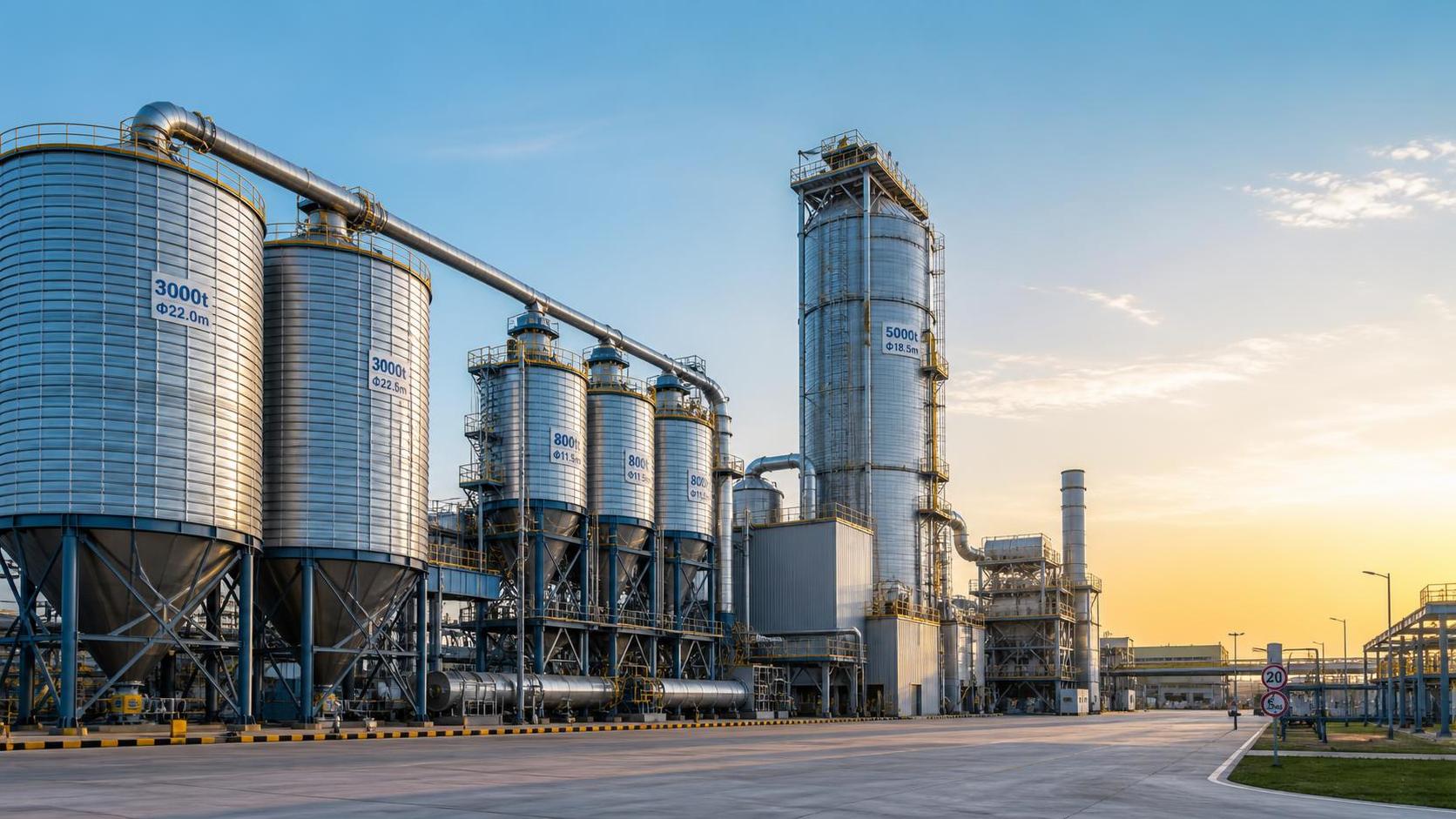
Selecting industrial silos is rarely a matter of choosing the largest vessel that fits the budget. Storage capacity is visible on a quotation; the operational consequences of a poor match are not. A silo that is oversized for actual turnover can increase capital tied up in inventory and expose sensitive materials to long dwell times. One that is undersized can turn receiving and dispatch into a bottleneck. A design that fits neatly on a layout drawing may still create problems if the material bridges, segregates, absorbs moisture, or requires frequent cleaning.
For projects involving grain, cement, fly ash, minerals, fertilizers, feed, chemicals, or other bulk solids, the useful comparison is not “which silo is better?” It is “which silo configuration can store and discharge this material at the required rate, within the available site, while remaining maintainable and compliant over its operating life?” Capacity, footprint, and material compatibility are the three most visible parts of that decision, but they must be evaluated together.
Capacity should be based on operating inventory, not nominal volume
A stated silo capacity can be misleading unless the basis is clear. Suppliers may quote geometric volume, working volume, or a tonnage figure calculated using an assumed bulk density. These are not interchangeable. A 1,000 m³ vessel may hold radically different masses of wheat, cement, wood pellets, limestone powder, and plastic granules. Even within the same commodity category, density can vary with moisture level, compaction, particle-size distribution, and handling history.
A practical capacity calculation begins with the operating requirement:
- Average daily or hourly consumption;
- Supply lead time and expected shipment size;
- Required safety stock for seasonal supply risk or transport disruption;
- Maximum acceptable storage duration;
- Number of materials that must be stored separately;
- Peak receiving and loading periods;
- Whether the facility needs to continue operating during maintenance or cleaning.
The result is normally a required working inventory, rather than a nominal vessel volume. Buyers should then ask how much of the quoted silo can actually be used. Material often remains below the outlet due to flow limitations, and a headspace allowance is required to prevent overfilling and manage dust-laden air during pneumatic filling. If a supplier provides only a “ton capacity,” request the assumed bulk density, fill level, wall and hopper geometry, and estimated residual quantity after normal discharge.
For continuous-process plants, a single large silo can appear cost-efficient on a cost-per-tonne basis. Yet two or more smaller silos may provide better operational value where product grades change frequently, receiving schedules are uncertain, or downtime is expensive. Multiple units also allow one silo to be cleaned or inspected while another remains in service. The additional conveyors, valves, controls, and foundations must be included in the comparison, but redundancy should not be dismissed as a luxury when a production line depends on uninterrupted material supply.
Large diameter is not always the best answer to a limited footprint
Site constraints influence silo economics well beyond the land occupied by the shell. The relevant footprint includes truck access, rail unloading where applicable, intake pits, bucket elevators or pneumatic lines, dust-collection equipment, maintenance clearances, electrical rooms, control platforms, and emergency access. A silo farm may fit inside a plot boundary while still being difficult to operate safely.
Broadly, projects tend to compare three layout approaches:
Height is often treated as an engineering detail, but it can determine whether a project is viable. Aviation restrictions, local planning rules, port authority requirements, visual-impact conditions, and nearby power lines can limit a tall silo installation. Higher structures also raise the importance of wind load, seismic design where relevant, erection planning, lightning protection, and safe access for inspection.
Foundation design deserves early attention. Industrial silos impose concentrated and sometimes dynamic loads. Soil bearing capacity, settlement risk, groundwater conditions, frost exposure, and the location of existing underground services can materially alter civil costs. A quotation that excludes detailed geotechnical assumptions is not necessarily incomplete, but the assumptions must be visible. Comparing steel silo prices without comparing civil scope often produces a distorted project budget.
Expansion is another footprint question. A layout may be technically adequate for day-one demand but leave no space for another storage line, additional dust filtration, a new packing station, or improved vehicle circulation. Where future volume growth is plausible, reserving utility corridors and foundation zones can be less expensive than retrofitting around an operating silo later.
Material compatibility is primarily a flow and containment question
Many buying errors arise from classifying materials too broadly. “Powder,” “grain,” or “chemical” is not enough information for proper silo selection. The same basic material can behave very differently according to particle shape, fines content, temperature, moisture, and storage time.
Grain is usually free-flowing under suitable moisture conditions, but it introduces issues such as insect activity, condensation, spoilage, segregation, dust explosion risk, and temperature monitoring. Cement and fly ash can appear straightforward because they are commonly stored in steel silos, yet their fine particle size and aeration behavior make discharge design critical. Poorly configured aeration pads, air slides, cone angles, or discharge gates can cause erratic flow, flushing, compaction, or blockages.
Materials such as wet mineral powders, certain fertilizers, biomass products, clay-containing ores, filter cake, and some chemical intermediates may be cohesive, hygroscopic, corrosive, or prone to caking. These products can bridge across outlets, form stable ratholes, adhere to internal surfaces, or degrade during extended storage. In these cases, a conventional hopper and gravity outlet may not be enough. Flow aids, vibrators, air cannons, mechanical reclaim systems, live-bottom arrangements, internal liners, insulation, heating, or controlled humidity may be required. Each remedy has consequences for power consumption, maintenance, cleaning access, and safety.
Before comparing suppliers, a material data package should include at least:
- Bulk density, both loose and compacted where available;
- Particle-size distribution and percentage of fines;
- Moisture range at receipt and during storage;
- Angle of repose and, ideally, tested wall friction and flow-function data;
- Abrasiveness and expected wear points;
- Corrosive constituents or vapors;
- Maximum material temperature during filling;
- Dust explosibility information where applicable;
- Required turnover period, cleanliness standard, and risk of cross-contamination.
Where the cost of poor flow is material, representative bulk-solid testing is preferable to selecting a hopper angle from generic tables. Jenike shear testing or equivalent bulk-solids characterization can help establish whether a mass-flow or funnel-flow arrangement is appropriate. Mass flow, in which material moves across the entire cross-section during discharge, is useful for materials sensitive to aging, segregation, or degradation. Funnel flow can be acceptable for stable, free-flowing materials, but older product may remain against the walls for long periods.
The difference affects more than outlet geometry. It influences wall angle, outlet size, lining selection, feeder design, and the required strength of the discharge equipment. A low initial cost can quickly be lost if operators must repeatedly strike silo walls, enter confined spaces, or interrupt production to clear obstructions.
Construction material and internal protection must match the stored product
Steel is widely used for industrial silos because it enables high capacity, modular fabrication, and efficient site assembly. However, “steel silo” does not define corrosion resistance or product suitability. Galvanized steel, painted carbon steel, stainless steel, and lined carbon steel each have different roles. Selection should reflect the stored material, local humidity, expected condensation, external atmosphere, cleaning agents, and target service life.
For grain and many dry building materials, galvanized or properly coated steel can be suitable when moisture is controlled. Corrosive fertilizers, chloride-bearing products, acidic materials, and some chemical powders may require more robust coatings, stainless-steel components, or dedicated internal linings. Abrasive products require particular attention at inlet points, chutes, elbows, outlets, and reclaim equipment. Replacing worn sections inside a tall vessel is considerably more disruptive than specifying protection at the design stage.
Temperature also changes the selection logic. Hot products can damage coatings, create thermal expansion effects, and generate moisture condensation when vapor cools against the shell. Materials that are cooled in a silo may need aeration design that avoids uneven temperature zones. Where hot dust or process residues are stored, the design must address both material temperature and the temperature of conveying air.
Liquid storage should not be treated as an extension of dry-bulk silo selection. For projects that combine dry solids with fuels, oils, or process liquids, the vessel design, sealing approach, venting, foundation, inspection regime, and regulatory obligations differ substantially. Buyers assessing adjacent liquid-storage scope should evaluate dedicated equipment such as Oil Storage Tanks separately rather than applying dry-silo assumptions to liquid containment.
Discharge rate and conveying method often decide real-world performance
Storage is only one part of the system. Industrial silos must integrate with the method used to fill and empty them: bucket elevator, belt conveyor, screw conveyor, chain conveyor, pneumatic transport, truck loading, bagging line, mixer, kiln, boiler, or batching plant. The expected peak rate matters as much as average throughput.
A silo can store the right inventory and still fail the application if it cannot receive a bulk truck within the scheduled unloading window or provide a stable feed rate to downstream equipment. Fine powders may require careful coordination between pneumatic filling pressure, filter capacity, air relief, and level controls. Granular materials may suffer breakage if conveying speed or transfer impact is excessive. Fragile food ingredients and seeds may need gentler handling than mineral bulk materials.
Ask suppliers to define the guaranteed operating envelope: filling rate, discharge rate, material condition, maximum and minimum level, ambient conditions, and power or compressed-air requirements. A claimed discharge rate is of limited value if it applies only when the silo is nearly full, or if it depends on continuous operator intervention.
Instrumentation should be specified as part of reliability, not as an optional afterthought. High-level alarms and independent overfill protection are standard risk controls. Depending on the material and application, temperature cables, pressure-relief devices, load cells, radar level sensors, rotary paddles, moisture monitoring, and condition monitoring for conveying equipment may be justified. The correct sensor depends on dust level, dielectric properties, buildup risk, cleaning needs, and required measurement accuracy.
Safety, compliance, and maintainability must be visible in the scope
Bulk storage projects combine work at height, confined spaces, mechanical conveying, dust, and potentially combustible atmospheres. The compliance framework varies by country and site, so no universal certification list can replace local review. However, buyers should establish early which rules govern the project, including structural design codes, local building approvals, electrical classifications, occupational safety requirements, and dust-explosion controls where combustible dust is present.
For combustible dust, risk assessment should consider the complete system: receiving pit, elevators, conveyors, filters, silo headspace, and loading points. Measures may include dust extraction, housekeeping provisions, explosion venting or suppression where required by the applicable assessment, isolation devices, grounding, and appropriately rated electrical equipment. The relevant standards and authorities must be confirmed for the destination market rather than assumed from a supplier’s domestic practice.
Maintenance access also affects lifecycle cost. Inspect roof access, ladder and platform design, internal entry arrangements, cleanout access, filter replacement space, gearbox accessibility, and safe isolation points. If a silo will store food, feed, or high-purity chemical material, cleaning and cross-contamination control should be treated as a design requirement, not an operational workaround.
A more reliable way to compare quotations
Comparable procurement requires a common technical basis. Instead of requesting only capacity and price, issue a specification that states material data, storage duty, required throughput, site conditions, interface points, utility availability, corrosion category, safety expectations, and documentation needs. Ask each bidder to identify exclusions and assumptions in writing.
The comparison should distinguish between the silo shell and the complete operating system. Typical exclusions that can materially change final cost include foundations, erection equipment, freight, site welding, electrical works, automation, filters, conveying equipment, commissioning, insulation, corrosion protection, and local permits. Delivery risk should also be evaluated through fabrication capacity, reference projects involving similar materials, export packaging standards, quality documentation, spare-parts availability, and the supplier’s ability to support installation in the destination country.
The best industrial silos are not necessarily the largest, tallest, or lowest-priced units. They are the units whose usable capacity, physical layout, flow behavior, protection system, and handling equipment have been designed around the actual material and operating pattern. That discipline reduces the risk of a storage asset becoming a recurring source of downtime, cleanup work, inventory loss, and unplanned capital expenditure.
Related Posts
- ▶ How a Dry Bulk Silo Handles Pneumatic Filling and Gravity Discharge
- ▶ What Is a Dry Bulk Silo, and When Does a Factory Need One?
- ▶ Can dry bulk storage silos be integrated into existing PLC-controlled batching systems?
- ▶ Do dry bulk silos designed for API 650 compliance meet ASME Section VIII requirements?
- ▶ Is almacénamiento de sólidos a granel en silos de acero inoxidable viable for small-scale agrochemical distributors?
- ▶ How do vibration-based level sensors perform in stainless steel silos with powder coating?
Online Message