





Bulk Material Storage Silos: What Affects Material Segregation During Storage
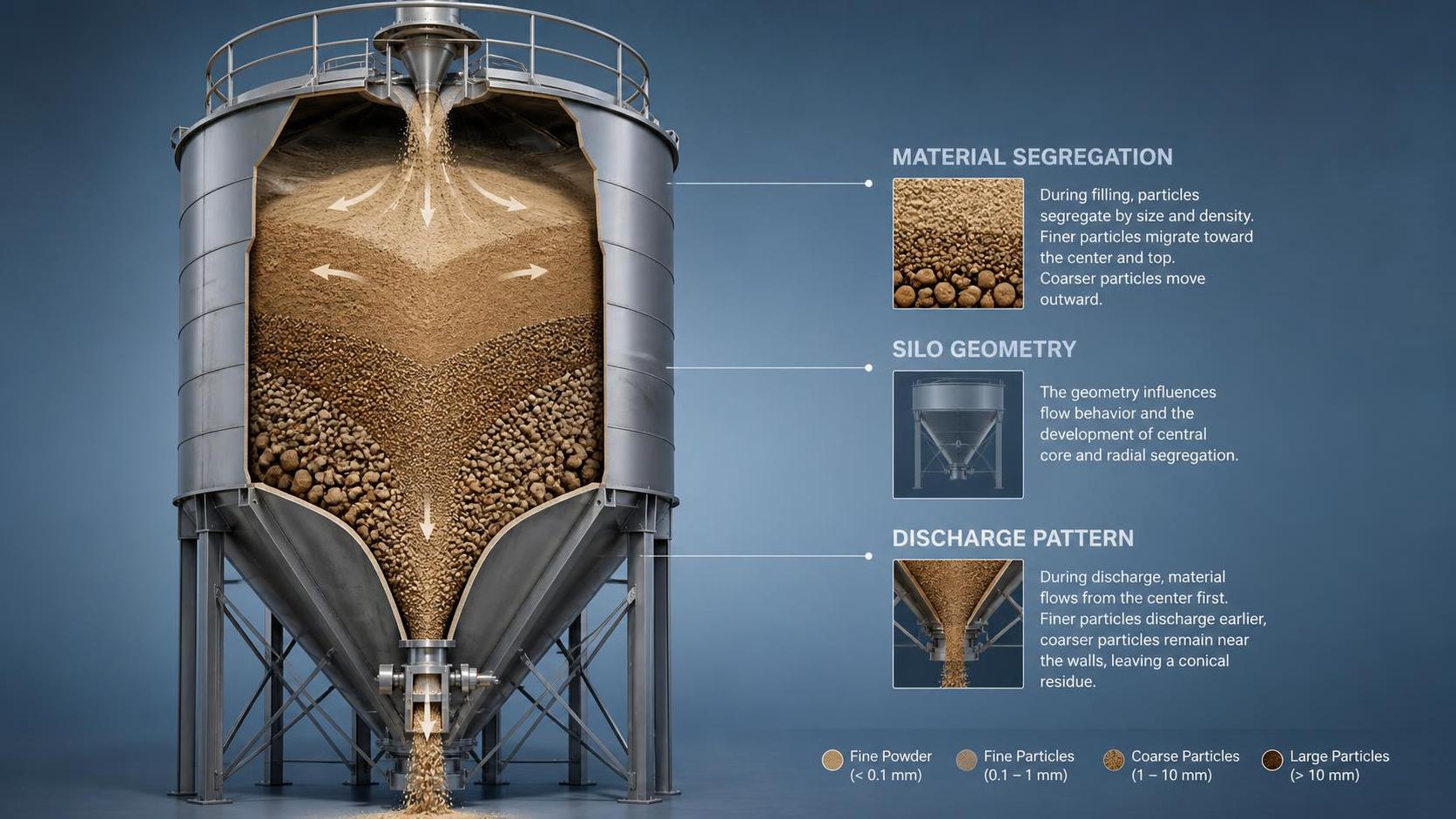
It usually starts with a complaint that sounds simple: the material coming out of the silo does not look or behave like the material that went in. In some plants, the problem shows up as inconsistent bulk density. In others, it appears as erratic discharge, dust spikes, shifting moisture behavior, or unstable feed into downstream equipment. Operators may first suspect poor raw material quality, but the issue often develops during storage itself.
In bulk material storage silos, segregation is one of the most common reasons for this mismatch. Fine particles move differently from coarse particles. Denser fractions settle differently from lighter ones. A material that looks uniform on a conveyor can separate during filling, sit in layers during storage, and discharge in a non-uniform pattern later. If you are evaluating silo performance for grain, cementitious powders, fly ash, mineral products, or chemical solids, it helps to understand that segregation is rarely caused by one factor alone. It is usually the result of material behavior meeting silo geometry, filling practice, and discharge pattern at the same time.
The most practical way to approach the issue is not to ask whether a material can segregate, but when, where, and under which handling conditions it is most likely to segregate. That shift in thinking makes it easier to choose the right storage method and avoid treating a design problem as a material problem.
Why segregation happens even before the silo is full
Many people picture a silo as a passive container, but storage begins influencing material the moment the first stream enters from the top. The falling trajectory matters. So does the velocity of the incoming flow. If a mixed bulk solid contains a range of particle sizes, shapes, or densities, the larger or heavier particles may roll farther across the surface while finer or lighter material remains closer to the fill point. This creates radial separation during filling.
Another common mechanism is sifting segregation. When a stream of mixed particles hits a pile, void spaces form between coarse particles. Fines can fall through those spaces and collect in different zones. This happens easily in dry free-flowing materials and can become worse when the silo is filled repeatedly from a fixed central location. Over time, the stored mass may develop layers or zones that are not visible from outside but become very obvious during discharge.
Fluidization can also play a role. Very fine powders may entrain air during pneumatic or rapid mechanical filling. If the air does not dissipate evenly, the powder may settle in a non-uniform way. In some cases, the top surface appears level while the internal density profile is not. This is one reason why the same powder may discharge smoothly one day and unevenly the next, even when the feed source seems unchanged.
The material properties that matter most
When people discuss segregation in bulk material storage silos, they often focus only on particle size. Size is important, but it is not enough on its own. A narrow size distribution can still segregate if particle density differs significantly. A material with similar density can still separate if shape varies enough to affect rolling, interlocking, or air retention.
Several properties deserve attention during technical evaluation:
Particle size distribution. Wide distributions usually create stronger separation potential, especially when fines move into void spaces around larger particles.
Particle shape. Rounded particles tend to roll farther than angular ones. Plate-like or fibrous particles may bridge or orient differently under load.
Bulk density variation. Components with different densities may sort during flow and piling, even if their particle sizes are not dramatically different.
Moisture condition. Slight moisture can reduce dusting and sometimes reduce free separation, but it can also increase cohesion. Once cohesion develops unevenly, flow becomes less predictable.
Aeration tendency. Fine powders that hold air can settle slowly and produce unstable density zones.
Flowability and compressibility. A material that compacts over time may not discharge in the same way it filled, which can make internal segregation more pronounced during withdrawal.
If you are comparing materials across applications, the key point is that two products with similar nominal particle size can still require very different silo designs because their shape, air sensitivity, or consolidation behavior differs.
Where silo design starts to amplify the problem
Even a well-characterized material can segregate if the storage vessel encourages non-uniform flow. One of the biggest design influences is the difference between funnel flow and mass flow behavior. In a funnel flow pattern, material in the center moves first while material near the walls remains stagnant for longer periods. That can preserve the separation created during filling and then release stored zones in sequence. In practical terms, downstream equipment receives changing composition over time rather than a steady mix.
Mass flow behavior is often preferred when minimizing segregation is important because all material moves whenever any material is withdrawn. That does not eliminate separation created during filling, but it reduces long-term stagnation and helps preserve first-in, first-out movement. Whether mass flow is feasible depends on wall friction, hopper angle, outlet size, and the material’s flow properties.
The geometry of the hopper also matters. A shallow hopper or undersized outlet may encourage ratholing, arching, or erratic discharge patterns that make segregation effects more visible. A tall cylinder with a centrally located inlet might look efficient from a layout perspective, but if the top loading arrangement creates repeated piling in one zone, the internal material distribution may become increasingly uneven.
This is why technical evaluations should not isolate capacity from flow pattern. A silo sized correctly for volume can still perform poorly if the filling and discharge conditions are not matched to the bulk solid.
Filling method is often the hidden variable
In many facilities, the storage vessel gets blamed while the filling practice stays unchanged. That can be a mistake. A single-point top inlet is simple, but it may create a cone-up or cone-down distribution depending on the material and feed rate. If the incoming stream hits the same point every cycle, the resulting segregation pattern can become very consistent and very problematic.
Changing the filling arrangement can help. Depending on the application, this might mean reducing drop height, controlling feed velocity, using a distributor to change how material lands, or avoiding conditions that overly aerate fine powder. Some systems benefit from multiple fill points or devices that limit radial sorting during deposition. The right choice depends on whether the material is more sensitive to rolling, sifting, or air entrainment.
Fine industrial powders deserve special attention here. In equipment such as Fly Ash Silos, filling conditions can strongly influence how powder settles and compacts. If the incoming ash is highly aerated, internal density differences may become a larger issue than visible size separation. That does not mean the silo is unsuitable; it means the inlet and venting arrangement deserve the same scrutiny as the shell and hopper.
Storage time changes the risk
Segregation is not only about what happens during filling. Time in storage can alter the internal structure of the material. Vibration from nearby equipment, repeated partial filling cycles, temperature changes, and gradual consolidation under load can all increase non-uniformity. A material that appears acceptable after short-term storage may behave differently after sitting longer under pressure.
This is especially relevant when the material contains fines that compact more readily than coarse fractions. During discharge, the denser compacted zones may move later or break loose in chunks, while looser zones flow earlier. Operators may interpret this as random flow trouble when it is actually a time-related segregation and consolidation effect.
If the application involves long dwell times, it is worth checking whether the silo was evaluated only for initial flowability or also for time consolidation behavior. Those are not the same thing.
How to investigate the source without guessing
When a segregation problem appears, jumping directly to a hardware change can waste time. It is better to narrow down where the separation is being created and where it is being magnified.
Start by watching the process in sequence. Does inconsistency appear immediately after filling, only after storage, or mostly during discharge near the end of the cycle? If the first discharge already varies, the issue may be largely created during filling. If material is stable at first and becomes inconsistent later, stagnant regions or time-related consolidation may be contributing more.
Then compare the discharge pattern with the silo’s expected flow regime. If center withdrawal dominates and wall regions remain inactive, funnel flow may be preserving internal segregation. If erratic slumping or intermittent flow occurs, outlet or hopper conditions may be part of the problem.
Sample placement matters too. Testing only the feed stream and one final discharge point may hide the mechanism. More useful observations come from sampling at different stages of discharge and comparing trends rather than looking for one isolated value. You are not trying to prove perfect uniformity; you are trying to identify whether the composition shifts in a pattern that points back to filling, storage, or withdrawal behavior.
Practical adjustments that often reduce segregation
The most effective corrections are usually modest but targeted. If deposition at the top is causing radial separation, reduce free-fall distance or revise the feed arrangement. If air retention is a factor, check whether venting and feed rate are allowing the powder to settle evenly. If the hopper promotes funnel flow and the application requires more uniform discharge, revisit wall finish, hopper angle, and outlet design with the material’s measured flow properties in mind.
Some operations also benefit from changing how the silo is cycled. Repeated small top-ups can create layered storage conditions that are different from full-batch filling and discharge. Where process constraints allow, a more controlled fill-and-draw pattern may reduce composition swings. In other cases, a reclaim or blending step downstream is more realistic than trying to eliminate all internal separation inside the vessel.
For powder-heavy installations, a storage unit such as Fly Ash Silos should be considered not just as a capacity component but as part of the flow system. Inlet configuration, air management, hopper discharge, and expected residence time all interact. Looking at only one of those factors usually leads to partial fixes.
Common mistakes during technical selection
One frequent mistake is choosing a silo mainly by volume and available footprint. That approach may work for liquids, but it is risky for mixed or fine bulk solids. Another is assuming that if a material has flowed acceptably in one plant, it will behave the same way everywhere. Small changes in moisture, feed velocity, internal surface condition, or storage time can change the segregation pattern enough to affect operations.
It is also common to overestimate the value of mechanical agitation as a cure. Agitation may help in some situations, but it can also introduce new flow irregularities or maintenance burdens if the root cause is poor filling distribution or an unfavorable hopper design. A better first step is to identify the dominant segregation mechanism and then decide whether the answer lies in filling control, flow pattern correction, or process sequence.
A more reliable way to judge storage stability
If you are comparing options for bulk material storage silos, try to evaluate them through three linked questions. First, how likely is the material to separate during filling based on its size range, density difference, and air sensitivity? Second, will the silo preserve that separation through stagnant regions or layered residence time? Third, will the discharge pattern average those differences out or release them one zone at a time?
That line of thinking is more useful than asking for a general promise that the silo will “prevent segregation.” No storage system can erase every material tendency. The better goal is to make separation less severe, less persistent, and less disruptive to the next process step.
When those questions are addressed early, the final design decisions become more grounded. You are less likely to blame raw material quality for a storage-induced problem, and more likely to choose a configuration that fits the actual behavior of the bulk solid. In technical terms, that is usually the difference between a silo that merely stores material and one that supports stable handling over time.
Related Posts
- ▶ How a Dry Bulk Silo Handles Pneumatic Filling and Gravity Discharge
- ▶ What Is a Dry Bulk Silo, and When Does a Factory Need One?
- ▶ Can dry bulk storage silos be integrated into existing PLC-controlled batching systems?
- ▶ Do dry bulk silos designed for API 650 compliance meet ASME Section VIII requirements?
- ▶ Is almacénamiento de sólidos a granel en silos de acero inoxidable viable for small-scale agrochemical distributors?
- ▶ How do vibration-based level sensors perform in stainless steel silos with powder coating?
Online Message