





Industrial Silos vs Storage Tanks: Which Fits Bulk Material Handling Better?
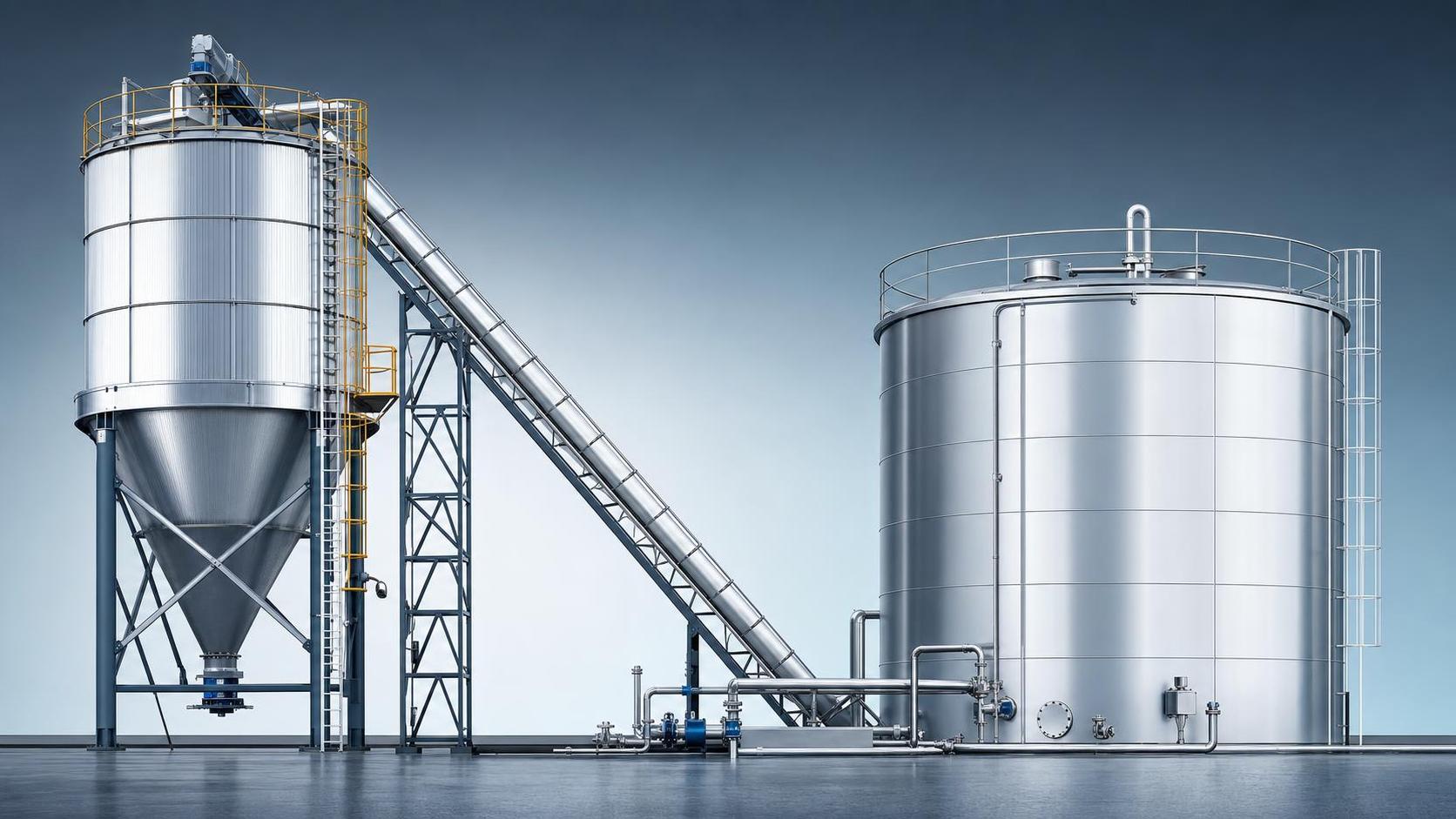
Industrial Silos vs Storage Tanks: Which Fits Bulk Material Handling Better?
When planning bulk material handling systems, choosing between industrial silos and storage tanks can directly affect efficiency, safety, and long-term costs.
For grain, power, building materials, and chemical operations, the right storage structure shapes daily throughput and future expansion options.
This comparison looks at structure, material flow, cost, and operating risks, so the final choice aligns with real production needs.
What Makes Industrial Silos Different From Storage Tanks?
The main difference starts with the material being stored. Industrial silos usually handle dry bulk solids, while storage tanks are built for liquids, slurries, or gases.
That sounds simple, but in practice it affects nearly everything, including discharge behavior, structural load, maintenance routines, and site layout.
Industrial silos are generally tall, vertical, and designed to promote gravity flow. Storage tanks are often wider and optimized for holding fluid materials safely.
This also means industrial silos depend heavily on hopper design, outlet geometry, and wall friction. Tanks depend more on sealing, corrosion control, and pressure management.
Core Comparison at a Glance
When Industrial Silos Are the Better Fit
Industrial silos are usually the better choice when the material is dry, free-flowing, and handled in large volumes.
This applies to wheat, corn, feed, cement powder, fly ash, lime, clinker dust, and many granular chemical products.
One strong advantage is vertical storage efficiency. Industrial silos use height well, which helps plants increase capacity without expanding the ground footprint too much.
That matters on crowded industrial sites where logistics lanes, truck access, and utility corridors already limit new construction space.
Another advantage is controlled discharge. Well-designed industrial silos can feed conveyors, screw systems, bucket elevators, and batching equipment with stable flow rates.
In grain and feed projects, this supports smoother intake, blending, and shipping schedules. In cement and power plants, it reduces interruptions across continuous processes.
Typical Strengths of Industrial Silos
- High storage capacity within a compact land area
- Efficient gravity-based bulk material handling
- Better integration with automated conveying systems
- Suitable for segmented storage by grade or batch
- Lower contamination risk when designed for enclosed transfer
For companies planning modular growth, bolt-assembled systems can also shorten installation time and simplify transport to remote project sites.
A relevant example is Grain Bolt Assembly Silos, which fit grain storage projects needing scalable capacity and reliable structural performance.
When Storage Tanks Make More Sense
Storage tanks are the right solution when the stored medium flows like a liquid or must be pumped through a closed process line.
This includes edible oil, water, liquid chemicals, fuel, slurry, and some temperature-sensitive products.
In these cases, industrial silos are usually not the practical answer because solids-flow engineering is different from liquid containment engineering.
Tanks support mixing, agitation, heating, insulation, pressure regulation, and level control more naturally than industrial silos do.
They are also easier to adapt when the process requires internal coatings, corrosion-resistant alloys, or strict environmental sealing.
So, if the product behaves like a fluid, storage tanks usually win on safety, handling consistency, and regulatory compliance.
The Real Decision Point: Material Behavior
Many selection mistakes happen because teams focus on capacity first and material behavior second. That order often creates problems later.
Industrial silos perform well only when the stored bulk solid has been evaluated for density, moisture, particle size, compressibility, and flow characteristics.
If powder compacts easily, bridges across the outlet, or separates during filling, an ordinary silo design may underperform.
This is why experienced suppliers spend time on discharge design, cone angle, wall material, aeration systems, and outlet sizing.
Storage tanks also require material analysis, but the technical focus shifts toward viscosity, chemical compatibility, evaporation, and pressure conditions.
In actual projects, the best choice is rarely about shape alone. It is about how the product behaves from filling to discharge.
Questions That Clarify the Choice
- Is the material a dry bulk solid or a fluid?
- Does it flow freely, or does it cake and compact?
- Will discharge depend on gravity or pumping?
- Is contamination control a critical requirement?
- Will future capacity expansion be necessary?
Cost, Maintenance, and Long-Term Project Value
Initial cost matters, but operating cost usually shapes the better investment over time.
Industrial silos can deliver strong long-term value when bulk throughput is high and site space is limited.
Their vertical format may reduce land use, shorten transfer paths, and support automation. Those savings become more visible in large plants.
However, industrial silos must be designed correctly. Poor flow performance can lead to downtime, manual intervention, product loss, and safety concerns.
Storage tanks may appear simpler, but liquid systems also carry maintenance costs related to seals, pumps, coatings, valves, and cleaning procedures.
The better investment depends on whether the storage system supports stable production with minimal interruptions, not just lower purchase cost.
A supplier with experience across grain, building materials, electric power, and chemical projects can usually reduce selection risk early.
That is especially important for industrial silos, where structural design and flow engineering need to work together from the start.
How to Choose the Right Bulk Material Handling Solution
If the material is dry, stored in volume, and moved through gravity-fed handling steps, industrial silos are often the stronger option.
If the material is liquid, pump-driven, or requires agitation and sealed containment, storage tanks are usually the better fit.
The practical path is to evaluate five things together: material behavior, daily throughput, site space, automation goals, and expansion plans.
For many dry bulk operations, industrial silos create a better balance of capacity, flow control, and land efficiency.
That is why they remain central to modern bulk material handling in grain, cement, ash, and granular product storage.
Where modular installation and grain-focused performance matter, Grain Bolt Assembly Silos can be a practical reference point during evaluation.
The strongest decisions come from matching equipment to the way material actually moves, not simply to the volume that must be stored.
Related Posts
- ▶ How a Dry Bulk Silo Handles Pneumatic Filling and Gravity Discharge
- ▶ What Is a Dry Bulk Silo, and When Does a Factory Need One?
- ▶ Can dry bulk storage silos be integrated into existing PLC-controlled batching systems?
- ▶ Do dry bulk silos designed for API 650 compliance meet ASME Section VIII requirements?
- ▶ Is almacénamiento de sólidos a granel en silos de acero inoxidable viable for small-scale agrochemical distributors?
- ▶ How do vibration-based level sensors perform in stainless steel silos with powder coating?
Online Message