





Stainless Steel Silos vs. Coated Steel: Comparing Lifetime Costs
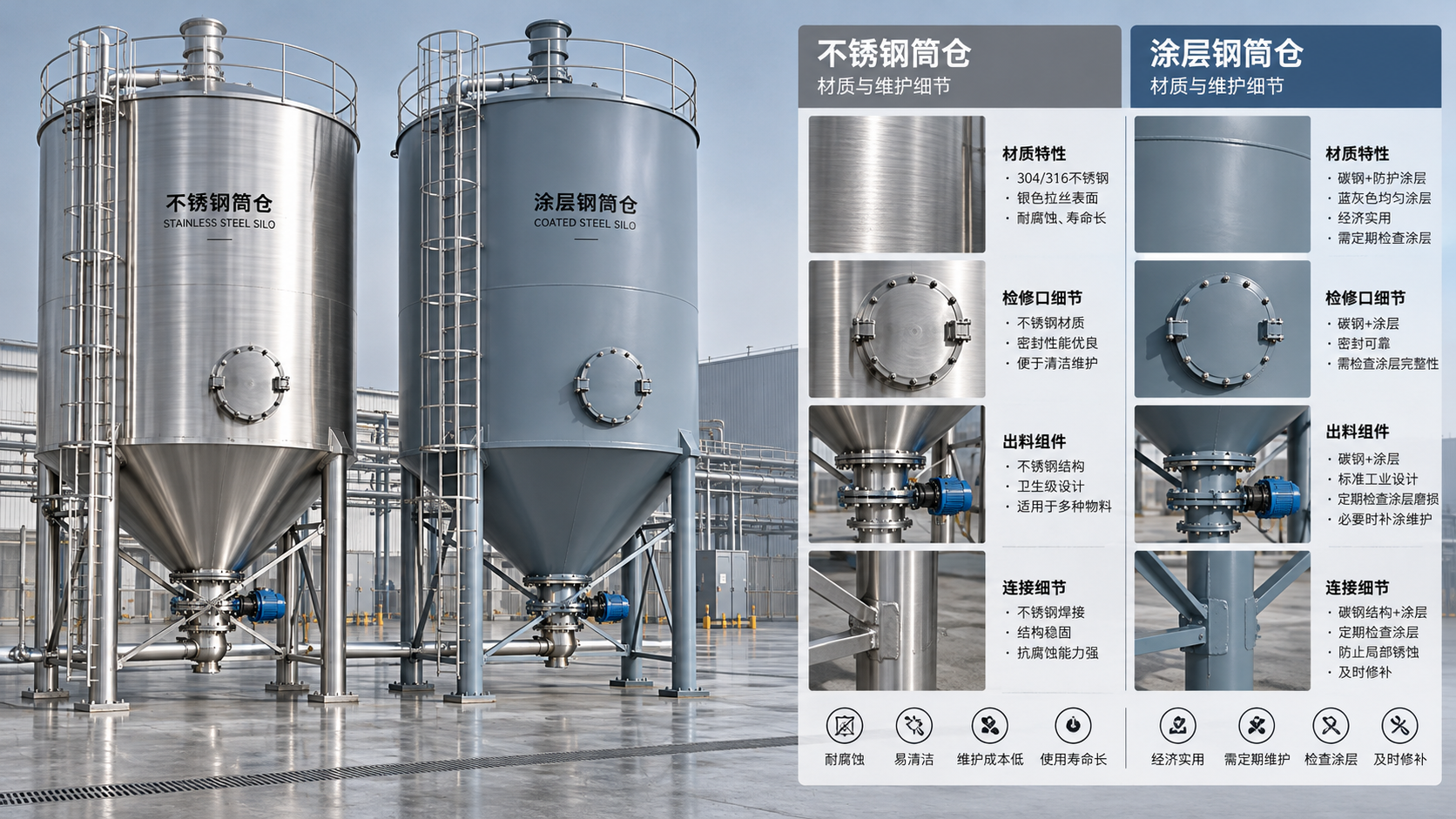
Stainless steel silos justify their higher initial cost when they avoid recurring corrosion repairs, demanding cleaning work, or production interruptions over the planned operating period. Coated carbon steel often offers better lifetime value for dry, compatible materials in controlled conditions, especially when inspection and maintenance are straightforward. The comparison changes when moisture, chlorides, abrasive solids, or frequent washing enter the process.
A useful cost comparison starts with equivalent storage capacity, structural duty, discharge performance, and installation scope. It then adds the expenses that develop during operation: inspections, surface repairs, cleaning, access equipment, lost availability, and eventual replacement. Without those boundaries, a cheaper quotation can conceal a more expensive maintenance obligation, while an expensive stainless specification can purchase corrosion resistance the application never needs.
Define the coated steel alternative before comparing prices
“Coated steel” describes several different systems. Galvanized steel uses a zinc layer to protect the underlying steel, including sacrificial protection near small exposed areas. Painted or polymer-coated steel relies mainly on a barrier between the substrate and its surroundings. Some designs combine metallic protection with an additional coating. Their deterioration mechanisms, repair methods, and suitability for stored products differ.
The internal and external surfaces also face separate conditions. An exterior coating suited to weather exposure does not automatically suit contact with a chemical powder, food ingredient, or abrasive mineral. An internally uncoated galvanized silo and a carbon steel silo with a specified internal lining should therefore appear as separate options in the cost analysis.
Stainless steel requires equally precise definition. Alloy grade, surface finish, weld treatment, and fastener materials affect durability. A general description such as “stainless construction” leaves too much uncertainty to support a lifetime-cost claim. The quotation should identify which parts are stainless, including the hopper, roof, outlet, and product-contact fittings.
The operating conditions that change the result
Dry storage often favors coated steel because corrosion requires conditions that support electrochemical activity. However, a dry incoming product does not guarantee a dry silo. Temperature differences between stored material, ambient air, and the steel wall can create condensation. Moisture can also enter through roof joints, vents, or poorly sealed access openings.
That distinction matters for grain and mineral powders. Localized condensation near the roof or wall can create a corrosive wet zone even when the average moisture level appears acceptable. Material adhering to a surface holds moisture against it and makes inspection harder. The cost model should reflect these local conditions rather than rely only on the bulk product specification.
For Cement Silos, dry cement storage often makes coated carbon steel a credible economic option. Water ingress introduces a separate problem: cement can cake or harden, obstruct discharge, and complicate cleaning. Stainless steel does not prevent that process failure, so roof sealing, condensation control, and reliable discharge remain relevant whichever wall material is selected.
Chemical storage requires a more specific compatibility assessment. Product composition, concentration, temperature, moisture content, and cleaning chemicals all influence the material choice. A stainless grade that performs well with one substance may deteriorate with another. Chloride exposure deserves particular attention because it can cause localized attack on susceptible stainless surfaces, especially at crevices and deposits.
Abrasion creates a different cost mechanism. Moving particles can wear an organic lining or remove a protective metallic layer around filling points, transitions, and outlets. Stainless steel also experiences mechanical wear. Where abrasion controls service life, wall thickness, flow geometry, and replaceable wear components may contribute more to value than corrosion resistance alone.
Installation costs extend beyond the shell
A meaningful capital comparison includes foundations, erection, lifting equipment, conveying connections, filters, level instruments, access systems, and commissioning. Structural calculations must use the same stored-material properties and site loads. Comparing quotations with different bulk densities, usable capacities, or wind and seismic assumptions produces an apparent saving without demonstrating equivalent performance.
Fabrication and installation details also influence future maintenance. Bolted joints introduce seals, fasteners, and interfaces that need attention. Welded construction reduces some joint interfaces but makes weld quality and surface restoration important. Stainless fabrication requires control of carbon steel contamination and suitable treatment of affected weld areas. Coated construction needs an agreed method for repairing damage caused by transport, handling, and erection.
Those tasks belong in the installed price. A coating repair allowance omitted from a quotation will still become a project expense if lifting damage exposes the substrate. Similarly, unspecified stainless weld finishing can leave a gap between the assumed corrosion resistance and the delivered condition.
Maintenance cost is shaped by access and downtime
The expense of repairing a silo surface extends beyond paint or replacement metal. Internal work can require emptying, isolation, cleaning, safe access arrangements, ventilation, surface preparation, and a return-to-service inspection. An organic coating may also need controlled application conditions and sufficient curing time before refilling. These activities can exceed the direct material cost of the repair.
Repair frequency alone therefore gives an incomplete picture. A readily accessible exterior patch during a scheduled shutdown has a different economic effect from internal lining work that interrupts a continuous process. Large internal areas, difficult hopper access, and limited spare storage increase the consequences of the same coating defect.
Stainless steel removes the need to renew a conventional protective paint layer on stainless surfaces, but it still requires inspection and cleaning. Deposits, damaged joints, worn outlets, and corrosion at unsuitable components remain possible. A lifetime model that assigns zero maintenance to stainless construction overstates its advantage.
Downtime should be valued against the actual operating arrangement. If another silo can accept incoming material and keep production supplied, the interruption may create handling costs without reducing output. Where no reserve capacity exists, the same repair can constrain production. Lost contribution, outsourced storage, and extra transport should be calculated separately to avoid counting the same consequence twice.
Cleaning performance depends on finish and geometry
Stainless steel is attractive where wet cleaning is frequent or product residues must be removed thoroughly. Its value depends on the specified surface and construction details. Rough welds, ledges, inaccessible pockets, and poorly drained outlets retain material regardless of the shell alloy. A stainless silo with difficult internal geometry can remain expensive to clean.
Coated surfaces introduce additional considerations when coating fragments, exposed substrate, or absorbed residues would affect product quality. The lining needs documented suitability for the stored material and cleaning method. Aggressive scrubbing or an incompatible cleaning agent can shorten its service life, creating a recurring conflict between cleanliness and surface protection.
Cleaning assumptions should match the process. A dedicated silo holding one dry product has a different cost profile from a vessel undergoing frequent product changes and wet sanitation. Assigning the same cleaning expense to both options can obscure the strongest reason to choose stainless steel—or create a benefit that the actual operation will never realize.
Build the comparison around cash flows, not advertised lifespan
A useful lifetime-cost model has a defined evaluation period and a common basis for discounting future spending. It includes installed capital, planned maintenance, credible repair scenarios, cleaning differences, interruption costs, and end-of-period disposal or residual value. Financing and tax treatment can be included where relevant, provided both alternatives use consistent assumptions.
Present-value lifetime cost = installed cost + discounted operating and repair costs + discounted replacement costs − discounted residual value.
Advertised service life should not substitute for those cash flows. A silo can remain structurally usable while its internal surface needs repeated refurbishment. Conversely, a sound vessel may be retired early because the site changes products, capacity, or layout. Economic life and physical life are separate inputs.
For each alternative, develop a central operating case and plausible variations. The most useful variables are those capable of reversing the result: internal repair frequency, duration of shutdowns, cleaning labor, corrosion severity, and the timing of replacement. The extra stainless investment is justified when the present value of avoided expenses exceeds that premium within the intended operating horizon.
Residual value deserves restraint. Stainless scrap has potential value, but recovery depends on dismantling costs, contamination, transport, alloy identification, and future market conditions. Reuse value depends on whether the silo can be dismantled and installed economically elsewhere. Neither should be treated as a guaranteed recovery amount.
Turn uncertain assumptions into comparable quotation terms
The strongest cost comparison connects each major assumption to a specification or an operating record. Previous repair history from similar storage conditions is more useful than a broad statement about material durability. Where that history is unavailable, the analysis should show a range of repair intervals and downtime consequences instead of presenting an unsupported precise forecast.
Quotation details that resolve the largest uncertainties include:
- Material identification: stainless grades or substrate and coating systems for the shell, hopper, roof, and relevant fittings, with internal and external protection described separately.
- The surface preparation, application, inspection, and site-repair requirements for coated steel. A named coating without these details leaves its installed performance uncertain.
- Fabrication condition at handover: weld finishing, contamination control, sealing arrangements, and treatment of transport or erection damage.
- Maintenance access and the assumptions behind any projected service life, including product properties, cleaning methods, and environmental exposure.
A selective material arrangement also deserves evaluation when exposure varies across the silo. Stainless contact components or a suitable replaceable lining can address a severe local condition while retaining a carbon steel structure elsewhere. Such designs need compatible joints, suitable fasteners, and a maintenance plan; poorly detailed interfaces can concentrate deterioration and erase the expected saving.
The final choice should remain stable under credible changes in repair and operating assumptions. If a small adjustment in shutdown duration reverses the result, reserve storage and repair access deserve further attention before the material specification is fixed. Where coated steel remains economical across those variations, its lower capital requirement has a sound basis. Where recurring surface work dominates the calculation, a properly specified stainless silo has a clear economic justification.
Related Posts
- ▶ Bolted vs. Welded Dry Bulk Storage Silos: Installation Trade-Offs
- ▶ Stainless Steel Silos vs. Coated Steel: Comparing Lifetime Costs
- ▶ Stainless Steel Silos for Food Powders: What Hygienic Design Requires
- ▶ 304 vs. 316 Stainless Steel Silos: Which Grade Fits Your Material?
- ▶ Sizing a Dry Bulk Silo Around Delivery Loads and Production Demand
- ▶ How a Dry Bulk Silo Handles Pneumatic Filling and Gravity Discharge
Online Message