





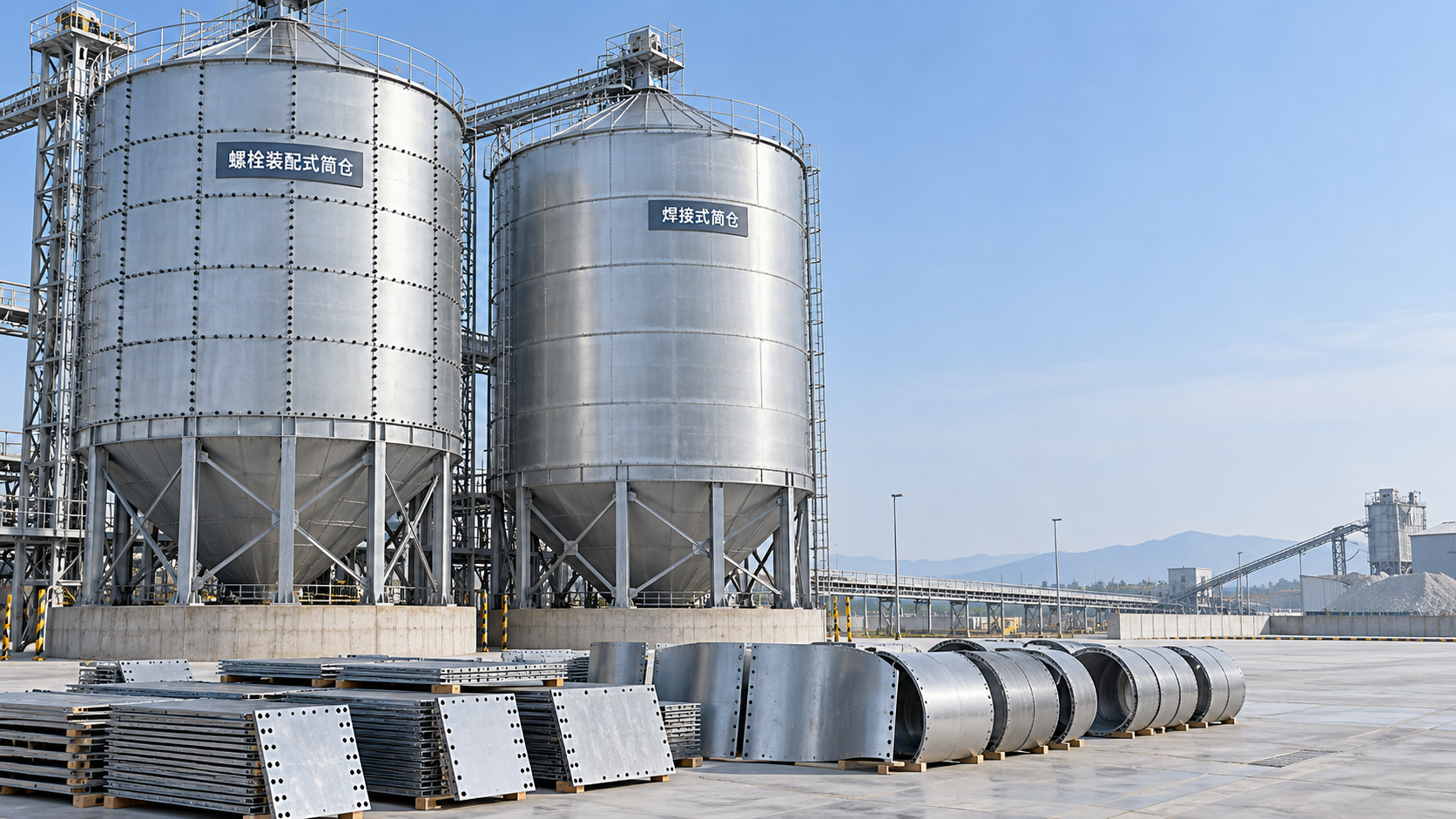
Choosing between bolted and welded dry bulk storage silos affects installation schedules, site logistics, and maintenance. The stronger option depends on your project’s actual constraints.
Bolted systems often reduce site welding, while welded designs can limit shell joints requiring seal maintenance. Neither approach automatically delivers lower installed costs or faster commissioning.
For project managers handling grain, cement, or chemical storage, crew availability, weather exposure, lifting access, and quality control often matter more than the initial quotation.
Start by comparing complete installation plans against material characteristics and commissioning targets. Include foundations, transport, erection, inspections, accessories, and handover requirements before selecting a construction method.
Which Construction Method Fits Your Installation Constraints?
Bolted silos typically arrive as panels or sections assembled using specified fasteners and joint sealing systems. Welded silos may arrive complete or require field fabrication.
This distinction changes the comparison substantially. A small, shop-welded silo delivered in one piece presents different installation challenges from a large silo welded entirely onsite.
Ask suppliers to identify their proposed delivery configuration before comparing prices. Otherwise, apparently similar offers may contain very different transport, lifting, labor, and inspection assumptions.
Use these differences to shortlist suitable systems, then verify the supplier’s actual design. Construction method alone does not establish structural capacity, corrosion resistance, or operational reliability.
Will Bolted Assembly Actually Shorten Your Critical Path?
Bolted assembly can reduce dependence on field welding, especially when panels arrive fabricated and coated. This advantage matters where qualified welding resources are difficult to secure.
However, assembly speed depends on accurate foundations, complete deliveries, organized panel identification, suitable lifting equipment, and an experienced crew. Missing components can interrupt otherwise efficient erection.
Field-welded construction adds fit-up, welding, examination, and potentially coating activities to the site schedule. These tasks need realistic durations and clearly defined release points between stages.
Shop-welded construction transfers much of that work away from the site. Installation may be brief if transport, crane access, foundations, and connection details are ready.
Compare schedules from approved drawings through operational handover, including procurement and factory fabrication. A shorter erection period may still follow a longer overall delivery lead time.
Require each supplier to show dependencies for foundation acceptance, roof installation, access platforms, discharge equipment, electrical connections, and commissioning. Shell completion alone is an incomplete milestone.
For phased projects, confirm whether individual silos can become operational independently. Shared conveyors, dust collection, controls, or unfinished access routes may prevent the expected early startup.
Can Your Site Receive, Store, and Lift the Components?
Bolted panels can offer transport flexibility because shipments are usually more compact than complete shells. Actual savings depend on packaging, delivery distance, unloading arrangements, and shipment quantities.
Large shop-welded units may need route surveys, oversize permits, escorts, and checks for bridge or overhead restrictions. These requirements should be priced before placing an order.
Sectional welded designs can ease transport constraints, but move joining work back onsite. Confirm which welds remain, their accessibility, and the required inspection after erection.
Available laydown space also influences execution. Panel packages need organized storage and protection against damage, while large fabricated sections require stable supports and suitable handling clearances.
Ask for a preliminary lifting plan covering component weights, working radius, crane configuration, ground bearing capacity, and exclusion zones. Silo diameter alone cannot determine crane suitability.
Some bolted erection systems use jacks to build at lower elevations, reducing certain crane activities. Their suitability still depends on the design and temporary stability arrangements.
For constrained industrial sites, check delivery and lifting plans against operating traffic, adjacent equipment, and overhead services. Restricted access can outweigh an apparently attractive fabrication price.
How Do Weather and Quality Control Change Installation Risk?
Bolted construction still requires disciplined workmanship. Misaligned holes, incorrect fasteners, unsuitable tightening, or poorly prepared sealing surfaces can create leakage paths and complicate later maintenance.
Specify the supplier’s fastening procedure, including verification methods and acceptance records. Do not assume every joint uses the same torque requirement or needs routine retightening.
Sealant and gasket selection must account for stored material, temperature, moisture exposure, and joint movement. Some chemical applications require compatibility checks beyond standard weather sealing.
For field welding, confirm applicable welder qualifications, welding procedures, fit-up criteria, and inspection responsibilities. Examination methods and coverage should follow the governing design and project specification.
Wind and precipitation may require welding shelters, while temperature can affect preheating or other procedure requirements. Include weather allowances rather than treating every shift as productive.
Bolted projects also face weather delays. High winds can stop panel handling, and unsuitable surface conditions or temperatures can prevent sealants from achieving their specified performance.
Both methods need coating inspections and repair procedures for transport damage, erection damage, and exposed steel. Field welding may require additional restoration around heat-affected areas.
Create inspection hold points before joints become inaccessible. Early acceptance of seals, welds, and coating repairs reduces the chance of discovering defects during final commissioning.
What Must Change for Grain, Cement, or Chemical Storage?
The stored material should guide the specification before construction preferences do. Bulk density, flow behavior, abrasiveness, moisture sensitivity, and temperature affect structural and operational requirements.
For grain, consider moisture management, aeration arrangements, cleanability, and pest exclusion. Joint details and weather protection matter, but storage performance also depends on the complete handling system.
For cement, prioritize moisture exclusion and controlled discharge. Fine powder can reveal small leakage paths, making roof penetrations, shell joints, and equipment connections important inspection areas.
Pneumatic filling introduces additional requirements for filtration, pressure protection, and filling controls. Neither a bolted nor welded shell should be assumed suitable for pressure without verification.
For chemicals, identify corrosion risks and compatibility with steel, coatings, gaskets, and sealants. A continuous welded shell does not compensate for an unsuitable material specification.
If the bulk solid can generate combustible dust, address explosion protection, isolation, ignition control, and applicable regulations through competent specialists. Shell construction cannot resolve these hazards alone.
Confirm the design basis for wind, seismic loads, filling and discharge loads, and anticipated operating cycles. Comparable quotations require comparable assumptions, regardless of the joining method.
Compare Installed Cost, Not Just the Silo Price
A useful commercial comparison separates equipment supply from freight, unloading, foundations, erection, inspections, coating repairs, access equipment, and commissioning. Include owner-provided resources in the same worksheet.
Bolted systems may reduce welding labor while increasing joint assembly and sealing work. Field-welded systems may require more specialized labor, examination, and weather protection during construction.
Shop-welded systems can simplify onsite fabrication but create higher transport or lifting demands. Determine whether these costs remain economical within your actual route and site constraints.
Request explicit exclusions for cranes, temporary power, scaffolding, welding shelters, unloading, and testing. An incomplete scope can make the lowest quotation become the most expensive installation.
Maintenance estimates should reflect expected service conditions and inspection access. Bolted joints require attention to seals and fasteners; welded shells require monitoring of welds and corrosion.
Ask how repairs would be performed during operations or shutdowns. Panel replacement and welded repairs both require engineering review, safe access, and assessment of affected coatings.
Avoid generic percentage savings or service-life claims without supporting assumptions. Compare documented costs, credible schedules, warranty conditions, and maintenance requirements for the specific proposed designs.
What Should a Supplier Prove Before You Approve the Design?
Request a proposal package that states usable storage capacity, design bulk density, delivery configuration, erection method, structural design basis, corrosion protection, and included auxiliary equipment.
Capacity quoted in tonnes depends on bulk density and usable volume. The same silo geometry can hold different material masses, so verify your project’s operating assumptions.
When assessing larger projects, 3000-6000 Tons Silos can serve as a starting point for capacity discussions. Confirm the proposed construction method and project-specific configuration directly with the supplier.
Shandong Guokai International Trade Co., Ltd. develops, manufactures, and sells steel storage silos for grain, building materials, electric power, and chemicals, supporting project-specific technical discussions.
Ask suppliers for comparable project references with similar materials, dimensions, climates, and site restrictions. Relevant installation experience provides stronger evidence than a general list of completed projects.
Before handover, require inspection records, approved drawings, maintenance instructions, and completion of specified functional checks. Include discharge equipment, filtration, controls, and safety devices where applicable.
Make the Decision Around Your Project’s Binding Constraint
Choose bolted construction when its transport flexibility and reduced field welding match your constraints, and the proposed crew can reliably execute fastening, sealing, and erection procedures.
Choose welded construction when the design and service conditions support it, and shop delivery or field fabrication fits your transport, labor, inspection, and schedule requirements.
For dry bulk storage silos, the best installation choice is the system with a verified execution plan, complete commercial scope, and suitable performance for the stored material.
Approve the construction method only after validating those three elements together. That decision gives your team a clearer budget, a defensible schedule, and practical maintenance expectations.