





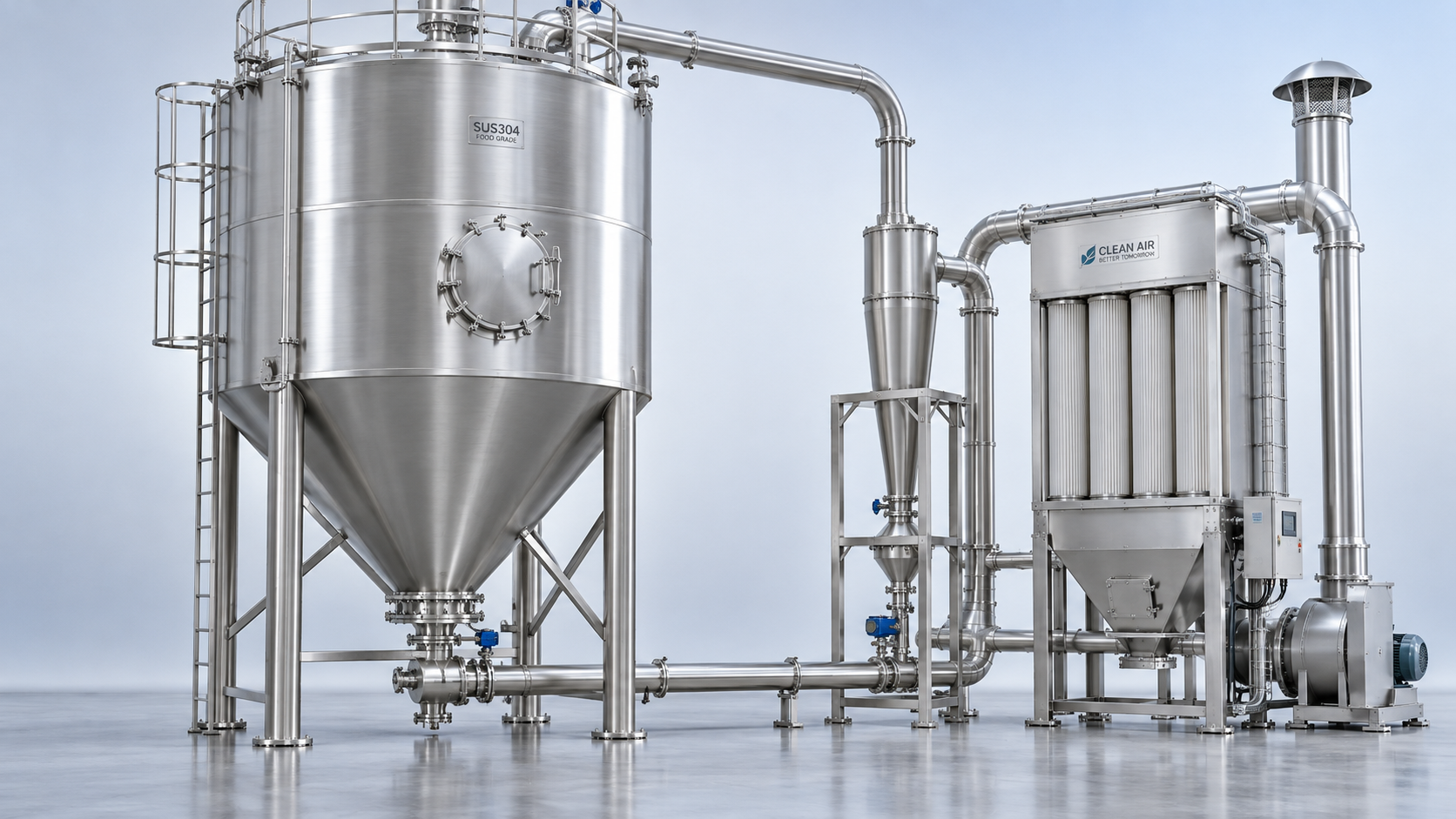
Stainless Steel Silos for Food Powders: What Hygienic Design Requires
For quality control and safety teams, storing food powders safely requires more than corrosion-resistant equipment. Hygienic performance depends on construction, moisture control, cleanability, and verification.
Stainless steel silos must limit contamination risks, prevent moisture ingress, and support effective cleaning without leaving powder trapped in seams, fittings, or dead zones.
Surface finish, weld quality, discharge geometry, and inspection access all influence hygiene performance, while combustible dust hazards require separate safeguards based on the actual powder.
This article examines the features to assess when specifying a silo, helping teams evaluate supplier proposals and protect product quality throughout storage and discharge.
What Makes a Silo Hygienic Enough for Your Powder?
A hygienic silo must preserve the powder’s agreed quality throughout its intended storage cycle and allow contamination controls to be inspected, maintained, and verified.
Start with a product risk profile: moisture sensitivity, fat content, allergen status, microbial concerns, particle size, flow behavior, storage temperature, and expected residence time.
Milk powder, flour, starch, and powdered seasonings can require different controls. A design suitable for one material may retain residues or encourage condensation with another.
Define acceptable outcomes before discussing equipment details. These should include residual product limits, cleaning acceptance criteria, moisture protection, traceability, and safe access for routine checks.
Clarify whether the silo handles one product continuously or changes between formulations. Allergen changeovers and sensitive ingredients usually require stronger evidence of cleaning effectiveness.
For ready-to-eat ingredients, environmental contamination deserves particular attention. Dry conditions can prevent microbial growth while still allowing pathogens to survive for extended periods inside equipment.
Which Stainless Steel Grade and Surface Finish Should You Specify?
Specify stainless steel according to the powder, cleaning chemicals, operating conditions, and corrosion exposure. Material selection should address product-contact surfaces and vulnerable ancillary components.
Grades such as 304 and 316L are common options, but neither automatically guarantees suitability. Chloride exposure, cleaning temperature, concentration, and contact time influence performance.
Ask for material certificates and a component schedule identifying the alloy used for walls, cones, outlets, fasteners, valves, and other surfaces exposed to product.
Surface finish should reduce residue retention and support the chosen cleaning method. Specify a measurable requirement, its measurement method, and where verification will occur.
A surface roughness target of Ra 0.8 micrometers or lower is common in hygienic specifications, but it is neither universal nor sufficient by itself.
Scratches, pits, embedded particles, and polishing defects can undermine an acceptable average roughness reading. Inspect surface condition alongside measurements, especially around welds and discharge components.
Where Will Powder Hide After Discharge?
Residual powder creates carryover, allergen, pest, and quality risks. Inspect the complete product path, including the roof underside, inlet transitions, cone, outlet, and connected equipment.
Internal joints should avoid open seams, overlapping plates, exposed threads, and crevices that collect powder. Product-contact welds should be continuous and appropriately finished for cleaning.
Request weld inspection criteria covering cracks, porosity, undercut, and incomplete fusion. Finishing should remove unacceptable defects without thinning the material below its required design thickness.
Heat tint and welding contamination need suitable treatment where required. Specify post-fabrication cleaning and any necessary pickling or passivation, with records explaining the completed process.
Gaskets should fit flush and remain secure under operating conditions. Recessed seals, protruding edges, and incompatible elastomers can trap residues or release fragments into product.
Pay special attention to level probes, access covers, sampling ports, and outlet valves. Small fittings often create hygiene weaknesses that general arrangement drawings barely reveal.
Ask the supplier to explain how each concealed interface is cleaned or inspected. An inaccessible recess should trigger a design review before fabrication proceeds.
Will the Discharge Geometry Actually Empty the Silo?
Hopper angle alone does not establish reliable discharge. Powder cohesion, wall friction, outlet size, consolidation, and storage time determine whether material flows or remains behind.
Request flow testing using representative powder when the application warrants it. Include realistic moisture levels and storage conditions rather than relying only on fresh samples.
Mass flow can reduce stagnant regions and improve residence-time consistency when correctly designed. Its suitability must be established through powder properties and hopper design calculations.
Funnel flow can leave material against the walls while a central channel empties. These retained zones may contain older powder and complicate cleaning verification.
Evaluate the outlet valve and downstream feeder together with the silo. A restrictive connection can defeat an otherwise appropriate hopper geometry and create persistent hold-up.
Flow aids require their own hygiene assessment. Aeration systems need suitable air quality, while vibrators and internal devices must avoid introducing contamination or inaccessible surfaces.
Include discharge trials in acceptance planning. Define the operating sequence, remaining product measurement, inspection locations, and acceptable residue before agreeing that emptying performance is satisfactory.
How Will You Prevent Moisture From Entering or Condensing?
Moisture can enter through leaks, humid conveying air, wash water, or condensation. Each source needs a specific control supported by the installation’s operating conditions.
Review roof seals, access covers, pipe connections, and weather-exposed penetrations. Outdoor stainless steel silos need appropriate weather protection without creating hidden cavities that retain water.
Condensation occurs when a surface falls below the surrounding air’s dew point. Consider seasonal temperatures, overnight cooling, incoming powder temperature, and the humidity inside headspaces.
Insulation, conditioned air, or temperature management may help, depending on the assessment. Insulation systems must also prevent water entry and allow examination of vulnerable areas.
Specify conveying and aeration air quality according to product risk. Address moisture, oil, particles, and microbial contamination where relevant, with measurable limits and maintenance responsibilities.
Vent filtration should match the contamination risk and operating airflow. Include filter access, replacement procedures, blockage monitoring, and pressure protection appropriate to the silo design.
Temperature and humidity measurements can support investigation and trending, but sensor locations matter. Monitoring should target conditions associated with condensation and product deterioration during storage.
Can You Clean It Effectively and Prove It Is Dry?
Choose the cleaning strategy before finalizing the silo design. Dry cleaning and wet cleaning impose different requirements for access, drainage, equipment compatibility, and release checks.
Dry cleaning may involve controlled vacuuming, brushing, or other validated methods. Avoid practices that spread dust or redistribute contamination into adjacent equipment and processing areas.
Use vacuum equipment suitable for the dust hazard and hygiene environment. Brushes and tools should resist shedding and remain identifiable, cleanable, and controlled between uses.
Wet cleaning requires more than installing spray devices. Demonstrate coverage of relevant surfaces, including inlet structures, instrument fittings, cone transitions, and areas behind internal components.
Specify drainage and drying arrangements wherever water can collect. Remaining moisture can cause caking, corrosion, or microbial growth when powder is introduced after cleaning.
Define release criteria that combine inspection with appropriate testing. Allergen tests, microbiological sampling, or other methods should reflect the hazard and the cleaning procedure.
ATP testing can support hygiene monitoring, but it does not establish absence of a specific allergen or pathogen. Interpret results within a documented verification program.
Validate difficult conditions, including maximum storage duration and challenging product changeovers. Record cleaning parameters, inspection findings, corrective actions, and authorization to return the silo to service.
Can Staff Inspect and Sample Without Creating New Risks?
Inspection access should reach the locations most likely to retain powder or moisture. A large manway offers limited value if critical fittings remain hidden.
Provide safe external access to filters, instruments, sampling points, and seals requiring maintenance. Consider platforms, fall protection, lighting, and clearance for removing components safely.
Design sampling points to limit contamination and allow cleaning between samples. Define the sampling purpose, because one outlet sample may not represent the entire stored batch.
Use remote inspection methods where practical, including cameras or inspection ports. These can reduce entry requirements while helping teams document residues and surface condition.
Silo entry requires an appropriate confined-space assessment and procedure under applicable rules. Address isolation, atmospheric hazards, engulfment, rescue arrangements, and authorization for each planned entry.
Protect product identity through documented filling and discharge controls. Batch records should account for residual material, shared conveying routes, and changes in storage allocation.
Which Safety Controls Must Be Assessed Separately?
Hygienic construction does not establish combustible dust safety. Many food powders can form explosive atmospheres, and the actual material’s properties must inform the hazard assessment.
Obtain relevant dust test data where needed, including explosion severity and ignition characteristics. Particle size and moisture can change results, so representative samples matter.
A competent assessment should address ignition sources, dust accumulation, filling, conveying, and connected equipment. Grounding and bonding help control static but do not cover every hazard.
Explosion venting, suppression, isolation, or other protection may be required under applicable standards. Their selection depends on equipment conditions, layout, and the assessed explosion risk.
Coordinate safety devices with hygiene requirements. Vent panels, isolation equipment, and pressure protection must remain accessible and maintainable without introducing uncontrolled contamination pathways during operation.
Also assess structural loads, overpressure, vacuum, overfilling, and maintenance isolation. Cleaning or conveying changes can introduce operating conditions that the original mechanical design never anticipated.
What Evidence Should You Request From the Supplier?
Issue a written specification covering product characteristics, contact materials, surface acceptance criteria, weld quality, cleaning strategy, moisture controls, discharge performance, and the relevant safety requirements.
Request detailed drawings showing internal joints and interfaces, not only external dimensions. Ask suppliers to identify assumptions, exclusions, and components supplied by other contractors.
When reviewing Shandong Guokai International Trade Co., Ltd. proposals, request application-specific documentation supporting suitability for food powders, alongside the company’s broader steel silo project experience.
A listing such as Pellet Feed Steel Silo can introduce a storage option; it does not establish suitability for food powders without supporting technical evidence.
Confirm the proposed construction, material grade, cleaning access, and food-contact documentation independently. Feed pellets and fine food powders can have substantially different hygiene and flow requirements.
Agree acceptance checks before purchase: document review, surface and weld inspection, functional tests, discharge trials, and cleaning verification where appropriate to the intended application.
Factory checks should be followed by installation checks covering site connections, transport damage, seals, filters, and commissioning cleanliness. Retain results as part of equipment qualification.
Make the Decision on Verifiable Hygiene Performance
The strongest specification connects each significant product hazard to a design feature, an operating control, and evidence showing that the control performs as intended.
Approve stainless steel silos when the complete system can protect powder, discharge predictably, and support verified cleaning. Material grade and polished appearance alone cannot establish suitability.
For quality and safety teams, the practical goal is clear: eliminate avoidable retention points, control moisture, verify cleaning, and manage dust hazards through a separate assessment.