





304 vs. 316 Stainless Steel Silos: Which Grade Fits Your Material?
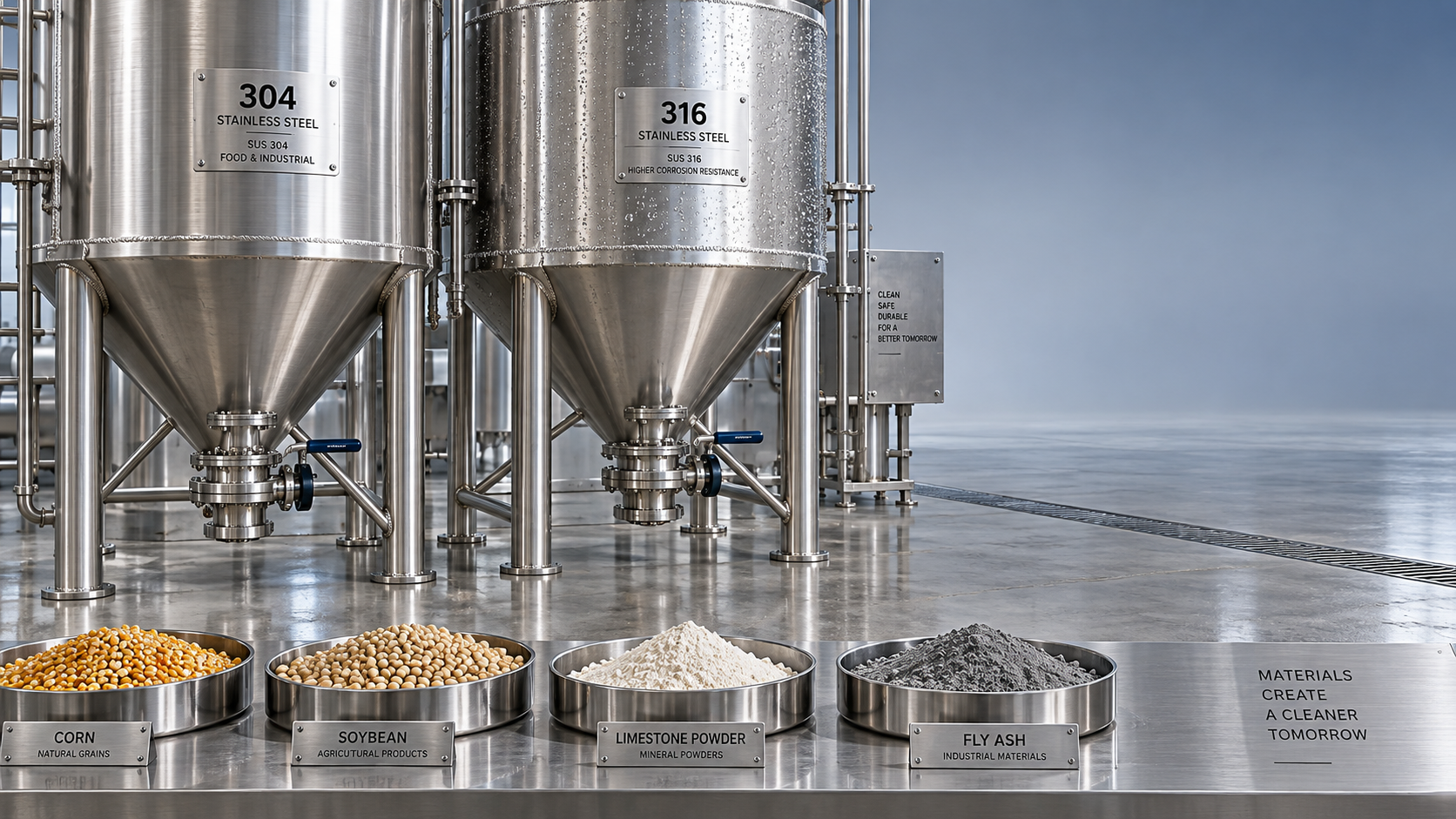
A silo may hold dry grain for most of the year, yet face its toughest corrosion conditions during a short cleaning cycle or a humid shutdown. Another may store a seemingly harmless powder that becomes aggressive only when condensation forms against the wall. Choosing between 304 and 316 stainless steel silos therefore starts with the stored material and its operating environment—not simply the purchase price.
For technical evaluators, the decision is whether 304 provides adequate resistance under realistic conditions or whether 316’s molybdenum-enhanced protection justifies the additional investment. Moisture, chlorides, temperature, cleaning chemicals, and fabrication quality all influence that answer. The right specification accounts for the conditions inside the silo, outside the shell, and around details where residues or water can collect.
What actually changes between 304 and 316?
Both grades are austenitic stainless steels. Their corrosion resistance comes from a thin, chromium-rich passive film that forms on the surface. When conditions allow, this film can reform after minor damage. Neither grade, however, is immune to corrosion.
304 typically contains approximately 18% chromium and 8% nickel. 316 generally contains approximately 16–18% chromium, 10–14% nickel, and 2–3% molybdenum, depending on the applicable specification. Molybdenum improves resistance to localized corrosion, particularly chloride-related pitting and crevice corrosion. That is the central reason to consider 316—not a general assumption that it is better for every stored product.
The useful distinction is exposure tolerance, not a universal quality ranking. A well-designed 304 silo can be the appropriate choice for a controlled dry application. A poorly detailed 316 silo can still develop corrosion at contaminated welds, stagnant crevices, or areas exposed to concentrated salts.
Read the material specification beyond its commercial name
“Grain,” “mineral powder,” and “chemical product” are not sufficiently detailed descriptions for alloy selection. Two products in the same category may behave differently because of moisture, soluble salts, additives, or contamination introduced during handling.
Before requesting a firm recommendation, assemble a short exposure profile:
- Composition: identify the main product, additives, impurities, and likely carryover from previous batches.
- Moisture: record normal and maximum values, including wet deliveries or upset conditions.
- Soluble chlorides: examine salts in the product, process water, cleaning water, and surrounding atmosphere.
- Temperature: include filling temperature, storage conditions, cleaning, and thermal cycling.
- Storage duration: distinguish rapid turnover from extended residence and seasonal shutdowns.
- Cleaning: document chemical identity, concentration, contact time, rinsing, and drying procedures.
For powders, the behavior of a water extract can be more informative than the dry composition alone. If condensation dissolves salts at the wall, the local environment may differ significantly from the average bulk material. Likewise, the pH of the dry product says little about the chemistry of the liquid that forms when it becomes wet.
Dry grain: 304 is often reasonable, but dryness must be maintained
For many dry grain applications with low chloride exposure and controlled cleaning, 304 is a sensible candidate. The larger concern may be preventing condensation, moisture ingress, spoilage, and deposits rather than upgrading the alloy.
Insulation and moisture management deserve attention alongside grade selection. Solutions such as Insulated Moisture-Proof Grain Silos can be considered within the broader storage design, with insulation details, weather sealing, ventilation, and operating procedures reviewed for the actual site. Insulation alone does not guarantee condensation-free storage; filling temperature, ambient humidity, and thermal bridges still matter.
316 becomes more relevant when grain contains salt-bearing additives, coastal exposure affects the shell, or cleaning introduces significant chloride contact. Food use by itself does not make 316 mandatory. Applicable requirements, cleanability, and the actual exposure conditions should guide the specification.
Building materials: distinguish corrosion from wear
Cement, mineral fillers, and other building-material powders may be relatively manageable when dry, yet cause different problems after water ingress. Wet deposits can create persistent local exposure, while certain additives or contaminants introduce aggressive ions.
At the same time, particle impact and sliding abrasion can damage inlet zones, cone walls, and outlets. Moving from 304 to 316 does not automatically solve this. Particle hardness, velocity, impact angle, and flow pattern should inform decisions about replaceable liners, wear allowances, and discharge geometry.
Chemical products: neither grade is a default answer
For chemical storage, compatibility must be assessed using the exact substance, concentration, temperature, and impurity profile. 316 often offers an advantage in chloride-bearing environments, but hydrochloric acid and some other aggressive exposures can be unsuitable for both grades. Increasing temperature may also change an otherwise acceptable assessment.
Use established corrosion data for comparable conditions, then seek specialist review or testing where uncertainty remains. A general statement that a chemical is “compatible with stainless steel” is not an adequate basis for specifying a large silo.
Where stainless steel silos face their highest corrosion risk
Corrosion rarely distributes itself neatly across the entire shell. It tends to start where moisture, deposits, contaminants, and unfavorable geometry meet. These locations deserve more attention than a simple alloy comparison suggests.
Condensation and the wet–dry boundary
A dry bulk solid can become a corrosion concern when humid air reaches a cooler wall. Moisture dissolves soluble constituents, and subsequent evaporation can concentrate them. Repeated wetting and drying may therefore create more aggressive local conditions than the incoming product specification indicates.
Review roof areas, thermal bridges, cold external surfaces, and locations where deposits remain between batches. Temperature and humidity monitoring can help establish whether a presumed dry service is genuinely dry.
Crevices, seals, and retained deposits
Gaskets, overlapping joints, bolt assemblies, and compacted residues can create sheltered spaces where liquid remains trapped. Crevice corrosion may occur under conditions less severe than those needed to initiate pitting on an open surface.
316 provides improved resistance, but drainage, accessible cleaning, and appropriate joint design remain essential. Where higher-chloride exposure is unavoidable, neither 304 nor 316 should be accepted without reviewing the complete exposure conditions.
Cleaning cycles and external exposure
A cleaning routine can be more demanding than normal storage. Chloride-containing cleaners, excessive concentration, elevated temperature, prolonged contact, and inadequate rinsing can all increase risk. Specify the approved cleaning procedure rather than relying on operators to interpret a broad “stainless-compatible” instruction.
Evaluate the exterior separately. Coastal salt deposition, industrial fallout, and moisture trapped beneath damaged insulation may affect the outer shell even when the stored material is benign. Cladding, sealing, drainage, and inspection access belong in the corrosion-control plan.
The grade on the drawing is only part of the specification
For welded stainless steel silos, 304L and 316L are commonly considered because their lower carbon content reduces susceptibility to sensitization associated with welding. Low-carbon grades do not eliminate the need for proper welding procedures or make chloride exposure harmless.
Technical review should cover several fabrication details:
- Material traceability: require certificates identifying the specified grade and applicable material standard; consider positive material identification where mix-up risk warrants it.
- Weld quality: address joint preparation, suitable consumables, process control, and inspection criteria.
- Surface restoration: define removal of weld heat tint and contamination, with suitable pickling and passivation procedures where required.
- Contamination control: separate stainless steel handling from carbon steel grinding debris, tooling, and storage surfaces.
- Internal details: review weld profiles, ledges, seals, and access points for residue retention and cleanability.
A polished surface is not proof of chemical compatibility. Conversely, a practical industrial finish may be adequate for some dry bulk materials. Specify surface condition according to hygiene, cleaning, corrosion, and flow requirements—not appearance alone.
Structural sizing remains a separate engineering exercise. Shell thickness, stiffeners, supports, and anchorage must account for bulk density, filling and discharge loads, pressure conditions, and site loads. Choosing 316 does not justify reducing thickness without calculation.
Does the 316 premium pay for itself?
The answer depends less on an assumed service-life multiplier than on the consequences of deterioration. For a noncritical, dry application with accessible inspection, 304 may offer the stronger economic case. Where corrosion could contaminate product, interrupt continuous operation, or require difficult field repairs, additional alloy resistance may carry greater value.
Compare complete installed proposals on an equivalent basis. Include plate grade and thickness, fabrication, surface treatment, insulation, access, and inspection provisions. A quotation for 304 with thorough finishing cannot be meaningfully compared with a minimally defined 316 quotation.
A practical lifecycle assessment should consider:
- Initial installed cost and financing assumptions.
- Inspection frequency and access costs.
- Cleaning time, water use, and drying requirements.
- Repair costs, including internal access and production interruption.
- The consequences of corrosion debris or product contamination.
- Potential changes in stored materials or cleaning methods.
Avoid assigning either grade a fixed service life without exposure evidence. Instead, compare credible operating scenarios: normal dry storage, occasional condensation, and a foreseeable wet or chloride-bearing upset. This makes the investment decision more defensible than a general promise of “longer life.”
A selection decision you can defend at technical review
Start with 304 or 304L when the material is reliably dry, chloride exposure is low, cleaning is controlled, and fabrication and inspection requirements are clearly defined. Document those operating boundaries so the selection remains valid after commissioning.
Give 316 or 316L stronger consideration when moisture and chlorides can occur together, cleaning is more demanding, external salt exposure is significant, or failure consequences justify added resistance. Confirm compatibility rather than treating molybdenum as universal insurance.
Reconsider both grades when aggressive chemistry, elevated-temperature chloride conditions, persistent wet deposits, or severe wear dominate the application. Another alloy, a qualified lining system, altered operating conditions, or a different storage concept may be necessary.
When discussing a project with Shandong Guokai International Trade Co., Ltd., whose steel silo activities cover grain, building materials, electric power, and chemicals, provide the exposure profile alongside capacity and layout requirements. Ask the proposed design to identify the alloy, surface treatment, moisture-control measures, and conditions assumed in the selection.
The best choice is not automatically the more expensive stainless steel. It is the grade supported by the material chemistry, operating conditions, fabrication quality, and maintenance plan—with enough margin for realistic variation, but without paying for resistance the application does not need.
Related Posts
- ▶ Bolted vs. Welded Dry Bulk Storage Silos: Installation Trade-Offs
- ▶ Stainless Steel Silos vs. Coated Steel: Comparing Lifetime Costs
- ▶ Stainless Steel Silos for Food Powders: What Hygienic Design Requires
- ▶ 304 vs. 316 Stainless Steel Silos: Which Grade Fits Your Material?
- ▶ Sizing a Dry Bulk Silo Around Delivery Loads and Production Demand
- ▶ How a Dry Bulk Silo Handles Pneumatic Filling and Gravity Discharge
Online Message